

Federal court denies Westminster’s request to dismiss excessive force lawsuit in 2018 death

A federal court has denied the city of Westminster’s request to dismiss an excessive force lawsuit in the 2018 shooting death of a man who allegedly charged officers with a knife, after acknowledging a pattern in the police department of no de-escalation attempts.
“Plaintiff’s allegations are sufficient to establish that given the frequency with which police officers encounter individuals of diminished mental capacity, the need to implement appropriate training should have been obvious to the City,” wrote U.S. District Judge Raymond P. Moore in a Jan. 13 order.
Police killed Timmy Henley, 27, outside an apartment complex, saying he held a knife above his head and charged at officers, according to police accounts. However, the lawsuit from Henley’s estate claimed the only knife was located behind a closed apartment door.
According to records, on Sept. 4, 2018, Henley was hallucinating after consuming cocaine. Two hours prior to the fatal interaction, Officer Louis Engleberg responded to a 9-1-1 call to find Henley standing on a neighbor’s truck and claiming that dogs were chasing him (they were not). After a patdown and a medical check, Westminster police released Henley.
After a second 9-1-1 call reporting a possible apartment break-in at the same complex, Engleberg again responded with Officer Chris Hempelmann. Engleberg recognized Henley after the man exited an apartment, seeming disoriented. Reportedly, Henley tried to descend a flight of stairs but the officers, rather than de-escalating, shot him 11 times.
There was no body-worn camera footage of the interaction. Colorado’s 2020 police accountability law, Senate Bill 217, set a deadline of July 1, 2023, for local law enforcement agencies to equip their officers with cameras.
“The City of Westminster has persisted in its decision to not use body cameras despite numerous examples of cases where the officer’s narrative is plainly contradicted by other evidence,” wrote Raymond K. Bryant and Luke W. McConnell, attorneys for the plaintiff, in the federal complaint filed on Jan. 6, 2020.
U.S. Magistrate Judge S. Kato Crews reviewed the allegations and Westminster’s motion to dismiss, ultimately recommending on Dec. 22 that the circumstances plausibly described a violation of Henley’s constitutional rights.
As evidence of Westminster’s failure to train and supervise its officers, the lawsuit cited three other instances, including two in which Engleberg used force on children, “where excessive force was allegedly used on individuals with diminished mental capacity or emotional disturbances.”
The prior interactions included Engleberg going hands-on with an 11-year-old autistic boy, a similar altercation involving an emotionally-distressed 16-year-old, and a fatal police shooting of an unarmed man in mental distress – one that did not involve the officers sued in Henley’s death.
Westminster objected to Crews’ recommendation, saying the other instances of reported misconduct were dissimilar, and, in the fatal case, occurred too close to the Henley shooting for the city to take proper corrective action. There was also no proof, the city continued, that training specifically about mentally or emotionally compromised individuals would have led to a different outcome.
“Considered together,” Moore wrote in response, “the allegations underlying these incidents are sufficient to show an informal custom of allowing the City’s officers to escalate situations involving people with diminished mental capacity by using force and a failure to train or supervise its officers.”
Sgt. Trevor Materasso, spokesperson for the Westminster Police Department, said that the city is finalizing its purchase for body-worn cameras, as well as its training and policy requirements. He estimated officers will begin wearing the equipment in early 2021. The city attorney’s office did not immediately respond to a request for comment about Moore’s order.
“We believe the motion was simply a delay tactic designed to impede our efforts to peer deeper into the evidence of the case and into the evidence of other incidents involving Westminster officers using excessive force,” said Bryant about the city’s request to dismiss. “When Westminster officers kill, they may silence the voice of their target, but the evidence left behind speaks volumes if it is allowed to be seen and acted upon.”
The case is Estate of Timmy Henley v. Westminster et al.



What courageous citizenship really looks like | Vince Bzdek
Vince Bzdek
vince.bzdek@gazette.com
Updated 18 hours ago
By Vince Bzdek What exactly is courage? Ernest Hemingway famously called it grace under pressure. Mark Twain wrote that “courage is resistance to fear, mastery of fear — not absence of fear.” C.S. Lewis refined that even more: “Courage is...
The coming election and mischief in the making | SONDERMANN
Eric Sondermann
eric-sondermann@coloradopolitics.com
Updated 4 days ago
America’s tribalism is such these days that we struggle to even agree on the basic rules. Elections have always been hotly contested. As the saying goes, “Politics ain’t beanbag.” The process has long involved elements of nastiness and underhanded conduct....

Colorado Politics Calendar Aug. 31-Sept. 6
Rachael Wright, Special to Colorado Politics
rachael.wright@coloradopolitics.com
Updated 4 days ago
CoPo’s weekly political calendar will help you find political and public-policy events throughout Colorado. It includes candidate and issue campaign events, public policy meetings, court hearings, state and local party conventions, assemblies, debates, rallies, parades, speaking engagements, traveling dignitary appearances,...

Tancredo in Running for Dept. of Ed. Position | A LOOK BACK
Rachael Wright, Special to Colorado Politics
rachael.wright@coloradopolitics.com
Updated 4 days ago
Forty-five years ago this week: “I know that my name has been placed before the Secretary of Education, and I know that I’m one of three or four being considered for the Department of Education’s Region 8,” said state Rep....
Colorado measure adding ID checks to mail-in voting qualifies for ballot
Marissa Ventrelli
marissa.ventrelli@coloradopolitics.com
Updated 2 days ago
A ballot initiative that would require voters to include additional information on mail-in ballots has qualified for the November election, according to the Secretary of State’s Office. Backed by El Paso County Treasurer Chuck Broerman and former Deputy Secretary of...
Colorado election website error exposes personal data of confidential voters
Marissa Ventrelli
marissa.ventrelli@coloradopolitics.com
Updated 2 days ago
A system update accidentally lifted protections on confidential records in Colorado, exposing dozens of voters’ personal information, according to the Secretary of State’s Office. The limit that normally blocks access to confidential voter profiles was inadvertently disabled during an update...

PUC adds weekly comment after killing private talks
Scott Weiser
scott.weiser@gazette.com
Updated 2 days ago
The Colorado Public Utilities Commission will take public comment at the start of every commissioner’s weekly meeting beginning Sept. 9 as part of its new transparency mandate, the commission announced, expanding a slot previously limited to the second Wednesday of...
10th Circuit overturns framework for sentencing probation violators by 11-1
Michael Karlik
michael.karlik@coloradopolitics.com
Updated 17 hours ago
In a rare decision by all 12 of its full-time judges, the Denver-based federal appeals court ruled in a lopsided vote on Friday that one of its members created a sentencing process for probation violators that was out of step...
Federal judge dismisses excessive force lawsuit against Colorado Springs, officer
Michael Karlik
michael.karlik@coloradopolitics.com
Updated 21 hours ago
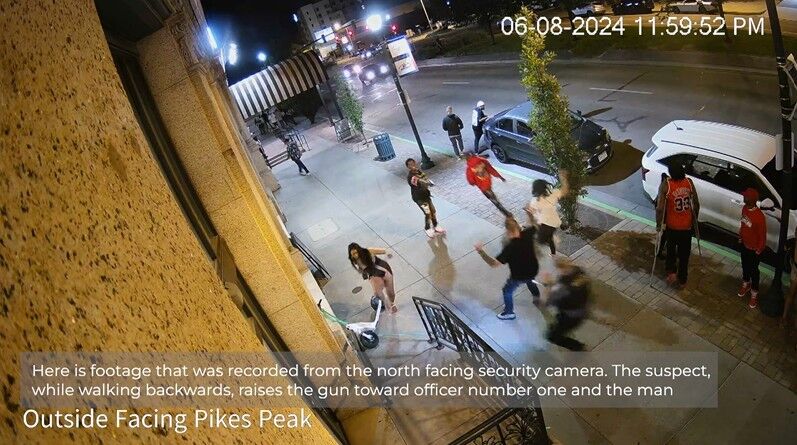
A federal judge concluded last week that a Colorado Springs police officer could not be held liable for shooting a suspect three times after the man menaced two victims with a gun and fled the scene. Al’morion Germany was involved...

DeFlock started from one man’s curiosity — now Flock cameras are a midterm issue
Claire Carter
claire.carter@washingtonexaminer.com
Updated 2 days ago
Will Freeman wasn’t looking to start a national movement when he launched DeFlock after noticing Flock Safety’s automatic license plate readers along the side of the road. The software engineer was driving across the country in 2024 when the cameras...
PREV
PREVIOUS

Federal judges in Colorado denied overwhelming majority of requests to release inmates for COVID-19
Out of two dozen responses to sentence reduction requests from inmates concerned about their health amid the pandemic, federal judges in Colorado approved only three in the final four months of the year. Known as compassionate release, a 2018 change in the law now allows federal inmates to petition a court directly if there are […]

Iconic eatery Denver Diner falls victim to COVID-19 closures
After decades of providing the Denver community with a 24/7 food and hangout spot, the iconic Denver Diner will be closing its doors for good, the diner announced on Facebook on Sunday. The family-owned and operated diner has occupied the corner of Speer Boulevard and Colfax Avenue for 30 years, serving as the go-to location […]