

City leaders demand regional housing solutions following Mayor Coffman’s homeless ‘stunt’

Numerous city leaders and homeless advocates demanded action Thursday in a virtual press conference inspired by Aurora Mayor Mike Coffman’s week-long experiment posing as homeless in Aurora and Denver.
“Our goal is to provide an alternate vision to solving housing and homelessness issues,” said Aurora City Council member Crystal Murillo.
Murillo said she and the city leaders are demanding the expansion of Aurora and Denver’s Regional Housing Taskforce and the inclusion on the taskforce of people experiencing homelessness and those who have been working to address homelessness.
Murillo, along with several other speakers, also criticized Coffman’s experiment, saying he took resources from those in need and betrayed the trust and privacy of the homeless individuals he encountered.
“We want to acknowledge that that is harmful in so many ways,” she said.
Denver City Council member Candi CdeBaca also spoke out against Coffman’s actions during the press conference.
“Mayor Coffman’s stunt in the news recently was disgusting and disappointing,” she said. “It takes someone with privilege and centers them in a story to create an illusion of understanding.”
“The only solution to homelessness is housing and we’re going to have to realize that.”
CdeBaca and other speakers argued against camping bans and homeless sweeps as ways to address homelessness in Denver and Aurora, claiming that each sweep conducted costs the City of Denver $10,000.
Rather than these strategies, Thursday’s speakers argued that providing housing for those experiencing homelessness is most important and effective.
“A housing-first approach is a scientific approach,” said Shelley McKittrick, a consultant with the Colorado Village Collaborative.
“If you tell people to change before they get housed, they’re not going to get housed because you cannot rehabilitate on the street.”
Though Coffman told CBS Denver that homeless drug users were choosing that “lifestyle,” McKittrick said people often begin substance abuse because they are homeless.
McKittrick said she has encountered many people experiencing homelessness who use drugs to escape the trauma of living on the street, help them sleep in uncomfortable conditions and stay awake to avoid being attacked in the night.
Other speakers pointed to causes of homelessness within disadvantaged groups like people of color suffering from poverty, women fleeing domestic violence and LGBTQ+ youth running from unsafe homes.
John Stone, Englewood City Council member at large, said he was homeless for five years between the ages of 16 and 21.
Though Stone was highly offended by Coffman’s experiment, calling it “immoral and disgusting,” he emphasized that he hopes the attention it caused will be used positively.
“I want for us to come together and generate something productive from this,” Stone said.
Stone reiterated the importance of a housing-first approach and said city leaders should never view homeless residents or drug addicts as lost causes.
Speakers pointed to organizations including the Metro Denver Homeless Initiative and Colorado Coalition for the Homeless that have been developing long-term, reachable plans for years to address homelessness locally.
“Why don’t we try helping people instead of chasing them around the city?” Stone said. “Why don’t we come together as a region?”

Colorado auditor finds serious issues with labor agency’s unemployment insurance accounting
Marianne Goodland
marianne.goodland@coloradopolitics.com
Updated 13 hours ago
Colorado’s state auditors found serious issues with the accounting practices of the unemployment insurance division of the Department of Labor and Employment, concluding the agency underestimated and overestimated figures to the tune of billions of dollars. The auditors labeled the...
Colorado’s newest federal judge speaks about techniques for advancing cases
Michael Karlik
michael.karlik@coloradopolitics.com
Updated 13 hours ago
U.S. Magistrate Judge Cyrus Y. Chung described on Wednesday the various tactics he employs to resolve court cases, summing up his role with a laxative-based metaphor. “Someone told a group of us federal magistrate judges that magistrate judges are the...

Three cargo ships damaged by ‘projectiles’ in Strait of Hormuz
Brady Knox, Washington Examiner
brady.knox.washington.examiner@gazetteedit.wpenginepowered.com
Updated 16 hours ago
Three cargo ships were damaged by unspecified “projectiles” while navigating the Strait of Hormuz, jeopardizing President Donald Trump’s goal of preserving the shipping lane’s safety. The strait was de facto closed the morning hostilities began on Feb. 28, with announcements...

Trump calls on Thune to be a ‘leader’ and get the votes for the SAVE America Act
NAOMI LIM Washington Examiner
naomi-lim-washington-examiner@coloradopolitics.com
Updated 17 hours ago
President Donald Trump increased pressure on Senate Majority Leader John Thune (R-SD) to pass the SAVE America Act, imploring him to be a “leader” after he expressed concerns that there is not enough support for the measure in his chamber....
The ‘talking filibuster,’ explained
Molly Parks, Washington Examiner
molly.parks.washington.examiner@gazetteedit.wpenginepowered.com
Updated 17 hours ago
Senate Republicans have for weeks been debating the use of the “talking filibuster” to guarantee the passage of the SAVE America Act in the upper chamber, after President Donald Trump called the legislation his “No. 1” priority. The bill, which...
Colorado’s Polis joins coalition of governors urging Congress to reject Trump tariffs
Marissa Ventrelli
marissa.ventrelli@coloradopolitics.com
Updated 12 hours ago
Colorado Gov. Jared Polis has joined 18 other governors in writing a letter to members of Congress, urging them to reject President Donald Trump’s efforts to codify tariffs that the U.S. Supreme Court recently invalidated. “Governors across the country are...

Department of Agriculture warns of packages holding potentially invasive seeds
Michael Braithwaite
michael.braithwaite@gazette.com
Updated 11 hours ago
Spring planting is around the corner, and the Colorado Department of Agriculture wants residents to know where their seeds are coming from. Officials with the department warned Tuesday that they received reports of unsolicited packages containing plant seeds mailed internationally...

Federal judge hears ICE agents’ confusion about law, injunction on warrantless arrests
Michael Karlik
michael.karlik@coloradopolitics.com
Updated 1 day ago
A federal judge heard testimony on Tuesday from U.S. Customs and Immigration Enforcement agents in Colorado, who had trouble describing the requirements of his recent injunction and the training they received on making warrantless arrests pursuant to the law. On...

10th Circuit dismisses challenge to Colorado legislature’s decorum rules
Michael Karlik
michael.karlik@coloradopolitics.com
Updated 20 hours ago
The Denver-based federal appeals court concluded on Tuesday that Colorado lawmakers cannot be sued for creating and enforcing rules of decorum that circumscribe the public commentary allowed at legislative committee hearings. A three-judge panel of the U.S. Court of Appeals...

U.S. energy secretary warns Colorado’s energy policies could drive up prices, deter businesses
Scott Weiser
scott.weiser@gazette.com
Updated 14 hours ago
U.S. Energy Secretary Chris Wright on Monday warned that Colorado’s energy policies could lead to higher electricity prices and deter businesses, such as data centers, from locating in the state. Wright, a former executive of a Colorado-based energy company tapped...
PREV
PREVIOUS
Governor extends mask mandate another 30 days
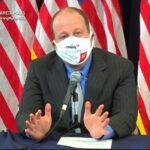
Lost in the midst of Wednesday’s chaos, both at the state Capitol in Denver and in Washington, D.C.: an extension of the Colorado’s requirement for wearing face coverings. Gov. Jared Polis extended, for a ninth time, an executive order mandating Coloradans wear masks in public places. The original order was issued April 17, 2020, and […]

TRAIL MIX | Senate floor speech was classic Bennet
It wasn’t the first time Michael Bennet had invoked ancient history in an attempt to make sense of the day’s exasperating events. Taking a turn at the microphone in the well of the Senate past midnight on the night of Jan. 6, Bennet made a case against an objection raised by Ted Cruz, the Texas […]