

Arapahoe County judge closed courtroom, violating public trial right, appeals panel rules

An Arapahoe County judge violated a defendant’s constitutional rights by closing his courtroom to keep out one individual during the trial, the Court of Appeals ruled on Thursday in reversing the convictions.
In the criminal proceedings against Terrel Shameek Turner, District Court Judge Ben L. Leutwyler III decided to exclude the wife of Turner’s co-defendant from the courtroom on the assumption that there would be a protection order keeping her away from certain parties at the trial, but without detailing the nature of the threat she might pose.
Prosecutors charged Turner with conspiring with Christopher Cruse to rob a marijuana dispensary, although the store’s manager was unable to open the safe and Turner left empty-handed. A jury found him guilty of burglary, attempt to commit robbery, attempt to commit theft and assault. He received five years in prison.
Turner appealed, citing an incident from the third day of his August 2017 trial: the prosecutor announced that Cruse’s wife had been arrested for harassing a victim advocate and a witness outside the courtroom.
“What’s important for the court, your honor,” the prosecutor told Leutwyler, “is that there will be a mandatory protection order in place that restrains [her] from having any contact with our victim advocate, and obviously, our advocate will be in the courtroom, so [she] is not going to be allowed legally to be in the courtroom.”
Cruse’s attorney responded that the wife was allowed to be present. The Sixth Amendment guarantees the right to a public trial that, among other purposes, serves to discourage perjury and encourage the fair treatment of the defendant.
Leutwyler agreed that having no contact between the wife and the alleged harassment victims was appropriate, and also pointed out that the woman had made aggressive statements and interfered with the presentation of evidence.
Although courtroom closures – even ones minor enough to exclude one person – are permissible for such reasons as protecting sensitive information, the U.S. Supreme Court in 1984 outlined in Waller v. Georgia the specific circumstances which allow for them. Those include having an “overriding interest” in the closure, considering reasonable alternatives and instituting as narrow a closure as possible.
For example, in 2010 the Supreme Court found a court had violated the Sixth Amendment by excluding the public during jury selection, believing there not to be enough room. In 2020, the Colorado Supreme Court issued two rulings on the subject, finding one judge gave no reason for excluding a pair of relatives and another judge excluded everyone but the jury to give an instruction, though not improperly. (A Court of Appeals panel subsequently ordered a new trial in the latter case.)
Considering Turner’s appeal, the three-member appellate panel agreed that Leutwyler had not elaborated upon how the wife’s presence during the remaining three-and-a-half days of testimony would have posed a threat to courtroom safety and order.
“[T]he record does not support a conclusion that [the] wife’s exclusion was for cause and necessary,” wrote Judge Gilbert M. Román, adding that the confrontation occurred outside the courtroom. “[T]he witness involved in the alleged incident had testified the following day and was excused from the trial following his testimony.”
Also problematic was the lack of details about the nature of the altercation. In this instance, the closure encompassed the testimony of 14 prosecution and one defense witnesses, plus closing arguments. The wife’s presence “could have reminded the trial participants of their duty to treat Turner and Cruse fairly,” Román wrote.
The appellate panel listed the alternatives Leutwyler could have considered to grant a closure for the benefit of the victim advocate involved: alternating between having the advocate and the wife in the room or having either of them observe remotely. The judges also noted Leutwyler took action before the issuance of any protection order.
The panel reversed Turner’s conviction and ordered a new trial. The case is People v. Turner.



Bennet, Hickenlooper to vote against Trump’s 10th Circuit nominee from Colorado
Michael Karlik
michael.karlik@coloradopolitics.com
Updated 7 hours ago
Colorado’s two Democratic senators will not vote to confirm President Donald Trump’s nominee to a vacancy on the Denver-based federal appeals court. Trump has selected U.S. District Court Chief Judge Daniel D. Domenico, who he appointed as a federal trial...
Who’s spending in Colorado to get your vote?
Marianne Goodland
marianne.goodland@coloradopolitics.com
Updated 4 hours ago
Groups that raise unlimited amounts of money have spent about $20 million in May and June to try and influence Colorado voters’ choices in the upcoming June 30 primaries. By law, these groups cannot coordinate with the candidates they support....
U.S. government declines to oppose multiple challenges to immigration detention in Colorado
Michael Karlik
michael.karlik@coloradopolitics.com
Updated 7 hours ago
Multiple federal judges in Colorado granted petitions from people challenging the lawfulness of their immigration detention this week after the government took the unusual step of declining to submit arguments in opposition. Colorado’s federal trial court is facing a flood of...

Tina Peters tells supporters to ‘stand up and fight back’ at Castle Rock event
Marissa Ventrelli
marissa.ventrelli@coloradopolitics.com
Updated 6 hours ago
Tina Peters, the former Mesa County clerk recently released from prison, warned supporters that what happened to her could happen to them, too, if they did not “stand up and fight back” at an event at the Douglas County Fairgrounds....

Iran strikes cargo ship in Strait of Hormuz, endangering Trump’s peace
Christian Datoc
christian-datoc@coloradopolitics.com
Updated 13 hours ago
Iran attacked a cargo ship traveling through the Strait of Hormuz on Thursday, possibly upending President Donald Trump‘s diplomatic end to the war with Iran. A U.S. official confirmed to the Washington Examiner that the Islamic Revolutionary Guard Corps “struck...

Senate GOP tries to mend fences with Trump after heated lunch
David Sivak
david-sivak@coloradopolitics.com
Updated 11 hours ago
Senate Republicans are trying to turn the page on a heated lunch with President Donald Trump that brought weeks of tensions to a new high-water mark. In a symbolic gesture, Senate Republicans took another vote on the Iran war Wednesday...
Colorado justices discuss solution to confusion from prior criminal ruling
Michael Karlik
michael.karlik@coloradopolitics.com
Updated 5 hours ago
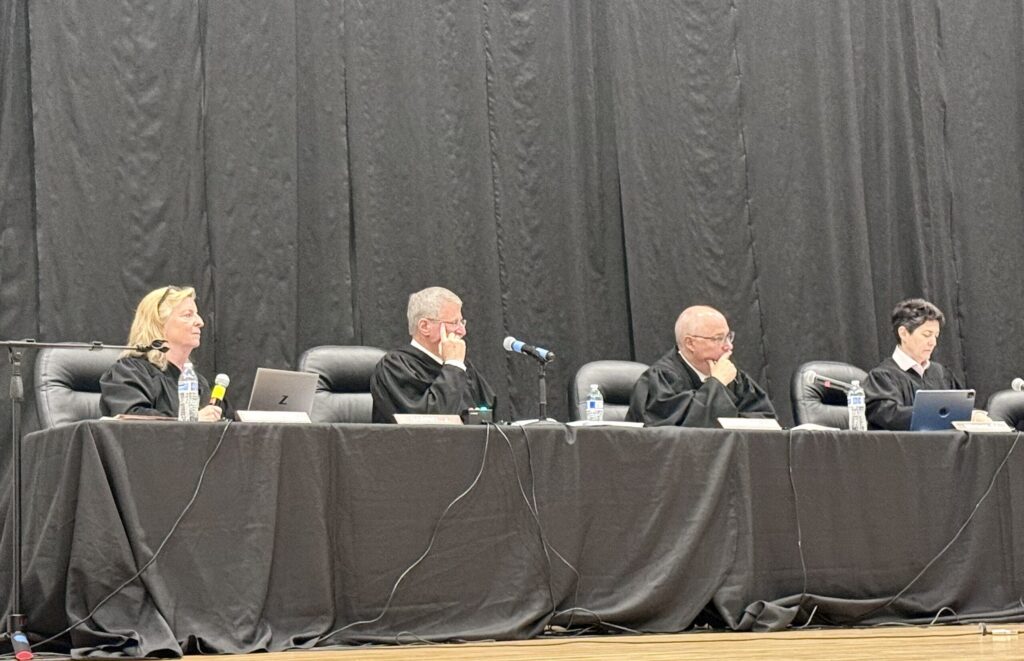
The Colorado Supreme Court pondered the fallout on Tuesday from its nearly six-year-old decision interpreting the state’s impaired driving laws, with the justices now addressing how defendants affected by the legal change must seek postconviction relief. In contrast to other...

Colorado to participate in Great American State Fair in Washington
Marissa Ventrelli
marissa.ventrelli@coloradopolitics.com
Updated 11 hours ago
Visitors to Washington, D.C. for the country’s 250th anniversary will have the opportunity to learn about Colorado’s natural beauty and culture during the Great American State Fair, a World’s Fair-style event that opened Thursday at the National Mall. While all...

RTD to reconsider service priorities as cuts, budget deficit loom
Michael Braithwaite
michael.braithwaite@gazette.com
Updated 15 hours ago
Should the Regional Transportation District aim to maximize ridership or system coverage? That question sat at the heart of the RTD Board of Directors’ first Comprehensive Operations Analysis briefing on Thursday afternoon. With the Denver transit agency facing a budget...

Mobolade, Colorado Springs leaders say election date lawsuit is attack on local voters
Brennen Kauffman
brennen.kauffman@gazette.com
Updated 13 hours ago
Mayor Yemi Mobolade and other city leaders will fight to keep Colorado Springs elections in April in the face of a new lawsuit. Mobolade, the mayor’s Chief of Staff Wayne Williams and City Councilmember Roland Rainey addressed the lawsuit in...
PREV
PREVIOUS

Lakewood city employee commended for stopping phone scam
A Lakewood city employee recently intervened to stop an elderly man from falling victim to a phone scam, according to the city’s Good News Blog. During a trip to a convenience store, Code Enforcement Officer Juan Bonilla-Acosta noticed a man on a phone call trying to find a gift card to purchase, according to an […]

Neguse, Fenberg set end-of-year virtual town hall with Boulder lawmakers
U.S. Rep. Joe Neguse is joining Senate Majority Leader Steve Fenberg and other Democratic legislators from Boulder for a virtual town hall on Tuesday to close out 2020 and point toward the new year. “We’ve all had to work together this year, and open communication has been more important than ever,” Neguse’s office said in […]