

OUT WEST ROUNDUP | Feds call pine tree threatened; Wyoming official says pandemic part of a plot
MONTANA
Feds say pine tree that feeds grizzlies is threatened
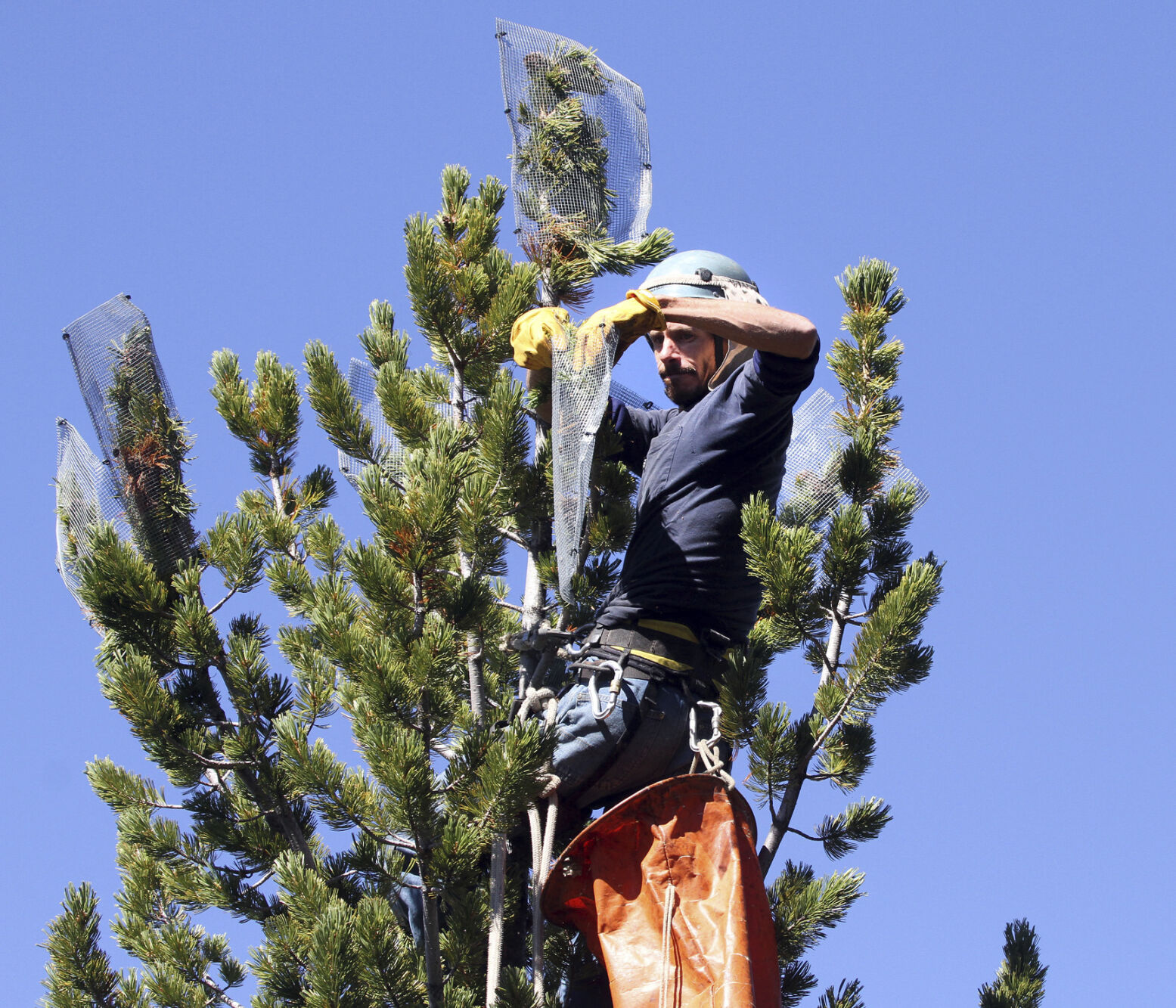
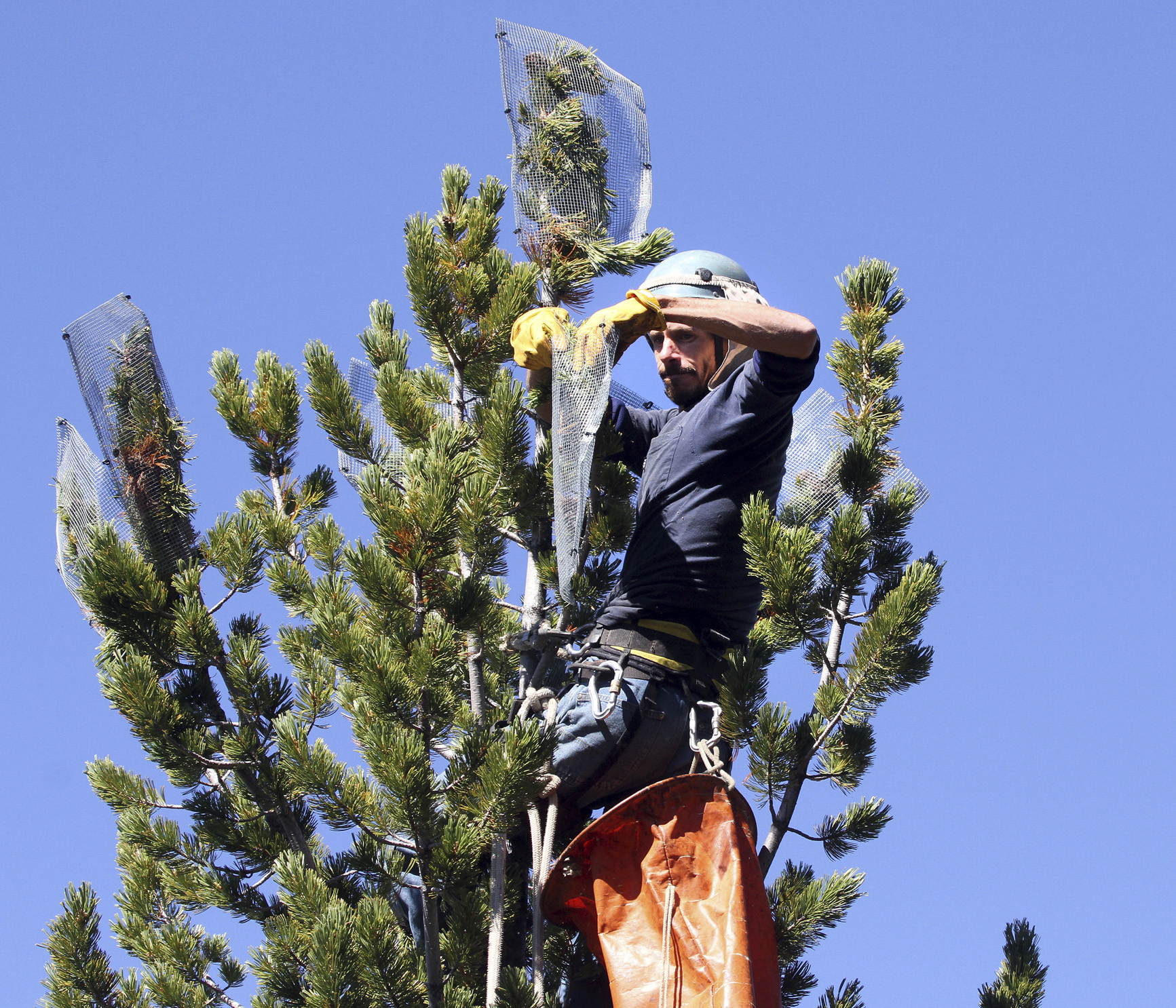
BILLINGS – Climate change, voracious beetles and disease are imperiling the long-term survival of a high-elevation pine tree that’s a key source of food for some grizzly bears and found across the West, U.S. officials said Dec. 1.
A Fish and Wildlife Service proposal would protect the whitebark pine tree as a threatened species under the Endangered Species Act, according to documents posted by the Office of the Federal Register.
The move marks a belated acknowledgement of the tree’s severe declines in recent decades and sets the stage for restoration work. But government officials said they do not plan to designate which forest habitats are critical to the tree’s survival, stopping short of what some environmentalists argue is needed.
Whitebark pines can live up to 1,000 years and are found at elevations up to 12,000 feet – conditions too harsh for most tress to survive.
Environmentalists had petitioned the government in 1991 and again in 2008 to protect the trees, which occur across 126,000 square miles of land in Wyoming, Montana, Idaho, Washington, Oregon, California, Nevada and western Canada.
A nonnative fungus has been killing whitebark pines for a century. More recently, the trees have proven vulnerable to bark beetles that have killed millions of acres of forest, and climate change that scientists say is responsible for more severe wildfire seasons.
The trees have been all but wiped out in some areas, including the eastern edge of Yellowstone National Park, where they are a source of food for threatened grizzly bears. More than half of whitebark pines in the U.S. are now dead, according to a 2018 study from the U.S. Forest Service.
That has complicated government efforts to declare grizzlies in the Yellowstone area as a recovered species that no longer needs federal protection. Grizzlies raid caches of whitebark pine cones that are hidden by squirrels and devour the seeds within the cones to fatten up for winter.
A 2009 court ruling that restored protections for Yellowstone bears cited in part the tree’s decline, although government studies later concluded the grizzlies could find other things to eat.
WYOMING
Health official: ‘so-called pandemic’ a communist plot
CASPER – A Wyoming Department of Health official involved in the state’s response to the coronavirus questioned the legitimacy of the pandemic and described a forthcoming vaccine as a biological weapon at a recent event.
The “so-called pandemic” and efforts to develop a vaccine are plots by Russia and China to spread communism worldwide, department readiness and countermeasures manager Igor Shepherd said at the Nov. 10 event held by the group Keep Colorado Free and Open.
Shepherd was introduced as and talked about being a Wyoming Department of Health employee in the over hour-long presentation in Loveland.
Shepherd’s baseless and unsubstantiated claims undermined Wyoming’s public health measures – and public exhortations – to limit spread of the virus, as well as its plans to distribute COVID-19 vaccines in the months ahead.
Even so, Wyoming officials including Gov. Mark Gordon, who at a recent news conference called people not taking the virus seriously “knuckleheads,” declined to comment.
Department Director Mike Ceballos and State Health Officer Dr. Alexia Harrist did not answer questions from The Associated Press, including when they became aware of Shepherd’s talk and what if anything they have done in response.
Phone and social media messages left for Shepherd on Dec. 4 weren’t returned.
He has worked for the health department since 2013 and has been a part of the state’s team responding to COVID-19, though not in a leadership role, department spokeswoman Kim Deti said.
Researchers have worried for months that politicized skepticism of COVID-19 vaccines could hurt their efficacy. Vaccines are more effective if most of the population is inoculated.
NEW MEXICO
State to require details of water for oil well drilling
ALBUQUERQUE – New Mexico oil and gas operators will be required to report the amount and quality of water used to drill wells, officials said.
The data collection is an attempt by state agencies to scrutinize water use across New Mexico’s economic sectors, the Albuquerque Journal reported Nov. 28.
Adrienne Sandoval, director of the Oil Conservation Division of the state Energy, Minerals and Natural Resources Department, said the reports will help fill a data gap for industry water use.
Hydraulic fracturing, or fracking, blasts water, sand and chemicals underground to break through shale formations to retrieve oil.
Operators previously reported the amount of produced water injected into storage wells but were not required to disclose water data for well completions.
Produced water is a salty chemical mixture surfacing along with petroleum, which companies often recycle for future fracking.
Office of the State Engineer data show oil and gas operations account for less than 1% of New Mexico’s water use.
Researchers: Starvation, weather to blame for bird die-off
SANTA FE – Starvation and unexpected weather are to blame for a statewide die-off among migratory birds in New Mexico, researchers said Dec. 4.
Biologists from multiple agencies collected hundreds of samples of warblers, swallows and other birds and sent them to the U.S. Geological Survey’s National Wildlife Health Center in Wisconsin to be analyzed.
The researchers found that nearly all the birds were severely emaciated, already starving when they moved into New Mexico. An unusual storm likely made things worse, they said, causing the birds to become disoriented and fly into buildings and objects. Some died from exposure to the cold weather, were killed by predators or hit by vehicles.
The evidence of starvation included kidney failure, empty stomachs, small amounts of blood, depleted fat deposits, irritated lung tissue and shrunken breast muscles that control the birds’ wings, the researchers said.
The researchers didn’t identify a single, definitive cause of death. They ruled out disease and poisoning.
Countless birds died earlier this year, with the first signs in late August. They were reported in the Taos area and at Valles Caldera National Preserve in the north to the cottonwood forest along the Rio Grande to southern New Mexico, including at White Sands Missile Range.
IDAHO
State is top pick for Energy Dept. nuclear test reactor
BOISE – The U.S. government said Nov. 19 that Idaho is its preferred choice ahead of Tennessee for a test reactor to be built as part of an effort to revamp the nation’s fading nuclear power industry by developing safer fuel and power plants.
The U.S. Department of Energy said in an email to The Associated Press that the site that includes Idaho National Laboratory will be listed as its preferred alternative in a draft environmental impact statement planned for release in December.
The Versatile Test Reactor, or VTR, would be the first new test reactor built in the U.S. in decades and give the nation a dedicated “fast-neutron-spectrum” testing capability. Some scientists decry the plan, saying fast reactors are less safe than current reactors.
The final environmental impact statement is due in 2021, followed by what’s called a record of decision finalizing the selection of the site. Plans call for building the reactor by the end of 2025.
The Department of Energy’s draft environmental impact statement also examines building the test reactor at Oak Ridge National Laboratory in Tennessee as an alternative.
Revamping the nation’s nuclear power is part of a strategy to reduce U.S. greenhouse gas emissions by generating carbon-free electricity with nuclear power initiated under the Obama administration and continuing under the Trump administration, despite Trump’s downplaying of global warming.

Gov. Polis names new leaders for Colorado health agencies in wake of Medicaid turmoil
Marianne Goodland
marianne.goodland@coloradopolitics.com
Updated 59 minutes ago
Gov. Jared Polis, on Thursday, announced he was appointing Gretchen Hammer to serve as acting executive director of the Colorado Department of Health Care Policy and Financing, and deputy executive director Stephanie Beasley to become the next commissioner of the...

Federal judge releases man immediately as consequence for immigration judge disobeying orders
Michael Karlik
michael.karlik@coloradopolitics.com
Updated 1 hour ago
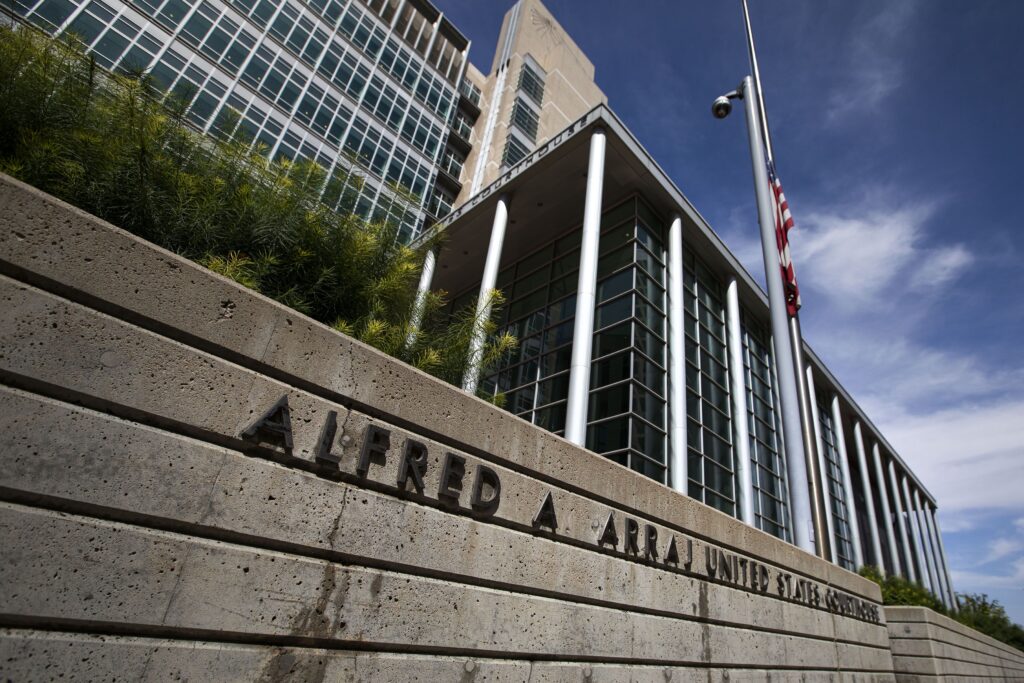
A federal judge ordered a man’s immediate release from immigration detention on Thursday after finding an immigration judge disregarded his prior orders requiring a bond hearing. For the past year, Colorado’s federal district court has faced a flood of “habeas corpus”...

Colorado sues Trump administration, calling new election order ‘unconstitutional’
Marissa Ventrelli
marissa.ventrelli@coloradopolitics.com
Updated 2 hours ago
Colorado Attorney General Phil Weiser has joined a multistate coalition suing President Donald Trump over a new executive order on elections, arguing the directive unlawfully intrudes on states’ authority to run their own voting systems and threatens access to mail...
Federal judge sides with Mesa County school district in ex-student’s First Amendment claims
Michael Karlik
michael.karlik@coloradopolitics.com
Updated 3 hours ago
A federal judge concluded last week that Mesa County Valley School District 51 and three of its administrators did not violate the First Amendment rights of a former student when they imposed minor discipline in response to disruptive behavior. In...

Why Colorado’s LGBTQ laws keep getting struck down by the Supreme Court
Jack Birle, Washington Examiner
jack.birle.washington.examiner@gazetteedit.wpenginepowered.com
Updated 2 hours ago
The Supreme Court has been a house of horrors for Colorado over the past decade, with the state facing a trio of major losses over laws it claims it has enacted to protect LGBT people but that the justices found...

Denver Democrat Neal Walia lands endorsement from Ro Khanna in Colorado’s state House District 9
Ernest Luning
ernest.luning@coloradopolitics.com
Updated 4 hours ago
California Rep. Ro Khanna on Friday endorsed legislative candidate Neal Walia in the race for an open state House seat, praising the Denver Democrat’s commitment to public service and progressive goals. Walia, who mounted an unsuccessful challenge against U.S. Rep....

Denver judge denies Gov. Polis request to dismiss ICE-related records case
Marianne Goodland
marianne.goodland@coloradopolitics.com
Updated 7 hours ago
A year after blocking the release of state records to federal immigration agents, a Denver judge has now denied Gov. Jared Polis’ effort to end the lawsuit at the center of the dispute. The lawsuit filed against the governor in...

Gov. Lamm challenges Congress to stop ‘decontrol’ of natural gas | A LOOK BACK
Rachael Wright, Special to Colorado Politics
rachael.wright@coloradopolitics.com
Updated 2 days ago
Forty-Five Years Ago This Week: In a memo to Colorado’s congressional delegation, Gov. Dick Lamm urged them to vote against the phased pricing deregulation provisions in the Natural Gas Policy Act, a measure introduced in Congress in 1978 and still...

Environmentalists and Colorado Springs Utilities split on retirement date for Ray Nixon coal power plant
Brennen Kauffman
brennen-kauffman@coloradopolitics.com
Updated 5 hours ago
On Tuesday night, around 25 people gathered at Old Colorado City Brewing to celebrate Ray Nixon’s retirement. Nixon is only 46 years old, but the retirement has been expected for several years. The crowd delivered toasts and signed a poster-sized...

Colorado National Guard members deployed to the Middle East
The Gazette
the-gazette@coloradopolitics.com
Updated 5 hours ago
The Colorado Army National Guard announced Thursday that more than 200 members are deploying to the Middle East. The members of the 1st Battalion, 157th Infantry Regiment (Mountain), a unit based at Fort Carson, are deploying to help support an...
PREV
PREVIOUS

SONDERMANN | Impact of big ballot issues looms
Eric Sondermann Amidst all the flurry and breathless pro and con commercials for eleven ballot issues this fall, two measures will prove of long-term consequence dwarfing all of the others. Colorado voters, in their biennial bacchanal of direct democracy, were certainly in an affirmative mood, saying “yes” to the overwhelming share of these questions. A […]
Boulder County passes strictest fracking regulations in the state
The Boulder County Board of Commissioners unanimously voted Thursday to pass strengthened rules and regulations for oil and gas development, including increasing setbacks for fracking sites. From now on, oil and gas well pads in the county will generally have to be at least 2,500 feet away from any home, school, child care, workplace or […]