

US Supreme Court suspends oral arguments for March; Colorado ‘faithless elector’ case planned for April
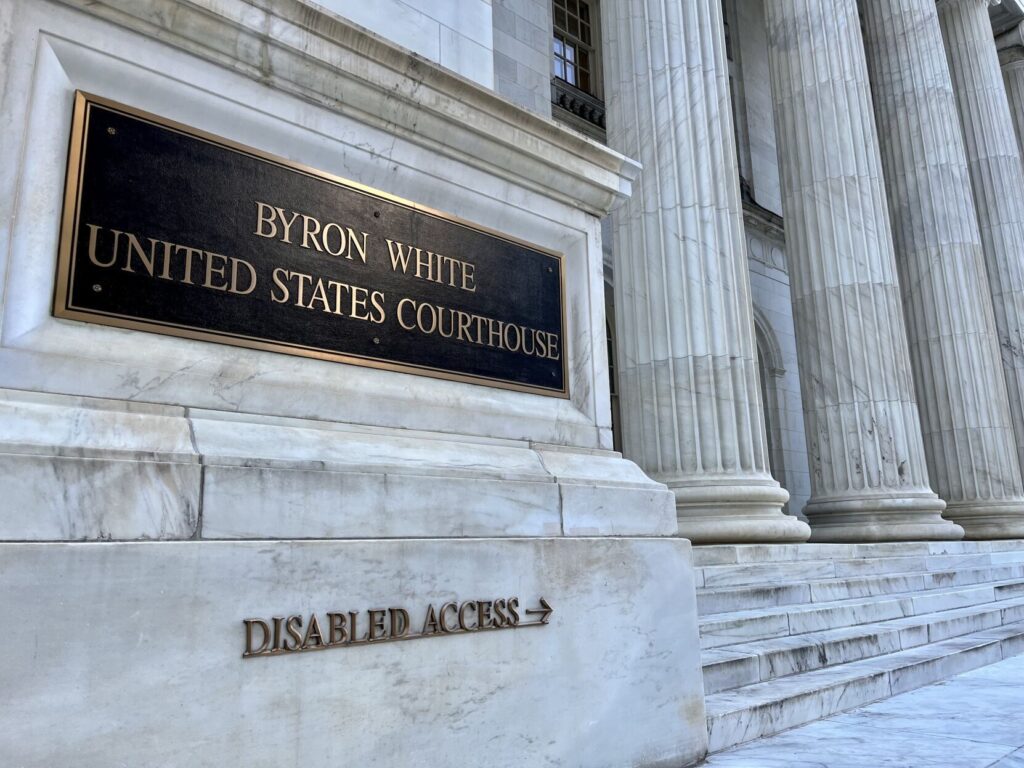
The U.S. Supreme Court Monday announced it would suspend its March oral arguments calendar, which was due to start next Monday and run through April 1.
In the announcement, the nation’s highest Court said it was acting to protect public health.
Among the arguments postponed for now: two involving President Trump, who is suing Deutsche Bank and his company’s accounting firm, Mazars USA LLP. The President is seeking to block those companies from releasing financial documents, including tax returns, which are being sought by the Committee on Oversight and Reform of the U.S. House of Representatives.
The Court has set a date of April 28 to hear the “faithless elector” case, Colorado Dept. of State v. Baca. The Court has not yet said what it would do about April oral arguments.
The Colorado appeal dates from the 2016 election. Democratic presidential candidate and former US Secretary of State Hillary Clinton won Colorado’s electoral college votes. But Micheal Baca attempted to cast his vote for Ohio Governor John Kasich. Two other Colorado electors – former state Sen. Polly Baca of Denver (no relation) and Robert Nemanich of Colorado Springs also wanted to vote for another candidate but in the end they said they voted for Clinton under duress.
The move was intended to add Colorado’s Electoral College votes to a group of “faithless electors” who intended block the election of President Trump.
Micheal Baca was replaced by another elector, who voted for Clinton. Seven electors in three states (Hawaii, Texas and Washington) voted for someone other than the person who won that state’s presidential election.
In three other states – Colorado, Maine and Minnesota – the votes of three electors were invalidated.
Twenty-one states have filed a friend of the court brief; another 11 individuals and organizations, including the Independence Institute and University of Denver Professor Robert Hardaway, have also filed amicus briefs.
The Institute’s brief, authored by David Kopel, notes that the U.S. Constitution “permits – indeed, requires – presidential electors to exercise their best discretion” voting for the President and Vice-President.
“The Constitution does not grant those who appoint electors the power to control electors’ judgment any more than the presidential power to appoint judges includes authority to control judges’ decisions,” the brief adds.
Hardaway’s brief argued that if the the Tenth Circuit Court of Appeals’ decision is allowed to stand, (it ruled in favor of the faithless electors), it would “effectively nullify thousands of citizens’ votes and their choice for executive.”
U.S. Supreme Court Justice Sonia Sotomayor has recused herself from the case, citing a friendship with Polly Baca.

Gov. Lamm challenges Congress to stop ‘decontrol’ of natural gas | A LOOK BACK
Rachael Wright, Special to Colorado Politics
rachael.wright@coloradopolitics.com
Updated 2 days ago
Forty-Five Years Ago This Week: In a memo to Colorado’s congressional delegation, Gov. Dick Lamm urged them to vote against the phased pricing deregulation provisions in the Natural Gas Policy Act, a measure introduced in Congress in 1978 and still...
Colorado justices accept appeals on Netflix taxation, children pursuing neglect cases
Michael Karlik
michael.karlik@coloradopolitics.com
Updated 16 hours ago
The Colorado Supreme Court announced on Monday that it will decide whether Netflix subscriptions are subject to the state’s sales tax as “tangible personal property.” At least three of the court’s seven members must agree to hear an appeal. The...
Proposal outlines $300M deal separating Pinnacol from Colorado state government
Marianne Goodland
marianne.goodland@coloradopolitics.com
Updated 16 hours ago
Colorado lawmakers are weighing a proposal that would allow Pinnacol Assurance to sever its remaining ties to the state in exchange for a $300 million payment, a long‑debated shift that supporters say could stabilize the insurer’s future and help plug...
Bill requiring employers to grant unpaid leave to Colorado lawmakers heads to governor’s desk
Marissa Ventrelli
marissa.ventrelli@coloradopolitics.com
Updated 15 hours ago
Colorado lawmakers are one step away from securing guaranteed unpaid leave from their day jobs during the legislative session after the House narrowly approved the proposal Thursday. Senate Bill 087 would require businesses to allow employees who are members of...
Redistricting fight escalates as Colorado Title Board clears competing ballot proposals
Marianne Goodland
marianne.goodland@coloradopolitics.com
Updated 15 hours ago
Colorado’s title board on Wednesday gave final approval to multiple ballot measures related to congressional redistricting, setting up a series of proposals that could alter how the state draws its U.S. House districts for the 2028 and 2030 elections. The...
Trump downplays major reform bill and says housing is ‘all about interest rates’
Zach Halaschak, Washington Examiner
zach.halaschak.washington.examiner@gazetteedit.wpenginepowered.com
Updated 18 hours ago
President Donald Trump downplayed the bipartisan housing legislation that many congressional allies hope will ease the affordability worries plaguing voters, saying instead in an exclusive Washington Examiner interview that housing is “all about interest rates.” Trump said on a phone call Thursday morning...
Colorado lawmakers propose deep cuts to close $1.2B budget gap
Marianne Goodland
marianne.goodland@coloradopolitics.com
Updated 14 hours ago
The panel of Colorado legislators in charge of crafting next year’s budget has finalized the 2026–27 spending plan built on deep cuts and one‑time cash transfers in an attempt to close a shortfall of more than $1.2 billion. The plan...
Denver judge denies Gov. Polis request to dismiss ICE-related records case
Marianne Goodland
marianne.goodland@coloradopolitics.com
Updated 18 hours ago
A year after blocking the release of state records to federal immigration agents, a Denver judge has now denied Gov. Jared Polis’ effort to end the lawsuit at the center of the dispute. The lawsuit filed against the governor in...
10th Circuit grants rare all-judges’ review of Colorado banking regulation
Michael Karlik
michael.karlik@coloradopolitics.com
Updated 20 hours ago
The Denver-based federal appeals court announced on Thursday that it will hold a rare all-judges review of a recent decision that permits Colorado to require out-of-state banks to abide by the state’s maximum interest rates when they lend to in-state...
Colorado appeals court orders new sentencing for Tina Peters, upholds convictions
Michael Karlik
michael.karlik@coloradopolitics.com
Updated 14 hours ago
Colorado’s second-highest court determined on Thursday that a trial judge improperly sentenced former Mesa County clerk Tina Peters based upon her exercise of protected speech, while at the same time upholding her convictions. The three-judge Court of Appeals panel also...
PREV
PREVIOUS

King Soopers announces new policies, positive COVID-19 test for employee
The parent company of King Soopers on Sunday announced changes to its operations in light of the continued spread of COVID-19 coronavirus, and that two known employees had tested positive for the virus. “Effective immediately, the Kroger Family of Companies is enacting the Emergency Leave Guidelines policy, allowing paid time off for Associates diagnosed with […]

General Assembly passes bill to direct peace officer training money to small, rural jurisdictions
The Colorado House and Senate last week approved a bill to establish a scholarship fund for rural and small jurisdictions to fund police academy attendance and training for their recruits. A $1 fee on vehicle registrations generates revenue for the Peace Officers Standards and Training Board to support law enforcement training. In fiscal year 2018-2019, […]