

NTSB report points to well operators and town of Firestone for 2017 explosion
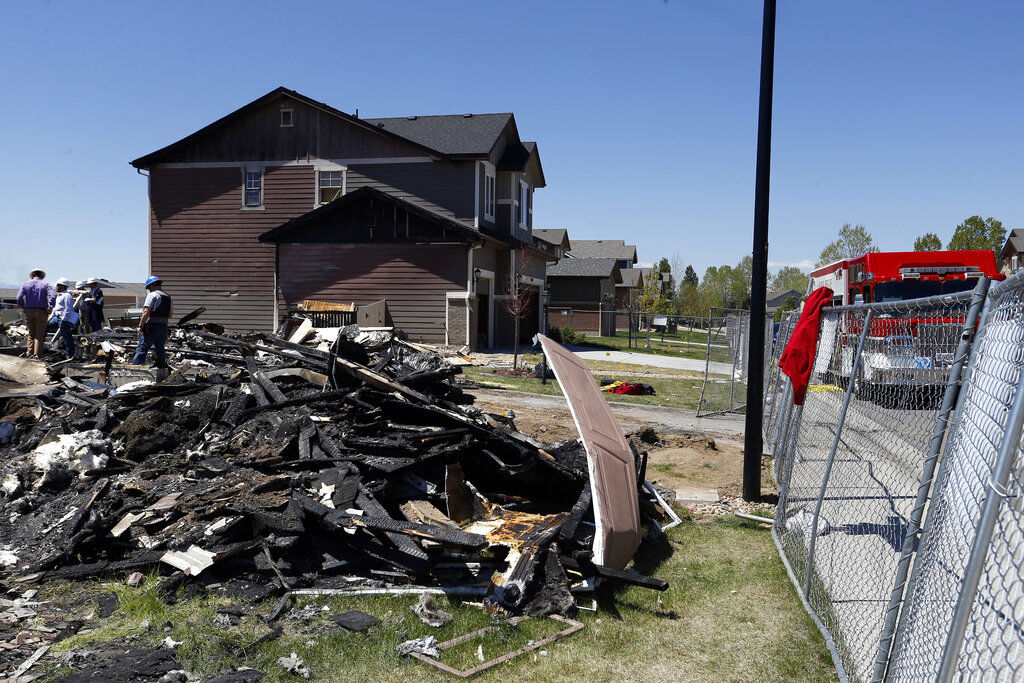
Tuesday’s National Transportation Safety Board report on the April 2017 explosion in Firestone that killed two and injured two points to failures by the owners of the flowline that leaked methane into a Firestone home.
But the town of Firestone wasn’t left off the hook, either.
The natural gas well connected to the abandoned flowline was originally drilled in 1993 by Gerrity Oil and Gas, the NTSB report said. The well was acquired by Patina Oil and Gas in 1997. Two years later, the company began plans to shut down that well, which was connected to a production facility, and install new flowlines that would go to a tank storage facility about a quarter-mile west of the well. That shutdown was connected to a housing development planned for the area, eventually including the home in Firestone that exploded in 2017. According to the NTSB report, the well was just 170 feet from the home.
The NTSB report said that while Patina claimed the flowline had been abandoned, records maintained by the Colorado Oil and Gas Conservation Commission “showed this to be incorrect.”
In October 2013, the well was acquired by Anadarko, and the company began operations.
On April 17, 2017, homeowner Mark Martinez and his brother-in-law, Joey Irwin, were installing a water heater in the basement of Martinez’ home. Methane that leaked from a severed flowline and into the Martinez basement ignited, blowing the home to bits. The explosion killed Martinez and Irwin and seriously injured Martinez’ wife, Erin, and their son, Nathan. Anadarko settled claims last year made by Martinez, her son, and Irwin’s parents, and in a statement said “it is clear that Mark Martinez and Joey Irwin were innocent victims in the explosion. Neither they nor Erin Martinez bear any responsibility or fault for what occurred.”
In 1999, COGCC regulations required flowlines be “disconnected from all sources and supplies of natural gas and petroleum, purged of liquid hydrocarbons, depleted to atmospheric pressure and sealed at the ends.” The report said that none of the three lines found at the residence were properly abandoned in accordance with these requirements.
As to the cause of the explosion, the NTSB determined that the flowline had likely been severed when the home was under construction in 2015. But the board also pointed to the town of Firestone, which it said had approved the development “adjacent to or previously part of oil and gas production fields” without requiring documentation from Anadarko on the location and status of its flowlines.
The town of Firestone responded to the NTSB report late Tuesday but did not address the NTSB’s determination that town officials who approved the development were at least partly the cause of the incident.
“The NTSB report released today provides important information regarding the tragic events of April 17, 2017,” said town manager AJ Krieger. “The report determines that fugitive gas from an improperly abandoned line was the ultimate cause of the explosion. The report also concludes that the line in question was not properly abandoned according to the COGCC’s requirements. In the town’s view, this makes the events of that day all the more tragic.”
Firestone recently started requiring removal of abandoned “subgrade infrastructure,” Krieger said, including the kinds of flowlines cited by the NTSB.
“The town is also in the midst of a complete update to its land development code, which will include enhanced requirements for regulating oil and gas activity,” Krieger said. “These more stringent regulations will not just focus on siting and pre-development activities, but also on the post-production life cycle and inspections.
“We believe the best path forward requires combining updated regulations with ongoing inspections. The Firestone Board of Trustees is committed to the safety and security of its residents as their highest priority.”
The COGCC issued a statement following the NTSB report that said it will file an enforcement action against Anadarko subsidiary Kerr McGee Oil and Gas Onshore LP, and it will issue a notice of alleged violation . If Kerr McGee agrees with the violations in the notice, then it will be resolved through an Administrative Order by Consent . All AOCs must be reviewed and voted on by the commission.
The COGCC detailed ownership in its statement: Kerr McGee Oil and Gas Onshore LP is a wholly-owned subsidiary of Anadarko Petroleum Corporation. On Aug. 8, 2019, Anadarko Petroleum Corporation was purchased by Occidental Petroleum Corporation. At this time, Anadarko Petroleum Corporation remains a wholly-owned subsidiary of Occidental Petroleum Corporation.
The Firestone explosion played a major role in sweeping changes the Colorado General Assembly made earlier this year to the COGCC’s mission and rules, as contained in Senate Bill 181. The measure mandates the COGCC to review and amend its rules on flowlines and inactive, temporarily abandoned and shut-in wells to ensure those rules protect public health and safety. Shut-in wells and flowlines are those that may still contain fluids, but the fluids are not actively flowing.
The law says the rules must allow public disclosure of flowline information. Deactivated flowlines must be inspected prior to being reactivated, the law said. Inactive, abandoned or shut-in wells also must be inspected before being put back into production or used for injection (part of the fracking process).
The COGCC has been engaged in rulemaking on SB 181 since last May, when Director Jeff Robbins issued objective criteria that is to guide the COGCC on its approvals until the rulemaking is completed, expected sometime next year.
The commission has yet to begin discussions of rules around flowlines; that’s scheduled for Nov. 19 and 20. However, draft rules are already out; they were published on Oct. 8.
With regard to abandoned flowlines, draft rules contain the same three existing requirements cited in the NTSB report. A new draft rule says the operator must also submit pressure test results conducted during the previous 12 months.
Within 90 days, new draft rules require operators to submit a “geodatabase” of the flowline and how the abandonment work was performed. The geodatabase – a way to manage geographic information systems files – also is required for other aspects of oil and gas production.
The anti-fracking group Colorado Rising seized on Tuesday’s report as an opportunity to launch another call for a moratorium on oil and gas permits. Anne Lee Foster said in a statement that the “report further highlights the need for a pause on oil and gas permitting in the state. The multiple failures by oil and gas operators outlined in the report demonstrate these corporations cannot be trusted and they are only out to protect their bottom line. Don’t take our word for it – Anadarko employees testified to it in a lawsuit against the company from their own shareholders. Until the Polis administration can get a full understanding of where these ticking timebombs lie, how can they possibly take on the liability of more wells in neighborhoods?”
More than three dozen formal statements on the flowline draft rules have been submitted in preparation for the Nov. 19-20 hearings.
The Colorado Petroleum Council and the American Petroleum Institute, in their statement, said that they had concerns about the draft rules on abandonment. While they “generally supported” the proposed changes, the CPC said “it is impossible to anticipate all of the situations where the operator and the director would appropriately consider whether removal is in the best interest of the public. That could include, for example, flowlines in proximity to cemeteries and historic sites, pasture and crop lands. CPC recommends that the commission include a provision that provides to the Director discretion to permit abandonment of a flowline in place where doing so would result in fewer impacts to health, safety, welfare, environment, and wildlife than would removal.” The CPC also has “significant concerns” around the risks of making public highly detailed flowline maps.
The Colorado Association of Home Builders also weighed in on the proposed rules. Among their suggestions: that oil and gas operators provide to landowners plans to remove abandon flowllines, and that upon request, operators must provide nearby landowners with information on planned flowline installations, although that information should be kept confidential between the operator and the landowner.
The COGCC is meeting Wednesday. Included in the agenda is a presentation on the CDPHE study that claimed minimal short-term health impacts from oil and gas activity.

Judge rules that Colorado law makes it too hard for parties to bar unaffiliated voters from primaries
Ernest Luning
ernest.luning@coloradopolitics.com
Updated 12 hours ago
A federal judge ruled in favor of the Colorado Republican Party late Tuesday, saying that a portion of the state law that allows unaffiliated voters to cast ballots in party primaries is unconstitutional because it imposes an unrealistic burden on...
10th Circuit upholds regulator’s methodology for Tri-State exit fees
Michael Karlik
michael.karlik@coloradopolitics.com
Updated 14 hours ago
The Denver-based federal appeals court upheld a regulatory agency’s methodology for calculating the fee owed by entities seeking to withdraw from Tri-State Generation and Transmission Association last week. Tri-State is a Westminster-based cooperative that provides and transmits electricity to member...
Federal judge proposes sanctions against Mike Lindell’s lawyers for continued fake citations
Michael Karlik
michael.karlik@coloradopolitics.com
Updated 15 hours ago
A federal judge is once again pursuing sanctions against lawyers for MyPillow CEO Mike Lindell for continuing to cite to court cases that do not exist, likely based on the faulty output of artificial intelligence tools. Last year, a jury...
Front Range cities oppose Democratic proposal to permit lot‑splitting as a path to affordable housing
Marianne Goodland
marianne.goodland@coloradopolitics.com
Updated 15 hours ago
Colorado lawmakers are pressing ahead with a plan to let homeowners split their lots to make room for smaller, more affordable houses. The proposal has drawn sharp opposition from Aurora, Colorado Springs, Denver and other Front Range cities that argue...

Susan Blanco signals views on role of appellate courts in first opinion as Colorado justice
Michael Karlik
michael.karlik@coloradopolitics.com
Updated 19 hours ago
Justice Susan Blanco’s first solo opinion as a new member of the Colorado Supreme Court made clear her view of the guardrails that keep the state’s highest court tethered to the issues it is asked to decide. On Monday, the...

Hegseth features Fort Carson soldiers after returning from Middle East, gives warning on Iran war
Reuters
reuters@gazette.com
Updated 19 hours ago
Defense Secretary Pete Hegseth said on Tuesday the next few days in the war against Iran would be decisive and warned Tehran that the conflict would intensify if it did not make a deal. Hegseth also highlighted his trip to the Middle...

Denver Council narrowly approves deal with Axon
Deborah Grigsby
deborah.smith@denvergazette.com
Updated 23 hours ago
After weeks of delay, the Denver City Council narrowly approved a one-year $150,000 contract with Axon for 50 automated license plate-reading cameras and the necessary system hardware, replacing the city’s former vendor, Flock. The 7-6 vote came during Tuesday’s regular...

Colorado leaders weigh next steps after Supreme Court rejects state ban on ‘conversion therapy’
Marissa Ventrelli
marissa.ventrelli@coloradopolitics.com
Updated 2 days ago
Colorado leaders said they are weighing next steps after the U.S. Supreme Court on Tuesday rejected the state’s ban on “conversion therapy” for children, as critics and supporters cheered or lambasted the ruling. The court’s near-unanimous decision called the Colorado...

Aurora homeless shelter opened too early, CEO says, as mold and plumbing issues emerge
Kyla Pearce
kyla.pearce@gazette.com
Updated 23 hours ago
Aurora’s largest homeless services project launched “way too early,” its CEO told city leaders Tuesday, saying the rushed opening left residents living amid mold, plumbing failures, and other issues inside the former hotel. During Tuesday’s Housing, Neighborhood Services and Redevelopment...

Gov. Polis declares April ‘dig safely month’ to mark 40th anniversary of Colorado 811
Scott Weiser
scott.weiser@gazette.com
Updated 22 hours ago
Gov. Jared Polis declared April 2026 as “Dig Safely Month” in Colorado, an annual observance that this year highlights the 40th anniversary of Colorado 811, the state’s One-Call Notification System. “Before everyone starts their warm weather projects around the house,...
PREV
PREVIOUS

Independent ethics commission to release investigative report on Hickenlooper complaint
The Colorado Independent Ethics Commission took a step closer Tuesday on the ethics complaints filed against former Democratic governor, and now-U.S. Senate candidate, John Hickenlooper. The currently four-member body voted unanimously to dismiss a motion made by Hickenlooper’s lawyer, Mark Grueskin, to dismiss the complaints, although since they dismissed without prejudice, the motion could be […]

State health exchange says that despite lower prices, it still pays to shop around
For the first time since the state’s health exchange opened in 2013, premiums are expected to be lower than the year before Friday, when open enrollment in the health plan begins. Connect for Health Colorado said more savings could still be found by shopping around. Connect for Health CEO Kevin Patterson told reports Wednesday night here […]