

TRAIL MIX | Advice for Colorado’s 2020 candidates: ‘Don’t disappear’ in Miami

The two Colorado Democrats running for president are about to get their chance to stand out in a crowd of White House hopefuls.
After months of making their cases for the nomination in televised town halls, at meet-and-greets in early primary states and online, former Gov. John Hickenlooper and U.S. Sen. Michael Bennet will be standing shoulder to shoulder for two hours with about half of the Democrats running to challenge President Donald Trump in 2020.
Hickenlooper and Bennet are set to appear on stage along with eight other presidential contenders on June 27, the second night of the Democrats’ two-night debate-a-palooza in Miami. The night before, on June 26, another 10 presidential wannabes will get their turn.
For the 10 minutes or so that each Coloradan will get the microphone, they’ll have the attention of millions of Americans, including a hefty share who haven’t yet paid much attention to the gaggle of aspiring commanders-in-chief – 23 at last count, though only 20 of them made the cut for the Democratic National Committee’s first round of sanctioned debates.
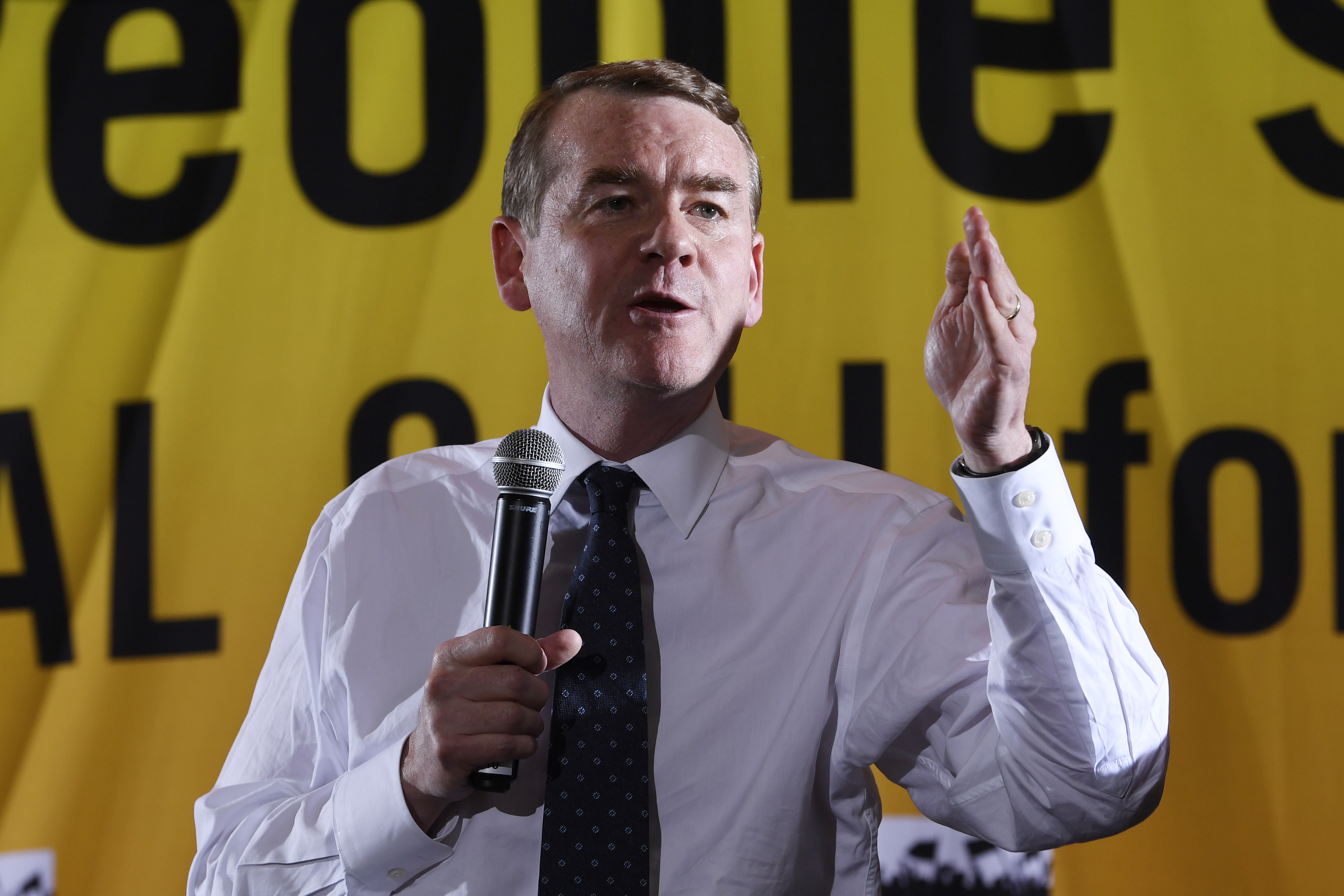
Hickenlooper and Bennet won the right to wrangle it out in front of a national audience – the debates will air 7-9 p.m. Mountain Time on NBC, MSNBC, and Telemundo – by navigating a complicated set of qualifying rules involving polling and grassroots fundraising benchmarks set by the DNC.
The two Coloradans both qualified by scoring at least 1% in three separate, approved polls, but missed the fundraising mark, which was to raise money from at least 65,000 individual donors spread out over a geographic range.
In total, 14 of this week’s debaters met both requirements, while six got there on polling results alone – a wrinkle that could come into play when the stage is set for a pair of July debates in Detroit, which will likewise be limited to 10 candidates on each night. If more than 20 meet the threshold, then an arcane set of tie-breakers will come into play, the DNC has said, potentially bumping candidates who made the first round from their next match-up.
The requirements tighten considerably for the third debate in September, possibly drastically winnowing the field that will get to spend some time talking together in the nation’s living rooms.
The stakes for next week’s inaugural debate couldn’t be higher.
Candidates who have languished in the back of the pack – including Hickenlooper and Bennet, though there are at least a handful even further back – have a chance to emerge and break through, maybe even land themselves in an upper tier of contestants.
If anyone on the Colorado political scene these days knows how to prepare for a high-stakes turn in the spotlight, it’s Andrew Markoff, who is managing Democrat John Walsh’s 2020 campaign for one of Colorado’s U.S. Senate seats.
The two-time national college debate champion co-founded Speech Labs, a company devoted to training all manner of clients – from Department of Defense employees to TED Talks presenters, professional athletes and venture capitalists – in public speaking.
In addition to his work coaching speakers, Markoff has carved out a reputation as something of an expert in helping politicians prepare for debates, and he agreed to share some observations and advice for Hickenlooper and Bennet ahead of their big show.
Markoff stresses the fundamentals, which he’s condensed into five tips: Know your opponent, practice your speech, roll with the punches, play the crowd and say all your points.
In addition, he adds, don’t gaffe – and don’t disappear.
“I think in this particular situation, ‘don’t disappear’ may be more important,” he said in an interview. “You’ve really got only a few opportunities with this viewership to distinguish yourself. They’re going to have to try to make the most of every second.”
He said he hopes Trump’s performance in the 2016 Republican primary debates – when the longshot reality television veteran commandeered the camera and wound up stealing the show – doesn’t change the presidential primary debate landscape going forward.
“I hope that our candidates aren’t taking their cues from him and the way that he gathered attention, because I think it was in many ways a sham and an act,” Markoff said. “But I do think these debates have always been theater to a certain extent. You have to understand, people aren’t expecting a policy download – they’re expecting to be informed and to be entertained.”
He continued: “You have a bunch of candidates largely introducing themselves to voters for the first time. Being on the debate stage and having the ability to speak to the camera for a couple minutes provides a degree of intimacy they won’t get with voters again. It’s important they lay out who they are, what their personalities are, not just what they plan to do.”
Markoff said Hickenlooper’s and Bennet’s “really compelling stories and compelling personalities” should shine through if they’re prepared and relaxed.
As for planning to stage a big moment – the zinger that will generate a million retweets – Markoff cautioned against it.
“You should never go into a situation like that and have that be part of your game plan,” he said. “That’s a recipe for forcing it. If you’re just genuine to yourself, if you go with the flow, if you stick to your authentic self and you don’t seek moments, you don’t seek controversy – you let the moment come to you – then you will be more successful.”
Still, it’s essential to be clear going in what points you want to make.
“If you have a good plan, it enables you to roll with the punches more. If someone takes you off your game, if someone challenges you, you know where you want to go. If you’re well-prepared and your message is thought out, you can win the exchange. But if your goal is just to fight, then you’re probably going to lose,” Markoff said.
Part of the plan, he said, is to be yourself.
“We saw in 2016 on the Republican side when folks like Jeb Bush thought in order to bounce back they would have to take it to Trump, that either backfired or misfired because that’s not who they were. Everyone could tell that Jeb Bush being the tough guy was fake.”
As for preparation, Markoff said it’s important to study your opponents and watch tapes of yourself speaking, but perhaps it’s most important to get accustomed to how this particular debate will play out, including practicing on a stage with nine stand-ins for the other candidates.
“That’s how I would do it so my boss is comfortable,” he said. “You put in your homework and you drill what they’re going to say. There’s nothing more valuable than the live simulation – that, to me, is the key tactic. Because your candidate has so little time, that’s how I would prepare them.”
Hickenlooper and Bennet — who have been assigned spots near the far left and right extremes of the debate stage — can use their brief turns in the spotlight to persuade millions of voters they belong on stage with the front-runners, Markoff said.
“Someone who is on the far ends of the stages now could move toward the center in future debates,” he said. “This debate is for the folks who made it, this is the chance to prove that theory. It’ll be incumbent upon them to show the voters and donors there really is something unique about them that should be heard again when the threshold goes up.”
Markoff added that if he were in the wings giving a final pep talk to one of the candidates before the debate starts, he would make sure to pass on one tip.
“The last thing I always say to people – I swear this is the best advice – is to slow down,” he said. “People who run for office are usually pretty smart, and they think fast, and there’s nothing more valuable to keep your focus than to take it step by step and slow down.”


Colorado auditor finds serious issues with labor agency’s unemployment insurance accounting
Marianne Goodland
marianne.goodland@coloradopolitics.com
Updated 11 hours ago
Colorado’s state auditors found serious issues with the accounting practices of the unemployment insurance division of the Department of Labor and Employment, concluding the agency underestimated and overestimated figures to the tune of billions of dollars. The auditors labeled the...
Colorado’s newest federal judge speaks about techniques for advancing cases
Michael Karlik
michael.karlik@coloradopolitics.com
Updated 11 hours ago
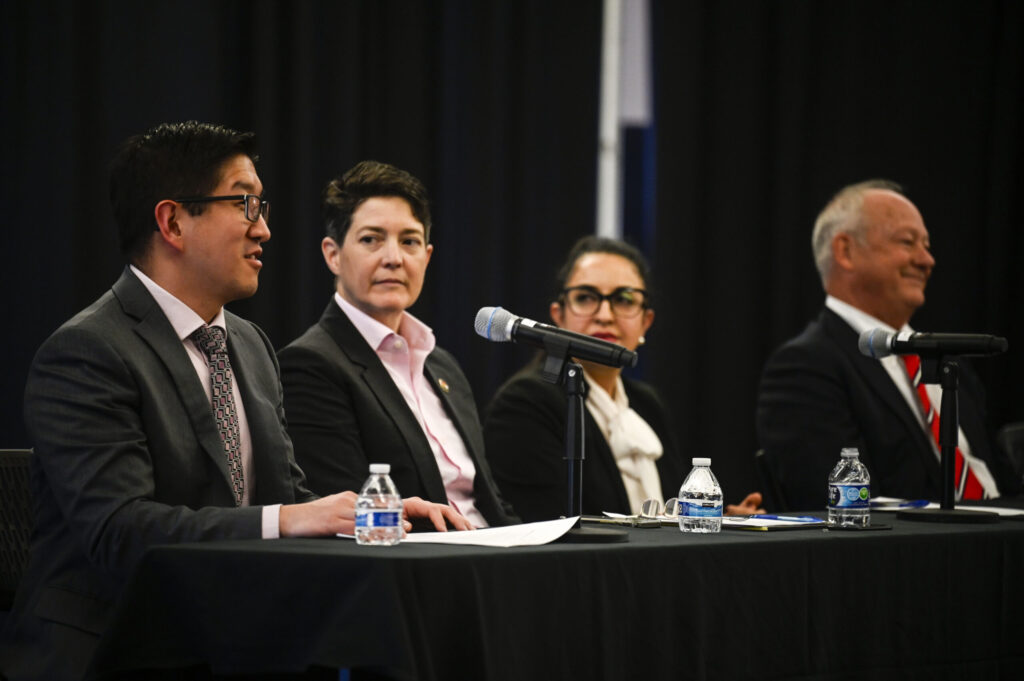
U.S. Magistrate Judge Cyrus Y. Chung described on Wednesday the various tactics he employs to resolve court cases, summing up his role with a laxative-based metaphor. “Someone told a group of us federal magistrate judges that magistrate judges are the...

Three cargo ships damaged by ‘projectiles’ in Strait of Hormuz
Brady Knox, Washington Examiner
brady.knox.washington.examiner@gazetteedit.wpenginepowered.com
Updated 15 hours ago
Three cargo ships were damaged by unspecified “projectiles” while navigating the Strait of Hormuz, jeopardizing President Donald Trump’s goal of preserving the shipping lane’s safety. The strait was de facto closed the morning hostilities began on Feb. 28, with announcements...

Trump calls on Thune to be a ‘leader’ and get the votes for the SAVE America Act
NAOMI LIM Washington Examiner
naomi-lim-washington-examiner@coloradopolitics.com
Updated 15 hours ago
President Donald Trump increased pressure on Senate Majority Leader John Thune (R-SD) to pass the SAVE America Act, imploring him to be a “leader” after he expressed concerns that there is not enough support for the measure in his chamber....
The ‘talking filibuster,’ explained
Molly Parks, Washington Examiner
molly.parks.washington.examiner@gazetteedit.wpenginepowered.com
Updated 15 hours ago
Senate Republicans have for weeks been debating the use of the “talking filibuster” to guarantee the passage of the SAVE America Act in the upper chamber, after President Donald Trump called the legislation his “No. 1” priority. The bill, which...
Colorado’s Polis joins coalition of governors urging Congress to reject Trump tariffs
Marissa Ventrelli
marissa.ventrelli@coloradopolitics.com
Updated 11 hours ago
Colorado Gov. Jared Polis has joined 18 other governors in writing a letter to members of Congress, urging them to reject President Donald Trump’s efforts to codify tariffs that the U.S. Supreme Court recently invalidated. “Governors across the country are...

Department of Agriculture warns of packages holding potentially invasive seeds
Michael Braithwaite
michael.braithwaite@gazette.com
Updated 10 hours ago
Spring planting is around the corner, and the Colorado Department of Agriculture wants residents to know where their seeds are coming from. Officials with the department warned Tuesday that they received reports of unsolicited packages containing plant seeds mailed internationally...

Federal judge hears ICE agents’ confusion about law, injunction on warrantless arrests
Michael Karlik
michael.karlik@coloradopolitics.com
Updated 1 day ago
A federal judge heard testimony on Tuesday from U.S. Customs and Immigration Enforcement agents in Colorado, who had trouble describing the requirements of his recent injunction and the training they received on making warrantless arrests pursuant to the law. On...

10th Circuit dismisses challenge to Colorado legislature’s decorum rules
Michael Karlik
michael.karlik@coloradopolitics.com
Updated 18 hours ago
The Denver-based federal appeals court concluded on Tuesday that Colorado lawmakers cannot be sued for creating and enforcing rules of decorum that circumscribe the public commentary allowed at legislative committee hearings. A three-judge panel of the U.S. Court of Appeals...
U.S. energy secretary warns Colorado’s energy policies could drive up prices, deter businesses
Scott Weiser
scott.weiser@gazette.com
Updated 13 hours ago
U.S. Energy Secretary Chris Wright on Monday warned that Colorado’s energy policies could lead to higher electricity prices and deter businesses, such as data centers, from locating in the state. Wright, a former executive of a Colorado-based energy company tapped...
PREV
PREVIOUS

Denver auditor: City bidding practices lack safeguards against political favoritism
Denver Auditor Timothy O’Brien.Larry Laszlo Denver City Auditor Timothy O’Brien has released a report that found city purchasing practices are too susceptible to political influence and contracting errors. The report, released Thursday, zeroed in on a city’s practice of not requiring vendors seeking to do business with the city to submit political contribution reports when […]

Bennet, Gardner split on Saudi arms sales block (VIDEO)
WASHINGTON – The U.S. Senate has voted to block the Trump administration from selling arms to Saudi Arabia, launching a new challenge to President Donald Trump’s alliance with the country amid rising tensions in the Middle East. Colorado’s senators split on the block, with Democrat Michael Bennet voting in favor of stopping arms sales and […]