

U.S. Senate bill would require national database of police shootings

WASHINGTON, D.C. – A bill pending in Congress would compel states to report details of fatal police shootings, like three in Colorado this month, to a national database.
The bill would require states to identify the persons involved in the shootings, specifics of the incidents and whether police acted appropriately.
The bill was introduced by U.S. Sen. Tim Scott, R-South Carolina, who said the government currently has no database that would allow the public to keep track of fatal police shootings. He said the database is a matter of government accountability.
Three fatal shootings by police have been reported in Colorado so far this month. The most recent such death was in Denver on March 19.
According to news reports, police were searching for a man wanted on an attempted-murder charge who earlier had escaped from Denver sheriff’s deputies at Denver Health medical center – a search that led them to an Aurora home. When an SUV was driven away from the home at high speed, police pursued it.
The driver was identified by authorities as 23-year-old Steven Nguyen, who was wanted on drug and firearms charges, but he was not the man police were trying to find. He was shot and killed by police, who reportedly fired because they thought he was looking for a gun inside the vehicle. Three officers involved in the shooting have been placed on administrative leave pending an investigation.
In a March 12 shooting, police killed a robbery suspect who barricaded himself in a Colorado Springs motel room with a female hostage, The Gazette of Colorado Springs reported. After negotiations with a crisis negotiator failed, police forced their way into the room and shot the man, identified as Corky Lee Oliver. The woman suffered injuries that were not life-threatening.
In a March 6 police shooting, two Pueblo police officers said they were chasing a man on foot after confronting him about his alleged violation of a restraining order. Police said he pulled a gun on them. Both officers fired, killing the man at the scene.
Support or opposition to the idea of a national database was moderate among spokespersons for some of Colorado’s political leaders.
“Whether we’re examining marijuana, climate change or crime, good policy decisions depend on good data to provide accurate information on what is or isn’t occurring in our communities,” said Jacque Montgomery, spokeswoman for Colorado Gov. John Hickenlooper.
Daniel Bucheli, spokesman for Colorado U.S. Rep. Mike Coffman, R-Aurora, said, “Rep. Coffman believes it’s important to continue the dialogue between police and the communities they protect and serve. In (Coffman’s 6th Congressional District), the police and the local community have a strong bond and trusting relationship and that is something the police are proud of. In his district, such a database isn’t something that seems necessary right now.”
Part of the motivation for the bill came from a 2016 U.S. Bureau of Justice Statistics report that found the killings of about 545 people by local and state police each year never were counted in national crime records.
Official FBI reports listed an average of 383 people killed by police each year. The new estimate is 928 people killed by police annually in the eight years prior to the report.
An Obama administration task force on policing recommended better data collection as part of its suggestions on criminal justice reform.
President Barack Obama said after meeting with the task force, “There was a great emphasis on the need to collect more data. Right now, we do not have a good sense, and local communities do not have a good sense, of how frequently there may be interactions with police and community members that result in a death, result in a shooting.”
Obama administration U.S. Attorney General Loretta Lynch announced creation of a voluntary federal database of police shootings. However, it was not required by law and has largely been ignored by the Trump administration’s Justice Department.
Instead, the reports have come largely from the news media. The most famous was a Washington Post report that found 995 police killings in 2015; 963 in 2016; and 987 in 2017.
Scott, the senator who introduced the bill for the national database with U.S. Sen. Charles Grassley, R-Iowa, called it the Walter Scott Notification Act.
He named it after an unarmed man who was shot and killed when he ran from a police officer who pulled him over for a broken brake light. The police officer was sentenced to 20 years in prison in December. A bystander’s video proved it was an unwarranted police killing, according to news reports.
Walter Scott is no relation to Sen. Tim Scott, who said the proposed legislation would “better address the issues that lead to officer-related shooting deaths. I believe this can help us keep both our officers and our communities safer.”
States that fail to comply with the reporting requirements would face a 10 percent reduction in federal law enforcement grants and funds.
Concern about police accountability was heightened last week when two Sacramento officers shot and killed a 22-year-old man in his grandparents’ backyard. They believed he was holding a gun. In fact, he had no gun. He was holding his cellphone, according to news reports.
Police believed he had been breaking car windows in the area, which is disputed by his family. The shooting led to tense demonstrations and confrontations with police.


Colorado legislators consider $500 million in general fund cuts amid $1.5 billion deficit
Marianne Goodland
marianne.goodland@coloradopolitics.com
Updated 10 hours ago
The legislature’s Joint Budget Committee is working through a list Wednesday of about 150 suggestions to cut as much as $1.5 billion in general fund dollars out of next year’s budget. The largest on the list prepared by JBC staff...
Colorado’s push for affordable housing continues as Gov. Polis signs HOME Act, workforce housing bill
Marissa Ventrelli
marissa.ventrelli@coloradopolitics.com
Updated 10 hours ago
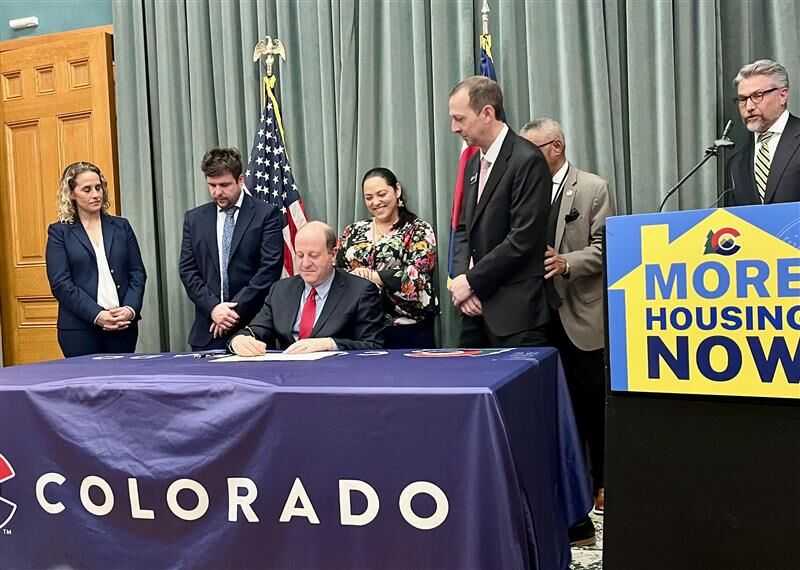
Gov. Jared Polis held the first public bill signing of the 2026 legislative session on Wednesday, signing a pair of housing measures into law. The bills — House Bill 1001 and Senate Bill 001 — are part of Democrats’ affordable...
Colorado farmers begin spring planting season with soaring fertilizer costs and price-gouging fears
Marianne Goodland
marianne.goodland@coloradopolitics.com
Updated 11 hours ago
As Colorado farmers prepare their fields for spring planting, many are sounding the alarm over fertilizer prices that have surged far beyond what they say global supply disruptions can explain. With nitrogen costs up 30% in a matter of days,...
Federal judge refuses to authorize immediate appeal in World Cup trafficking lawsuit
Michael Karlik
michael.karlik@coloradopolitics.com
Updated 11 hours ago
A federal judge declined to authorize an immediate appeal last week of a prior decision allowing companies operating out of Colorado to be sued for allegedly participating in a human trafficking venture involving Filipino laborers who constructed facilities for the...

Colorado lawmakers approve $150,000 ibogaine study bill targeting PTSD and addiction
Marissa Ventrelli
marissa.ventrelli@coloradopolitics.com
Updated 11 hours ago
The Colorado House Health and Human Services Committee advanced a bill that would create a $150,000 research pilot program to study the safety and effectiveness of ibogaine, a psychoactive compound that claims to treat post-traumatic stress disorder, opioid addiction, and...
Federal judge considers second round of sanctions against ex-Colorado judicial discipline director
Michael Karlik
michael.karlik@coloradopolitics.com
Updated 14 hours ago
A federal judge ordered Colorado’s former judicial discipline director on Tuesday to explain why she should not sanction him a second time for filing documents for improper purposes, such as harassment or delay. U.S. District Court Senior Judge Kathryn H....
Colorado Democrats want large corporations to pay fee if employees are on Medicaid
Marianne Goodland
marianne.goodland@coloradopolitics.com
Updated 10 hours ago
Democrats are seeking to require Colorado’s largest corporations to pay thousands of dollars for each employee that relies on the Medicaid program for health insurance. They don’t have to pay the fee if they can demonstrate offering an “affordable health...

Colorado justices agree to review insurance question that has divided federal judges
Michael Karlik
michael.karlik@coloradopolitics.com
Updated 19 hours ago
The Colorado Supreme Court granted a federal judge’s request on Friday to address an issue that has produced conflicting answers in policyholders’ lawsuits against insurance companies over unpaid benefits. “Parties (and judges) regularly spend undue time and money fighting in...

Farmworker overtime bill advances after lengthy debate in Colorado Senate
Marianne Goodland
marianne.goodland@coloradopolitics.com
Updated 1 day ago
The Colorado Senate on Tuesday narrowly advanced a bill to raise the overtime threshold for agricultural workers, defeating more than a dozen amendments from its leading opponent aimed at rewriting the measure. As introduced, Senate Bill 121 would raise the threshold for...

Colorado Agriculture Day: A feast for the ears, eyes and stomachs
Marianne Goodland
marianne.goodland@coloradopolitics.com
Updated 1 day ago
Gov. Jared Polis, legislators and friends of agriculture gathered at the state Capitol on Tuesday to celebrate Colorado Agriculture Day. The annual recognition of the contributions of Colorado farmers, ranchers and agribusiness drew hundreds to the Capitol’s west foyer, where...
PREV
PREVIOUS
The Pueblo Chieftain: Pull trigger on surplus school sales
Pueblo City Schools (D60) faces a lot of tough decisions that require extensive study and careful deliberations. Getting rid of surplus properties shouldn’t be one of them. It’s really a no-brainer that D60 should sell properties it no longer plans to use, as quickly as possible. Last week, D60’s board of education received an update […]
Report on sexual harassment allegations against Baumgardner raises questions of credibility
DENVER – The Jan. 18 report on a series of sexual harassment allegations against Colorado state Sen. Randy Baumgardner of Hot Sulphur Springs shows an investigator conflicted over the “he said, she said” nature of the allegations and a lack of witnesses to back up the complainant’s side of the events. As a result, the […]