

Legislature moving at the speed of fiber to get internet service to rural Colorado

After years of frustration over slow or non-existent broadband service in rural Colorado, the General Assembly is poised to move at the speed of fiber optic to finally connect rural communities, and economic opportunity, to the Internet.
In the past week, another measure that would make high-speed broadband service possible for rural schools, homes and businesses passed the House and is on its way to the Senate.
House Bill 1099, according to its proponents, is not only about high-speed internet service. It’s also an assist in rural economic development.
The bill is about something known as the right of first refusal. It works like this: a small telecom provider makes a bid to the state’s broadband deployment fund to provide high-speed service in a rural community. The company wants to put in fiber optic cable, the fastest service currently available.
But another telecom company has been in the area longer – as a phone provider, for example – and has that right of first refusal. That means they can swoop in and bid to provide that internet service, and take over the grant.
That’s what happened last year in Ridgway, in southwestern Colorado’s Ouray County. Elevate, a new telecom provider operated by the local non-profit Delta-Montrose Electric Association co-op, won a grant to provide high speed fiber optic service to about 2,000-area residents and businesses. The service would have reached speeds at one gigabyte, among the fastest currently available.
But CenturyLink has been operating in the area for years, so the company exercised its right of first refusal and took the broadband grant. And they elected to provide internet service through copper lines. That’s about 10 times slower than fiber optic and can be more expensive to customers.
That’s not fair to the customers or to the business that wanted to provide the better service, according to the bill’s sponsors, Republican Rep. Marc Catlin of Montrose and Democratic Rep. Barbara McLachlan of Durango.
House Bill 1099 won’t take away that right of first refusal. But it would mandate that the companies exercising that right provide service equal to or better than the original bid and at the same or lower cost.
“These communities are doing everything they can to get into modern world” with small entrepreneurs figuring out how to do it, Catlin told the House Transportation and Energy Committee last month. This is a just about fair play, he added.
Local telecom in rural communities isn’t only about faster service, according to Virginia Harmon of Elevate. They’re also providing communities with rural economic development. Harmon noted that 60 laid-off coal miners have found jobs with contractors putting in fiber optic lines.
If the bill passes, “the next time we get a grant, we can rest assured that if the incumbent provider exercises right of first refusal, our rural friends and families won’t be shortchanged with slow speed and outdated technology,” she said.
The bill drew little opposition in its passage through the transportation committee. The Colorado Telecommunications Association, which represents about two dozen small telecom companies, raised concerns that its members, which serve about 30 percent of the state by geography but only about 30,0000 customers, would not be able to compete with companies offering high speed service. CenturyLink and Comcast are also opposed but did not testify.
The House approved the measure on a 61-2 vote last week.
The most significant broadband bill of the session, Senate Bill 2, is awaiting a vote from the House Agriculture, Livestock and Natural Resources committee Monday.
Senate Bill 2 would transfer dollars currently routed to the state’s High Cost Support Mechanism (HCSM) to the broadband deployment fund. The HCSM, which is a surcharge paid by customers for voice service, currently brings in about $35 million per year, and most of those dollars go to CenturyLink as the phone provider of last resort. Under SB 2, 60 percent of those dollars would go the broadband fund in 2019 and by 2023 all of those dollars would transfer to that fund.
The bill also mandates that those who want to provide internet service do so at faster speeds than what’s currently available. For unserved communities, the speed of service would be at 10 megabits for downloading and one megabit up. That’s not terribly fast, and for now is below the standard set by the Federal Communication Commission, which wants to see 25 down and 3 up. But it’s a good start for communities that currently get no service at all or service so slow that only email is possible.
The House Ag Committee is expected to take action on the bill Monday afternoon.



Trump administration seeks to roll back protections for imperiled species | OUT WEST ROUNDUP
The Associated Press
the-associated-press@coloradopolitics.com
Updated 3 days ago
MONTANA Endangered species rollback sought BILLINGS — President Donald Trump’s administration moved on Nov. 19 to roll back protections for imperiled species and the places they live, reviving a suite of changes to Endangered Species Act regulations from the Republican’s...

Clash of the titans: Democratic race for governor pits two candidates similar in focus, but very different in style | Vince Bzdek
Vince Bzdek
vince.bzdek@gazette.com
Updated 10 hours ago
By Vince Bzdek The race for governor is shaping up to be a clash of Democratic titans, U.S. Sen. Michael Bennet and Attorney General Phil Weiser. They are two of Colorado’s highest profile politicians with deep track records who...

Calendar Dec. 8-14
Rachael Wright
rachael.wright@coloradopolitics.com
Updated 4 days ago
CoPo’s weekly political calendar will help you find political and public-policy events throughout Colorado. It includes candidate and issue campaign events, public policy meetings, court hearings, state and local party conventions, assemblies, debates, rallies, parades, speaking engagements, traveling dignitary appearances,...
GOP chair candidates circle Benson, statehouse candidate alleges SOS voter fraud | A LOOK BACK
Rachael Wright
rachael.wright@coloradopolitics.com
Updated 4 days ago
Thirty-Five Years Ago This Week: Although Colorado Republican Party Chairman Bruce Benson had told one of his predecessors that he hadn’t yet made up his mind as to whether he’d run for a third term, party insiders had already begun...
Dear Abby: A better answer to your question | SONDERMANN
Eric Sondermann
eric-sondermann@coloradopolitics.com
Updated 2 days ago
It was the beginning of October. I had been invited to speak to a class on political journalism at Colorado College, my old alma mater. The class was taught by none other than Vince Bzdek, the editor-in-chief of this paper...

Federal judge declines to order Denver to let police critic apply for review board
Michael Karlik
michael.karlik@coloradopolitics.com
Updated 6 hours ago
A federal judge declined on Friday to order that Denver permit a longtime police critic to apply to join the board tasked with reviewing officers’ use of force. Regan Benson sought to become one of the two community members on...
Flags lowered, colors raised: Colorado leaders and friends celebrate Sen. Faith Winter’s life
Marianne Goodland
marianne.goodland@coloradopolitics.com
Updated 2 days ago
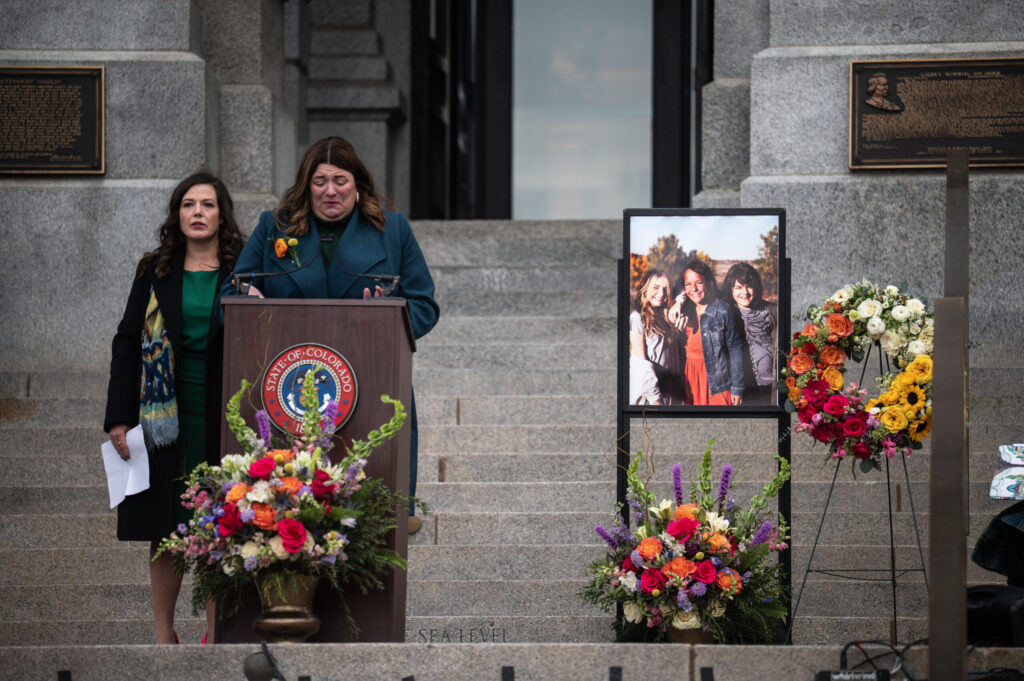
It was the colors that stood out as hundreds braved the cold on Friday to celebrate the life of Sen. Faith Winter, who died in a two-car crash on Nov. 26. Flags at the state Capitol flew at half-staff at...
Colorado Supreme Court to hear case on ballot measure disclosure requirements
Marissa Ventrelli
marissa.ventrelli@coloradopolitics.com
Updated 2 days ago
The Colorado Supreme Court has agreed to hear a case challenging whether the state can require ballot measure committees to disclose the names of their registered agents in election communications. The case stems from a complaint filed during the 2020...
Divided 10th Circuit orders pretrial release of defendant facing drug charges
Michael Karlik
michael.karlik@coloradopolitics.com
Updated 2 days ago
The Denver-based federal appeals court overturned a judge’s order keeping a defendant in custody pending trial on Friday, ruling 2-1 that she was entitled to release under the law. Erika Esmeralda Garcia stands accused of two charges related to the...

Trump finally gets his peace prize as FIFA hands him inaugural award at World Cup draw
Christian Datoc and Mabinty Quarshie, Washington Examiner
christian.datoc.and.mabinty.quarshie.washington.examiner@gazetteedit.wpenginepowered.com
Updated 2 days ago
President Donald Trump has long said he is unbothered by being snubbed for a Nobel Peace Prize. However, that did not stop his friend and FIFA President Gianni Infantino from handing him an award and a medal on Friday, seemingly created just...
PREV
PREVIOUS

Widespread walkouts expected as Colorado Springs-area students observe Florida shootings
Shortly after the Feb. 14 mass shooting at a high school in Parkland, Fla., Deanna Cooper sat on the floor of a Coronado High School classroom with her back pressed against a wall. The senior squeezed her eyes shut and took a few deep breaths. The school was undergoing a “shelter in place” drill, an […]

Q&A with Kelly Maher: Politics needs 'more than a tweet and a bullhorn' — and a little more humor, too
It’s easy enough to find someone who can get you hoppin’ mad over politics; easier still to find someone who’ll bore you into a coma. Just invite your least favorite uncle over for a beer, tell him you missed Rush today, and ask him to fill you in. But to find someone who can talk […]