

Marilyn Marks is back, and she has the ballot selfie in focus
Look who’s back in the game: Marilyn Marks, the thorn in the side of election officials whose protocols she scrutinizes and of the fellow Colorado Republicans she grills.
She’s been caring for her mother back east the past couple of years. Her mother recently passed.
She is a scrappy Southerner “praised in some circles, vilified in others,” the Aspen Times wrote when she moved from the Roaring Fork Valley to Denver in 2015.
She was the runner-up for mayor in 2009 but spotted so many weaknesses in the election system it became a mission for Marks. She founded an advocacy group, The Citizen Center, to take cases to court and she worked as a consultant to the state’s Libertarian Party.
When the state GOP was in turmoil in 2015, Marks was one of the bold-faced names on the roster asking questions.
Sometimes right, sometimes wrong, Marilyn Marks is never defeated.
She has a new target for her concern on how things are run in the Centennial State: the ballot selfie bill.
Though nobody enforces it, current law says you can’t tweet out a picture of yourself and your ballot saying, “Look, I wrote in Drew Carey for president!” or whatever. Hey, I didn’t tweet it out, OK?
It’s probably too late. House Bill 1014 to legalize the ballot selfie passed the state Senate Thursday, so it’s on its way to the governor’s desk to be signed into law. It had a pretty smooth ride, passing the House 31-4 and the Senate 62-2.
Marks considers that a fair fight.
“Not on his desk yet,” she said in an e-mail to me Sunday. “Takes 1-2 weeks to get there. And there is recall procedure before it goes. We are going to try that long shot and are starting a veto effort.”
Sunday night she e-mailed a letter to all 100 legislators. This is it. Is Marks on the mark, does she have a case?
Dear Colorado Lawmakers:
Major problems with the misnamed “ballot selfie” bill (HB17-1014) passed last week both undercut the intent of the bill and invite corruption of Colorado’s elections. A simple, no-cost solution has been overlooked.
I have explained the background of these seven serious bill problems below in the body of this letter:
No other state or modern democratic country permits the election activities that this bill permits. Most of these activities were banned in the late 1800’s as part of this nation’s election reform. Colorado lawmakers should fully deliberate whether citizens really support this broad rollback of voter protections to Boss Tweed times. The 125+ year old concepts of secret ballot rights are based on both a right and a duty to maintain a secret, anonymous ballot. The duty is mandatory to protect elections from corruption and voters from undue influence. The abiding concept for 125 years had been that a voter should never be able to prove how they voted. To do so invites election corruption. HB1014 fails because it retains the right, but not the duty of a secret ballot, -the fundamental principle of free and fair elections. Our elections must retain both the unshakable right and duty to stop a perversion of the democratic process. Please consider the destructive impacts of this bill and the opportunity to recall the bill before it reaches Governor Hickenlooper’s desk.
There is a simple no-cost solution that addresses the citizens’ demand for “ballot selfies.” I have explained it at the end of this letter.
I have listed seven major flaws in the bill, although there are numerous others.
We opponents are pleased with the remaining restrictions because sharing voted ballots (or posting ballot selfies) is clearly a danger to the integrity of the election, by encouraging voter intimidation and trading votes for favors. However, voters, proponents and supporters of the bill should not be fooled into believing that the bill is what the sponsors claimed or that sharing “selfies” is now protected by law.
A robust marketplace would likely develop for trading votes in Colorado as the traders would be able to prove the trades, not just rely on the honor system. The trade could be verified in numerous ways in Colorado-because voter can show the voted ballot to anyone via any means who can witness or notarize the accuracy of the voted ballot. There is nothing in the law to prevent this. It would be very hard to police when voted ballots can be displayed. In my view, this is institutionalized voter fraud.
It should be noted that the original bill as introduced included prohibitions on vote trading, but sponsors removed those prohibitions in amendments.
Electioneering statutes must be modified to permit the polling place electioneering provided in this bill. CORA laws that prohibit the disclosure of identifiable ballots must be amended to acknowledge that many ballots will be identifiable under this bill, and to make them available to the public after the election. Identifying one’s ballot should not reduce transparency of verification of the election.
No-cost solution-Almost all election officials publish copies of sample ballots on their websites. The old law can be amended simply to have the clerk clearly mark the website ballot as a sample. The voter may then download the unofficial ballot to share, post, email, etc. -which would not prove how he voted, but would allow his full political expression of his stated voting choice. Sponsors rejected this solution, insisting that voters should be able to prove how they vote. This should be reconsidered. No other changes to the existing law would be required. The bill can be recalled, and remedied with a brief substitute bill to provide sample ballots online.
I am happy to discuss this further if you have questions or comments.
Thank you for your consideration.
Marilyn Mark

Susie Wiles diagnosed with ‘early stage’ breast cancer: Trump
David Zimmermann Washington Examiner
davidzimmermannwashingtonexaminer@wpstage.coloradopolitics.com
Updated 1 hour ago
President Donald Trump announced White House chief of staff Susie Wiles has been diagnosed with “early stage” breast cancer and that she decided to take on the illness immediately. Wiles will not step down from her administrative role at this...
Hacked crosswalks in Denver sound anti-Trump messages
Deborah Grigsby
deborah.smith@denvergazette.com
Updated 22 minutes ago
Denver pedestrians got a surprise this weekend when the audio messages from push-button speakers on some crosswalks were mysteriously replaced with anti-President Donald Trump messages. “The walk signal is on, Trump … (reference to the Iran school that was bombed),”...

Federal judge formalizes injunction blocking USDA’s ‘pilot project’ for Colorado food assistance
Michael Karlik
michael.karlik@coloradopolitics.com
Updated 4 hours ago
A federal judge formalized his order on Monday to prevent the U.S. Department of Agriculture from requiring Colorado to participate in a food assistance “pilot project,” finding that it violates the law, the U.S. Constitution, and “the bounds of reasoned...

Colorado justices speak about inner workings of court, analysis of appellate opinions | COURT CRAWL
Michael Karlik
michael.karlik@coloradopolitics.com
Updated 4 hours ago
Welcome to Court Crawl, Colorado Politics’ roundup of news from the third branch of government. Members of the state Supreme Court provided an inside look at the workings of their institution, and a Colorado Politics analysis found that some appellate...
Appeals court finds no requirement for different judge to handle attorney-client conflict hearings
Michael Karlik
michael.karlik@coloradopolitics.com
Updated 5 hours ago
Colorado’s second-highest court rejected a defendant’s argument on Thursday that a judge improperly heard about a potential conflict between himself and his lawyer right before sentencing, and the man’s reaction could have “tainted” the sentencing decision. In September 2023, Anthony...

3,800 Colorado workers are on strike at JBS, one of the largest meatpacking plants in the US
Brittany Peterson
brittany.peterson@associatedpress.com
Updated 25 minutes ago
GREELEY, Colo. (AP) — About 3,800 workers at one of the nation’s largest meatpacking plants went on strike Monday in Colorado in what union representatives said was the first walkout at a U.S. beef slaughterhouse in four decades. Hundreds of...
The influencers? Some Colorado appeals judges outpace colleagues in setting legal precedent
Michael Karlik
michael.karlik@coloradopolitics.com
Updated 5 hours ago
A handful of judges on Colorado’s second-highest court are producing substantially more precedent-setting opinions than their colleagues, which create binding interpretations of the law that reach beyond individual cases. The Court of Appeals issues approximately 1,700 opinions each year. A...

What are metro districts?
Sage Kelley
sage.kelley@denvergazette.com
Updated 29 minutes ago
Created by the Special District Act of 1981 by the Colorado General Assembly, metro districts are quasi-governmental entities that didn’t really start showing up until the 2000s. Today, there are more than 2,400 across Colorado. A metro district is created...
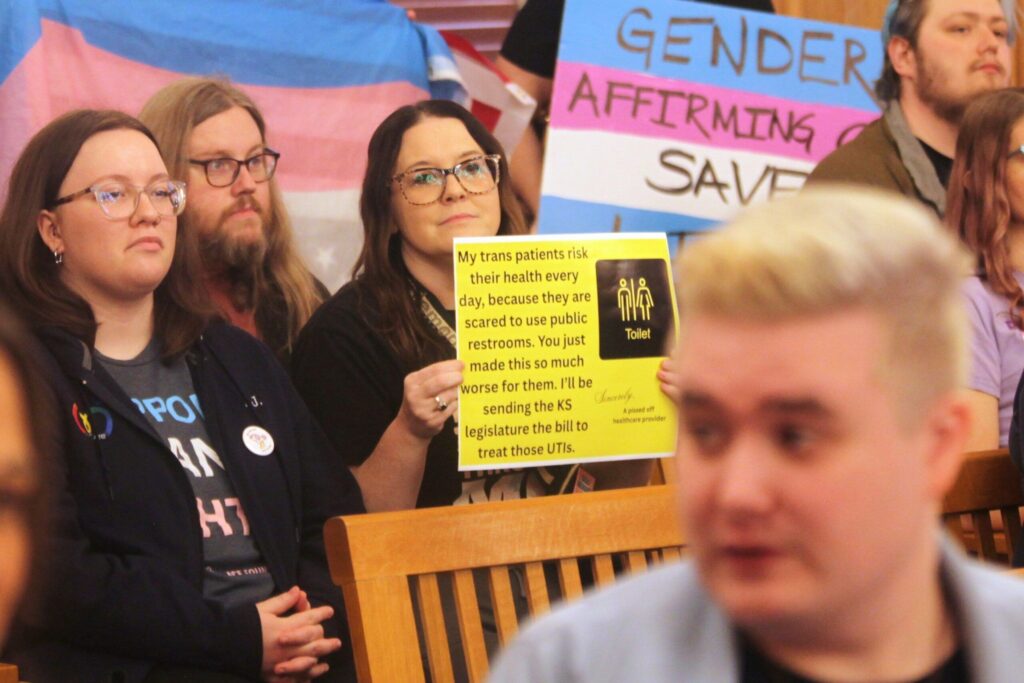
Law puts Kansas at vanguard of denying trans identities on government documents | OUT WEST ROUNDUP
The Associated Press
the-associated-press@coloradopolitics.com
Updated 12 minutes ago
KANSAS Law reverses trans documents TOPEKA — Kansas is set to invalidate about 1,700 driver’s licenses held by transgender residents and roughly as many birth certificates under a new law that goes beyond Republican-imposed restrictions in other states on listing...

DeGette challenger Melat Kiros trounces 15-term Democratic incumbent in Denver delegate vote
Ernest Luning
ernest.luning@coloradopolitics.com
Updated 1 day ago
The 28-year-old, first-time candidate challenging Democratic U.S. Rep. Diana DeGette in this year’s primary soundly defeated the 15-term incumbent in a delegate preference poll conducted Saturday at a county party assembly in Denver. Melat Kiros, the daughter of Ethiopian immigrants...
PREV
PREVIOUS

Denver Young Democrats' turmoil symbolic of party's struggle to rebuild
Last Tuesday evening in Denver, about 40 young Democrats gathered in a brewery for an “airing of grievances.” It was not a “festivus.” Sitting inside the backroom of the Diebolt Brewing Co., surrounded by fermentation tanks and the smell of yeast in this gentrified north Denver neighborhood, millennials sipped craft beer and sat on fold-out chairs […]
Insights: Hate crimes, is it too much to ask that the cops get it right?
Wait, that’s not already the law? It’s an apt response to a bill that would help ensure the state’s report on hate crimes is as accurate as it can be. Rep. Joe Salazar, the statehouse’s road warrior on civil rights, is sponsoring House Bill 1138, to require the state Department of Public Safety to scrutinize reports from […]