

Zarlengo: Relax, conservatives, Pope Francis didn’t call for progressive fix to climate change
Conservatives can breathe easy. Pope Francis’ recently released encyclical on the environment, Laudato Si, was expected by many to be a progressive environmentalist manifesto where Francis would reveal himself to be a true man of the left, injecting a new progressive force into the halls of the Vatican. Unfortunately for leftist progressives, who routinely cherry-pick and mistranslate his statements to serve their political agenda, Pope Francis once again demonstrated himself to be, well, a Catholic after all.
As one reads through the 184-page encyclical carefully, it becomes clear that the guiding purpose and theme of the encyclical was really all about preserving and protecting God’s greatest and most important creation – humanity. Pope Francis was particularly concerned with the poorest in the world and the most vulnerable, including the unborn.
There is no question that the Pope made statements that will please progressives and cause conservatives consternation. For example, the Pope accepted the idea that humans are contributing with natural causes to global warming through carbon-based emissions and suggested reinforced international treaties may be one solution to that problem.
However, what the progressive left would prefer to ignore is that Pope Francis also warned against imposing international control to a degree that would undermine the sovereignty of nations, he reaffirmed the Church’s defense of private property, and he warned against viewing all human intervention in the environment as a threat. In fact, Pope Francis made it explicitly clear that acknowledging mankind’s integrated connection with the environment is not to “put all living beings on the same level nor to deprive human beings of their unique worth and the tremendous responsibility it entails.”
Perhaps the best example of Pope Francis’ overriding theme was when he called out the progressive left for its hypocrisy with regard to abortion. Francis asks, “How can we genuinely teach the importance of concern for vulnerable beings, however troublesome or inconvenient they may be, if we fail to protect a human embryo, even when its presence is uncomfortable and creates difficulties?” Good question.
Even the solutions Pope Francis suggested to curb environmental damage and degradation were primarily human- and culture-focused rather than primarily reliant on government’s ability to solve problems. He calls for a change in culture, which, by its nature, must be done voluntarily, not under force of government. Overly selfish obsessions with technology, gadgets, personal pleasure, and meaningless items, at the expense of interpersonal relationships and the family, all contribute to this “culture of relativism” that Francis so eloquently calls out as “the same disorder which drives one person to take advantage of another, to treat others as mere objects, imposing forced labor on them or enslaving them to pay their debts.”
At the end of the day, do we have a moral responsibility to be good stewards of the Earth? Absolutely! Conservatives and progressives alike should agree on that. The question is how to be good stewards in practice. Catholic Church tradition teaches that when it comes to matters of faith and morals, the Pope speaks with his greatest authority. On matters of scientific conclusions and political mechanics, Catholics are allowed to accept or reject the Pope’s personal conclusions in good faith and good conscience.
But one thing is certain about Pope Francis’ position after reading Laudato Si: While humanity faces many crises and problems, the biggest crisis we face today is the degradation of our own humanity, and if we are going to be intellectually honest when it comes to fixing the world’s environmental problems, we best start fixing ourselves and our families.
Marc Zarlengo is a practicing attorney in the Denver area. He is a practicing Catholic and member of St. Thomas More Catholic Parish in Centennial.


Appeals court clarifies framework for parents’ First Amendment rights in child-naming disputes
Michael Karlik
michael.karlik@coloradopolitics.com
Updated 11 hours ago
Colorado’s second-highest court overturned a Jefferson County judge’s order last week in a long-running dispute about whether two ex-spouses must call their child by his first name or middle name outside the home. In doing so, a three-judge Court of...
10th Circuit judges recap do’s and don’ts for lawyers
Michael Karlik
michael.karlik@coloradopolitics.com
Updated 13 hours ago
Two members of the Denver-based federal appeals court spoke to attorneys on Monday about how to present cases effectively, and when it is helpful for outside entities to weigh in on pending appeals. Judges Robert E. Bacharach of Oklahoma and...
Trump administration awards rural health ‘transformation’ grants to all 50 states
Christian Datoc, Washington Examiner
christian.datoc.washington.examiner@gazetteedit.wpenginepowered.com
Updated 17 hours ago
The Trump administration announced hundreds of millions of dollars in new healthcare grants for all 50 states on Monday as part of a program launched by President Donald Trump’s One Big Beautiful Bill Act over the summer. The law allocated...
Divided appeals court overturns defendant’s $350,000 restitution obligation
Michael Karlik
michael.karlik@coloradopolitics.com
Updated 12 hours ago
Colorado’s second-highest court overturned a defendant’s obligation to pay nearly $350,000 in crime victim restitution last week because an Arapahoe County judge issued the restitution order beyond the legal deadline. The divided decision of a three-judge Court of Appeals panel...
Health insurers drift leftward in campaign donations even as they seek to sway GOP
Robert Schmad, Washington Examiner
robert.schmad.washington.examiner@gazetteedit.wpenginepowered.com
Updated 18 hours ago
Insurance lobbyists are working hard on Capitol Hill in an attempt to sway centrist Republicans into their camp as party leadership expresses strong skepticism toward extending enhanced Obamacare subsidies. As these lobbyists take meetings with GOP staffers and members, however,...

U.S. Rep. Lauren Boebert: On representing Colorado, working with Trump and releasing the Epstein files
Thelma Grimes
thelma.grimes@coloradopolitics.com
Updated 7 hours ago
For years, U.S. Rep. Lauren Boebert’s name has become a shorthand for controversy in her home state and in the nation’s capital. Recently, the outspoken Colorado Republican has drawn rare praise from some of her fiercest critics, particularly after breaking...

New jaguar spotted in Arizona points to progress in endangered species’ recovery | OUT WEST ROUNDUP
The Associated Press
the-associated-press@coloradopolitics.com
Updated 7 days ago
ARIZONA New jaguar spotted in wild The spots gave it away. Just like a human fingerprint, the rosette pattern on each jaguar is unique so researchers knew they had a new animal on their hands after reviewing images captured by...
8 exemplars to guide us into the new year | SONDERMANN
Eric Sondermann
eric-sondermann@coloradopolitics.com
Updated 6 days ago
It started as a one-off in my first year of writing this regular column. To ring in the new year back in the eventful year of 2020, I offered a shoutout to eight Coloradans who served as models of how...

Raids, pushback and TdA indictments defined Denver’s immigration story in 2025
Nico Brambila
nico.brambila@denvergazette.com
Updated 3 days ago
The Trump administration’s push for a large-scale, deportation effort — built around campaign warnings about Tren de Aragua, the Venezuelan prison gang that established a foothold in Colorado — collided with the realities on the ground in Denver, where raids...
Denver’s budget deficit shaped 2025 news coverage
Deborah Grigsby
deborah.smith@denvergazette.com
Updated 3 days ago
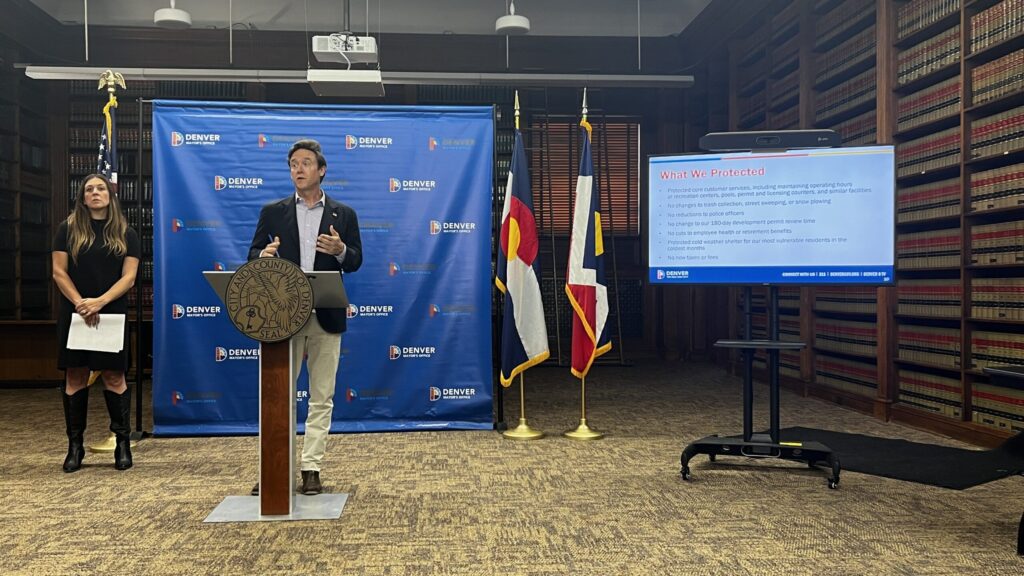
It was a year of big goals on a tight budget for the Mile High City, where Mayor Mike Johnston’s announcement of a $200 million city budget deficit dominated the news coverage. Facing a $50 million gap in its 2025...
PREV
PREVIOUS

Colorado conundrum: Growing economy could mean looming state budget shortfall
Colorado’s economy is performing so well, the state’s upcoming budget is expected to suffer. Wait, what? That’s according to budget forecasters who told state lawmakers last week that Colorado could end up with a $180 million budget shortfall at the end of 2016 fiscal year, in spite of the state experiencing its seventh consecutive year […]

Alonzo: Colorado well positioned to respond to papal encyclical on global warming
Last week the Colorado Latino Leadership, Advocacy and Research Organization (CLLARO) hosted a luncheon for faith leaders to discuss the moral implications of the Pope’s climate change encyclical and what Colorado’s faithful can do to support efforts such as the Clean Power Plan to alleviate the carbon pollution that is fueling global warming. The Pope […]