

A LOOK BACK | 40 years ago: ‘I’m sure there will be a woman vice president very soon’

Forty Years Ago This Week: Betty Rendel, president of the National Federation of Republican Women, traveled to Denver to personally check in on preparations for the national convention, which was rapidly approaching in September.
“The future of today’s more educated and highly trained young woman in the political arena is brighter than ever,” Rendel told reporters. “In fact, politics hold tremendous promise for a young woman today.”
Rendel argued that the greatest disadvantage women candidates for public office had faced in previous years was a reluctance to ask for money.
“But they’re getting over that,” Rendel told the Colorado Statesman. “They’re learning how to go out and ask for the money that they need. And men are willing to give to women candidates.”
The bias that women should be at home taking care of children was slowly slipping away, Rendel said, and women were, in her opinion, realizing that they could hold office as well as be a wife and mother.
“One of the best public offices for a young woman with children is being mayor. It’s a housekeeping-type office,” Rendel said, “with a crisis every minute. Women are well trained for that type of situation.”
Rendel admitted that there weren’t enough well-trained women in the public sphere to expect a woman president “in the near future, but I’m sure there will be a woman vice president soon.”
In other news, state Rep. David Skaggs, D-Boulder, said he was thoroughly exhausted after having waded through over 1,100 bills so far that legislative session. Many of his colleagues felt his pain with 41 other members of the House joining with him to co-sponsor a resolution limiting members to each be prime sponsor of just eight bills per session.
“It is time for some self-discipline to be exercised,” Skaggs said. “Unnecessary bills waste so much time.”
Skaggs told Statesman reporters that under the current rules, legislators could introduce an unlimited number of bills before the session began and then six more bills once the session started.
“The flood of bills coming onto the floor in the last two weeks – many of them trivial – has frustrated everybody,” Skaggs said. “The number of legislators who support my resolution reflects this frustration.”
According to Skaggs’ estimate, the 8-bill limit would save the state up to $500,000 a year in printing and staffing costs.
An anonymous insider quipped that “if there is a limit to the number of bills, certain committee chairmen won’t be able to kill bills in committee and say that there just wasn’t time to give them a hearing.”
Fifteen Years Ago: At the start of the special session on growth control, Gov. Bill Owens gave a “pep talk” to legislators – calling for “cooperation and compromise” and urging both parties to come up with a solution. There was no hiding that the message was significantly directed at Senate President Stan Matsunaka, D-Loveland, had refused to budge on growth control during the regular session and was seen as the chief reason the special session had been called.
“Let’s pass something we can agree on,” Owens said. “The partisan rhetoric can wait until next year.”
But mere minutes after Owens spoke, Matsunaka stood at his microphone in the Senate chamber and reaffirmed his dedication to binding urban service areas and preserving rural land uses outside cities.
“If we can’t pass legislation that will protect Colorado, then we sure as hell can make sure that nothing passes that will make it worse,” Matsunaka said.
Leaders of both parties had called for growth control legislation to avert another citizens’ initiative, but it wasn’t likely to happen as Democrats maintained a 18-17 majority in the Senate and Republicans a 38-27 hold on the House.
“We don’t want to pass one growth control law because we’re afraid of an initiative,” Matsunaka said.
Rachael Wright is the author of the Captain Savva Mystery series, with degrees in Political Science and History from Colorado Mesa University, and is a contributing writer to Colorado Politics and The Gazette.


Appeals court clarifies framework for parents’ First Amendment rights in child-naming disputes
Michael Karlik
michael.karlik@coloradopolitics.com
Updated 5 hours ago
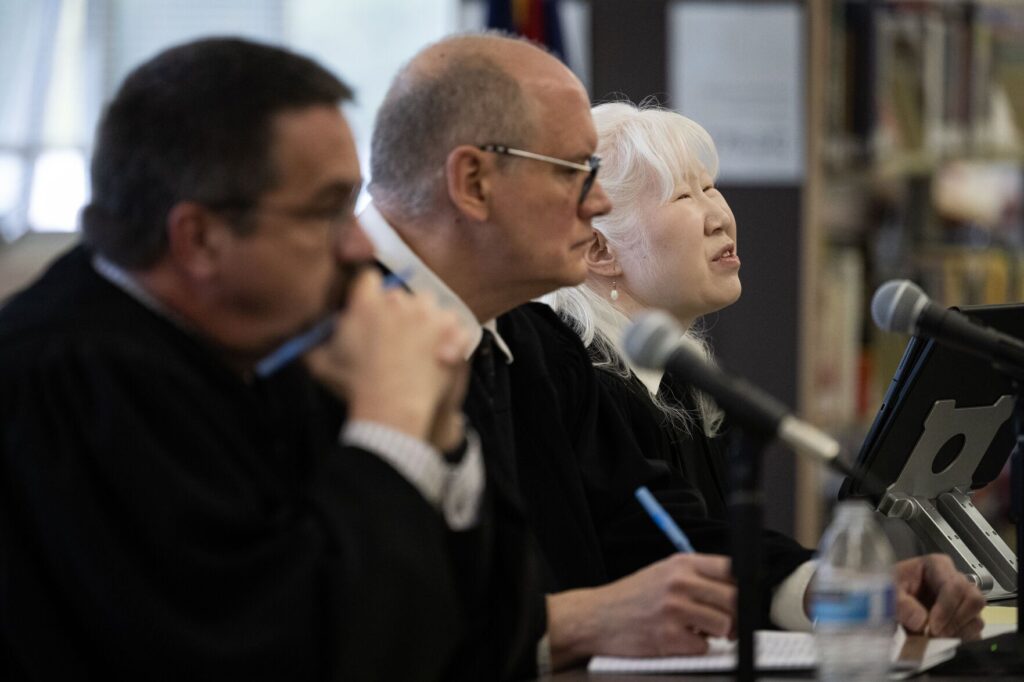
Colorado’s second-highest court overturned a Jefferson County judge’s order last week in a long-running dispute about whether two ex-spouses must call their child by his first name or middle name outside the home. In doing so, a three-judge Court of...

10th Circuit judges recap do’s and don’ts for lawyers
Michael Karlik
michael.karlik@coloradopolitics.com
Updated 7 hours ago
Two members of the Denver-based federal appeals court spoke to attorneys on Monday about how to present cases effectively, and when it is helpful for outside entities to weigh in on pending appeals. Judges Robert E. Bacharach of Oklahoma and...
Trump administration awards rural health ‘transformation’ grants to all 50 states
Christian Datoc, Washington Examiner
christian.datoc.washington.examiner@gazetteedit.wpenginepowered.com
Updated 11 hours ago
The Trump administration announced hundreds of millions of dollars in new healthcare grants for all 50 states on Monday as part of a program launched by President Donald Trump’s One Big Beautiful Bill Act over the summer. The law allocated...
Divided appeals court overturns defendant’s $350,000 restitution obligation
Michael Karlik
michael.karlik@coloradopolitics.com
Updated 7 hours ago
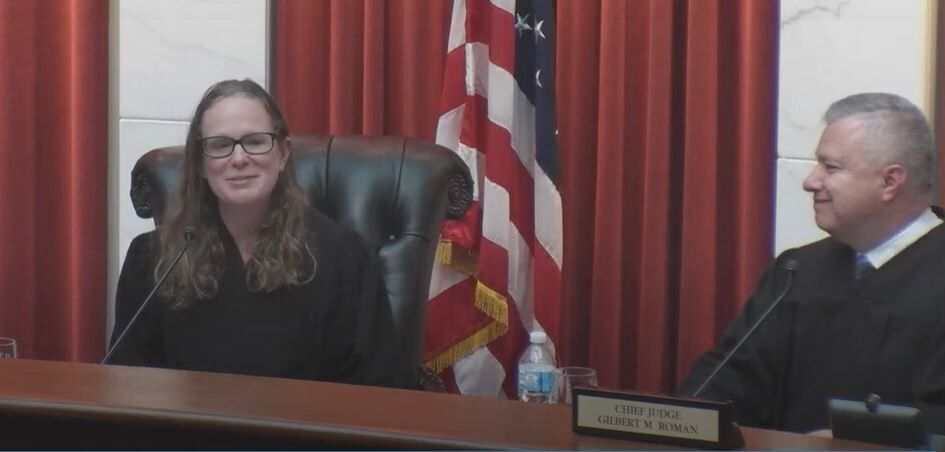
Colorado’s second-highest court overturned a defendant’s obligation to pay nearly $350,000 in crime victim restitution last week because an Arapahoe County judge issued the restitution order beyond the legal deadline. The divided decision of a three-judge Court of Appeals panel...

Health insurers drift leftward in campaign donations even as they seek to sway GOP
Robert Schmad, Washington Examiner
robert.schmad.washington.examiner@gazetteedit.wpenginepowered.com
Updated 12 hours ago
Insurance lobbyists are working hard on Capitol Hill in an attempt to sway centrist Republicans into their camp as party leadership expresses strong skepticism toward extending enhanced Obamacare subsidies. As these lobbyists take meetings with GOP staffers and members, however,...

U.S. Rep. Lauren Boebert: On representing Colorado, working with Trump and releasing the Epstein files
Thelma Grimes
thelma.grimes@coloradopolitics.com
Updated 2 hours ago
For years, U.S. Rep. Lauren Boebert’s name has become a shorthand for controversy in her home state and in the nation’s capital. Recently, the outspoken Colorado Republican has drawn rare praise from some of her fiercest critics, particularly after breaking...

New jaguar spotted in Arizona points to progress in endangered species’ recovery | OUT WEST ROUNDUP
The Associated Press
the-associated-press@coloradopolitics.com
Updated 6 days ago
ARIZONA New jaguar spotted in wild The spots gave it away. Just like a human fingerprint, the rosette pattern on each jaguar is unique so researchers knew they had a new animal on their hands after reviewing images captured by...
8 exemplars to guide us into the new year | SONDERMANN
Eric Sondermann
eric-sondermann@coloradopolitics.com
Updated 6 days ago
It started as a one-off in my first year of writing this regular column. To ring in the new year back in the eventful year of 2020, I offered a shoutout to eight Coloradans who served as models of how...

Raids, pushback and TdA indictments defined Denver’s immigration story in 2025
Nico Brambila
nico.brambila@denvergazette.com
Updated 2 days ago
The Trump administration’s push for a large-scale, deportation effort — built around campaign warnings about Tren de Aragua, the Venezuelan prison gang that established a foothold in Colorado — collided with the realities on the ground in Denver, where raids...
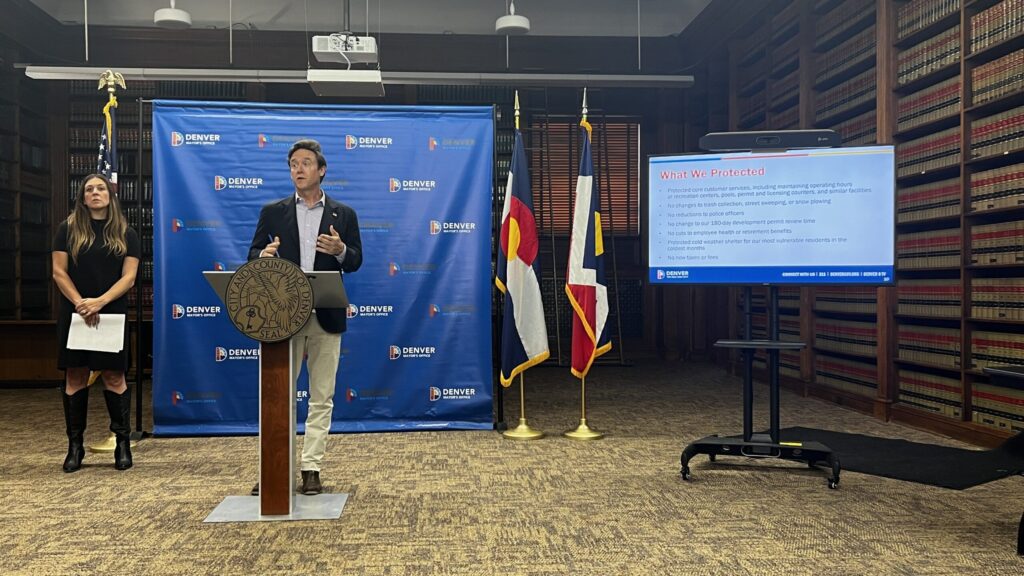
Denver’s budget deficit shaped 2025 news coverage
Deborah Grigsby
deborah.smith@denvergazette.com
Updated 2 days ago
It was a year of big goals on a tight budget for the Mile High City, where Mayor Mike Johnston’s announcement of a $200 million city budget deficit dominated the news coverage. Facing a $50 million gap in its 2025...
PREV
PREVIOUS

CAPITOL M, week of May 8, 2021 | Star Wars edition, and Rep. Gray left in stitches
The lighter side of the state Capitol, usually. May the Fourth is traditionally a celebration of all things Star Wars (tied to the pun “May the force be with you,” a line from the original movie). The state Capitol this week was no exception. A colorful assortment of Star Wars-themed ties – all tied to the […]

Court: Despite disability discrimination, man's conviction stands
Even if a Colorado judge had committed disability discrimination when he dismissed four hearing-impaired people from a jury pool, the federal appeals court based in Denver declined to overturn the defendant’s conviction, saying his lawyer handled the situation reasonably at trial. A three-member panel of the U.S. Court of Appeals for the 10th Circuit on […]