Who has the power to declare war?

Our constitutional framers boldly and ambitiously granted Congress the power to declare war yet granted the executive the responsibility, after war is declared, to supervise war as the commander-in-chief. That worked well until the Cold War began.
The U.S. has been involved in dozens of wars, antiterrorist operations and other military interventions over the past 80 years from Korea to Iran. Yet we have not declared war since 1942. We are unlikely to declare war this month.
Decisions about war and military interventions have shifted from Congress to the White House. Many members of Congress have regularly decried this rewriting of the Constitution.
A young congressman from Illinois named Abraham Lincoln in 1848 warned, “Allow the President to invade a neighboring nation whenever he shall deem it necessary for such purpose, and you allow him to make war at pleasure.”
Rep. Lincoln understood that the provision in the Constitution was assigned to Congress, because kings had always been involving and impoverishing their people in wars, pretending the good of the people was the intent. This was an oppression Americans wanted to prevent, and thus the framers designed our Republic as one where “no one man should hold the power” of bringing this kind of oppression upon the people.
Congress, frustrated by the costly and failed Vietnam War, tried to win back at least some of their war-making authority by crafting the War Powers Resolution of 1973. It was an earnest, yet compromised and probably ill-conceived congressional attempt, to reclaim its original Article 1 power.
Congress passed this resolution in 1973. President Richard Nixon vetoed it because he believed it was unconstitutional. Congress, in a rare move, passed it again in such strong numbers that they overrode Nixon’s veto. Recent presidents have generally agreed with Nixon and have mostly ignored this resolution, which is legally still in effect.
The resolution says a president can commit U.S. armed forces if a) Congress declares a war, b) Congress has approved a specific authorization for the use of military, or c) a national emergency has been created by an attack on the U.S. or its armed forces.
If this third event occurs a president, according to this resolution, is to report to Congress within 48 hours. Unless Congress declares war, the military engagement must be concluded within 60 days.
President Donald Trump did not ask Congress to declare war against Iran two weeks ago. He says he acted because “I think they would have attacked us.” He implied that Iran was likely to attack U.S. military installations in the Middle East and implied they might attack our country.
Moreover, he claimed Iran was moving quickly to produce nuclear weapons and that, because they are the world’s worst terrorist nation, this was an unacceptable threat to us as well as our allies in that region.
These factors motivated Trump to unilaterally initiate a massive military assault on Iran. He has, after the fact, consulted with a few senior congressional leaders and provided for some legislative briefings; yet, he has indicated no need for a declaration of war. And though he has occasionally referred to this as a war, he and his aides prefer to consider these joint efforts with Israel as an “excursion” or “operation.” One Trump-aligned U.S. senator says there is no need for a war declaration unless U.S. ground troops are sent in.
History may prove Trump to be right. Yet, he was at least initially unable to win public approval for this massive military operation and its assassination of dozens of Iranian leaders. This is in a stark contrast to public approval of or initial efforts in Korea, Iraq, Afghanistan and elsewhere.
This may be because Trump’s personal approval ratings are low. Or because this “war” was such a surprise and — this is more likely — Americans are understandably suspicious of getting into regime change and nation-building efforts that seem impossible for us to win.
Democrats with a handful of Republicans in the Congress tried unsuccessfully to insist that the Trump administration comply with the processes outlined in the War Powers Resolution of 1973. Trump refused.
The vote in the U.S. House was 219 to 212 and the vote in the Senate was 57 to 47, mostly along party lines, not to invoke the War Powers Resolution. This was largely a symbolic vote because Trump has the right to veto congressional actions, and Congress did not have the votes to override him.
Most U.S. allies reluctantly supported the U.S. or kept quiet about it. But Turkish President Recep Tayyip Erdogan and U.N. Secretary General Antonio Guterres called it a clear violation of international law and the U.N. Charter.
No one noted that it also violated President Gerald Ford’s executive order, signed in early 1976, establishing a formal ban on political assassinations by U.S. personnel. That order came about after congressional investigations uncovered multiple attempts by our intelligence operatives involved in assassinations in Cuba, the Congo, Vietnam and elsewhere.
Here are key challenges involved in who “decides” war and related military operations:
First, in 1789, the U.S. had a minuscule military and no overseas bases. Today, we have 750 military bases or installations in about 80 countries. We have 200,000 troops serving abroad. Our national security interests exist around the world not to mention our commercial and trade interests.
Second, in 1789, Congress was small: 26 senators and 65 House members. Many had been framers and/or soldiers in the Revolution. George Washington was their hero and now their president. But both he and they agreed with James Madison that those who conduct a war should not also be the proper judge of whether a war should be started.
Recent presidents have apparently not shared this earlier view and are distrustful of Congress as too large, too slow and leak prone. Trump recently said the primary check on his actions on the international stage is: “My own morality. My own mind. It’s the only thing that will stop me.”
A third challenge is that our country now has a vast network of intelligence gathering and spy agencies, 18 of them including the CIA, and they report to the White House. We have about 100 CIA “stations” abroad and perhaps as many as 25,000 intelligence operatives overseas. There are also countless satellites.
Congress may fund these, but Congress has no overseas operations and merely a few hundred staffers to counsel them. Congress, nowadays, depends on the executive branch for its international intelligence.
Yet another reason Congress has a challenging time exercising its war declaring power is that presidents suggest that any effort by Congress to counter a president’s military “operations,” by either strictly enforcing the War Powers Resolution or cutting off funding (or voting against supplemental budget requests), puts our military service people in harm’s way and unpatriotically threatens American lives and national security.
The well-intentioned War Powers Resolution was aspirational, yet has not worked. Some people understandably believe its unintended consequence in effect yielded more political leeway for military decision making to the White House.
There have been attempts to change things. A bipartisan study commission in 2008 co-chaired by two respected former secretaries of state, James A. Baker and Warren Christopher, called for the repeal of the War Powers Resolution.
It proposed instead a law to be called the “War Powers Consultation Act.” It was backed by Republican Sen. John McCain and Democratic Sen. Tim Kaine. Congress gave it respectful hearings but did not enact it into law.
The Baker-Christopher report tried to find a realistic, 21st-century “sweet spot” recognizing new realities. It would have required formal consultation between a president and Congress before a major military engagement. It would have created a permanent congressional consultation committee whose members would have the highest security clearances. It defined a significant armed conflict as operations lasting more than a week, and it required Congress to vote within 30 days as to whether it approved of the military operation.
This new reform to reclaim Congress’ role in the war making process failed. Some believed it gave too much power to presidents. Some wanted to try to make the 1973 Resolution work. Others recognized that too much had changed to correct course. One symbol of this is that the “football” with the code to launch a nuclear retaliation is always within a few feet of the president.
What now? Congress should keep trying to find an appropriate way to share this power. The framers may have been idealistic, yet they, and Madison and Lincoln, were right to be worried about this matter. Debates about who can decide when we are in war will inevitably continue as long as our constitutional republic survives — and this should be the case.
News columnists Tom Cronin and Bob Loevy regularly write about Colorado and national politics.


The delicate, ever-changing dance between politics and religion | SONDERMANN
Eric Sondermann for Colorado Politics
eric_sondermann_for_colorado_politics@coloradopolitics.com
Updated 2 days ago
The dance, really a marathon that brings to mind the classic movie “They Shoot Horses, Don’t They?”, has been going on as long as there have been governments and organized religion. That is to say that this delicate tango has...
Roasts, get yer roasts, here: Capitol M | Week of March 14, 2026
Marianne Goodland
marianne.goodland@coloradopolitics.com
Updated 3 days ago
The lighter side of the Capitol, especially in the past week Apparently, the pending and eventual switch to daylight stupid time has put people in some pretty funny moods. And thank goodness! On March 4, the Senate approved the appointments...

The backstory behind the school-funding TABOR ballot initiative | Paula Noonan
Paula Noonan
paula-noonan@coloradopolitics.com
Updated 3 days ago
Last session, the General Assembly took in a report on K-12 public school funding. The legislature ordered the report because an idea circulated Colorado was among the bottom five states in dollars allocated per student even though it is one...

You get what you pay for in your state reps | Hal Bidlack
Hal Bidlack
hal-bidlack@coloradopolitics.com
Updated 4 days ago
My regular readers will know of my affection for the Out West Roundup, a Colorado Politics feature that lets us keep up to date with the goings on out here in the western U.S., and draws attention to stories that...

Colorado’s GOP at its best — and worst | Dick Wadhams
Dick Wadhams
dick-wadhams@coloradopolitics.com
Updated 3 days ago
By Dick Wadhams Colorado Republicans are fighting to be relevant in the face of gross mismanagement by Democrats who totally control state government. While the Colorado Republican Party is mired in controversy, several Republican elected officials and candidates represent the...

Someone’s lying in latest activist embarrassment for Polis’ CPW Commission | Rachel Gabel
Rachel Gabel
rachel-gabel@coloradopolitics.com
Updated 7 days ago
Either Samantha Miller is lying, or Gov. Jared Polis is. If Miller is lying, she is so secure in the red carpet rolled out for animal activists by this administration she is willing to put words in the governor’s mouth....

Ask Secretary of State candidates if they’re in favor of independent election audits | Jon Caldara
Jon Caldara
jon-caldara@coloradopolitics.com
Updated 1 week ago
This part will disappoint angry people on Twitter: Relax. Put the pitchforks down. I am not relitigating the 2020 election or mail ballots or even Tina Peters. But I am saying people don’t trust elections like they used to. And...

Redistricting plan to give Colorado Dems 7 members of the U.S. House will split El Paso County | Bob Loevy
Bob Loevy
bob-loevy@coloradopolitics.com
Updated 7 days ago
A proposed redistricting plan, which would give Colorado seven Democratic members of the U.S. House of Representatives and only one Republican, will split El Paso County into two parts and thereby weaken the county’s influence in Congress. El Paso County,...

Can deliberation save democracy? | Vince Bzdek
Vince Bzdek
vince.bzdek@gazette.com
Updated 5 days ago
In September 2019, 523 Americans traveled to Dallas for an experiment called “America in One Room.” The gathering was designed to test a theory: Could representative citizens deliberate productively even in an era of intense polarization? The event focused on...
Redistricting scheme would give Colorado Democrats seven House members, split El Paso County | Bob Loevy
Bob Loevy
bob-loevy@coloradopolitics.com
Updated 6 days ago
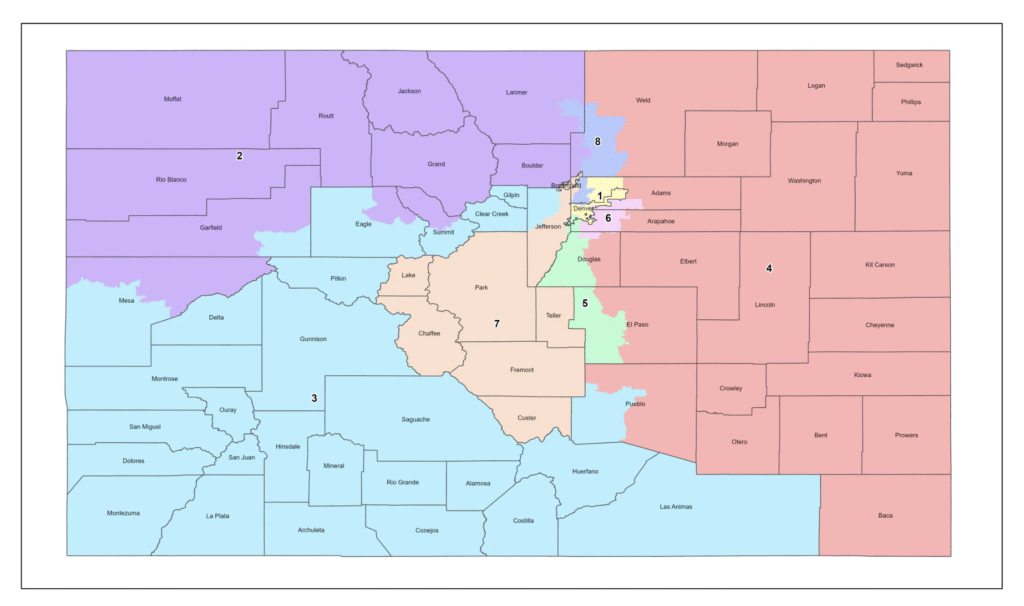
A proposed redistricting plan, which could give Colorado seven Democratic members of the U.S. House of Representatives and only one Republican, would split El Paso County into two parts and thereby weaken the county’s influence in Congress. El Paso County,...