

Colorado justices reject media request for police officer records on narrow grounds
At the same time the Colorado Supreme Court found that two media outlets were properly denied access to records bearing on police officers’ misconduct, it declined to endorse an interpretation of state law that would have enabled non-law enforcement entities to shield their documents by labeling themselves “criminal justice agencies.”
Instead, the justices on Monday concluded that label applies to one particular licensing agency, the Peace Officer Standards and Training (POST) Board. As a result, POST’s records certifying and decertifying law enforcement officers are subject to more stringent disclosure guidelines.
Previously, the state’s Court of Appeals concluded POST met the definition of a criminal justice agency. However, the appellate court reasoned that POST’s collection and storage of criminal records during the decertification process fulfilled the requirement that a criminal justice agency “performs any activity” related to criminal records. Under that logic, many other licensing agencies — including the Dental Board — could be deemed criminal justice agencies.
The Supreme Court distanced itself from that interpretation of state law. In a Dec. 23 opinion, Justice Maria E. Berkenkotter explained POST qualified as a criminal justice agency because its duties included law enforcement activities, and not because of recordkeeping responsibilities that could apply to numerous non-police agencies.

“We decide this case narrowly,” she wrote. Whether an agency falls under the more restrictive criminal records law “will necessarily turn on the specific functions an entity is required or authorized to perform.”
Jeffrey A. Roberts, executive director of the Colorado Freedom of Information Coalition, said he is disappointed the Supreme Court blocked access to police misconduct information by finding the Colorado Criminal Justice Records Act (CCJRA) applied to POST’s records, and not the state’s primary disclosure tool, the Colorado Open Records Act (CORA).
Law enforcement officers “are public servants who wield significant power, and their work histories should be known to the public. We disagree that a licensing agency is the same as one that investigates crime, and we think their records should be subject to CORA rather than the more-restrictive CCJRA,” he said.
“At the same time,” Roberts continued, “the Supreme Court seems to have avoided reaching the appellate court’s absurd conclusion that all other licensing agencies in the state could be seen as a criminal justice agencies … simply because they conduct criminal background checks.”

FILE PHOTO
Dueling records laws
The case, spurred by the reporting of Christopher N. Osher at The Gazette in Colorado Springs and of the Invisible Institute in Chicago, implicated the wide discretion government agencies have to deny open records requests when they fall under the label of “criminal justice agency.” Clarity Media Group, the parent company of Colorado Politics, also owns The Gazette and The Denver Gazette. Osher leads the investigative team of the Gazette family of newspapers.
Beginning in 2019, Osher and the Invisible Institute sent a series of requests to POST seeking data about the law enforcement officers certified and decertified in Colorado. The Department of Law, which is home to POST, determined the requests were subject to the CCJRA, which allows for greater withholding of information than CORA.
“Publicly disclosing the names of peace officers in response to your request threatens harm to ongoing investigations and to the safety of peace officers,” a spokesperson for the attorney general’s office wrote in response to one request.
The Gazette and the Invisible Institute then asked a judge to find the government had abused its discretion by failing to balance the privacy interests of officers with the public’s interest. Also, they maintained POST could not be a criminal justice agency because it actually operated more akin to a licensing agency — like the state’s Dental Board or Department of Motor Vehicles.
Denver District Court Judge J. Eric Elliff agreed POST is a criminal justice agency and that the records custodian acted within her discretion by denying the request.

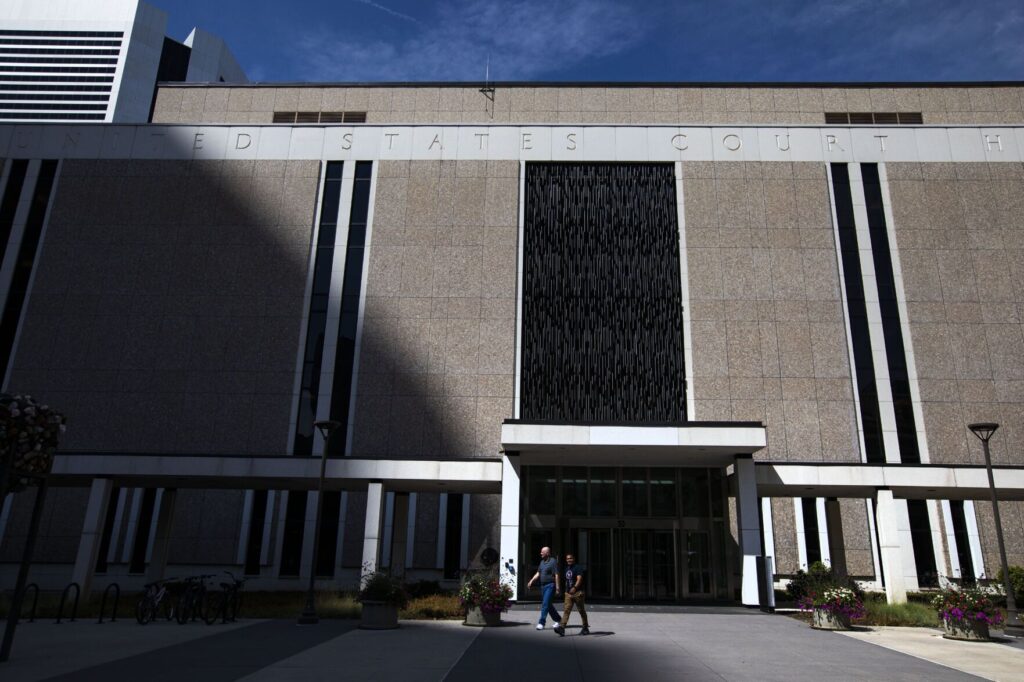
The Lindsey-Flanigan Courthouse in Denver.
The plaintiffs appealed to the Court of Appeals, where a three-judge panel appeared uncomfortable that any state body handling criminal records as part of its licensing duties is legally a criminal justice agency with a robust shield over all its files. Nonetheless, they conceded the broad language about the collection and storage of criminal records applied to POST’s revocation process for peace officers.
“In doing so, the General Assembly sought to convey that a criminal justice agency is one that performs any of the enumerated activities,” wrote Judge Robert D. Hawthorne.
During oral arguments to the Supreme Court, the plaintiffs maintained it made no sense to deem agencies that have any interaction with criminal records a criminal justice agency. The justices pointed out the legislature had written the law broadly, while also acknowledging the absurdity of labeling non-law enforcement licensing agencies as criminal in nature.
“I don’t know if you ask the average person on the street, ‘Is the Dental Board a criminal justice agency?’ most people would say yes to that,” said Chief Justice Monica M. Márquez.

(From left) Colorado Supreme Court Justice Brian D. Boatright, Chief Justice Monica M. Márquez and Justice William W. Hood III listen to arguments from Assistant Attorney General Caitlin E. Grant during the People v. Rodriguez-Morelos case as part of Courts in the Community at the Wolf Law building at University of Colorado Boulder on Thursday, Oct. 24, 2024. The semi-annual event entails the Colorado Supreme Court hearing arguments before an audience of students throughout the state. (Stephen Swofford, Denver Gazette)
A matter of function
The Supreme Court ultimately agreed POST is a criminal justice agency — with a broader shield over its records — because state law enables it to execute law enforcement functions, even if they amount to a fraction of POST’s work.
“True, it appears from the record that criminal prosecutions arising out of POST referrals may occur infrequently,” wrote Berkenkotter, “but the CCJRA’s definition of a criminal justice agency merely requires the agency to perform ‘any’ activity directly related to the detection or investigation of crime. Notably, it does not require that activity to be the agency’s primary function.”
Osher said he was heartened the Supreme Court backed away from the Court of Appeals’ reasoning, which would have “taken a wrecking ball” to the state’s open records law. However, he disagreed with the court’s characterization of POST’s law enforcement work, and said the ruling will make it harder to expose misconduct.
“I hope the state’s legislators will take up this issue and pass legislation that will ensure the public can obtain information about law enforcement officers the Colorado Supreme Court has now barred from public view,” Osher said.
A spokesperson for the Colorado Attorney General’s Office, which represented POST, said that disclosure of the POST database “would present significant safety concerns with regard to the private information of peace officers and would jeopardize undercover investigations. Today’s decision is an important ruling for public safety.”
The case is The Gazette et al. v. Bourgerie.
Editor’s note: This article has been updated with additional comments.

Federal judge considers second round of sanctions against ex-Colorado judicial discipline director
Michael Karlik
michael.karlik@coloradopolitics.com
Updated 52 minutes ago
A federal judge ordered Colorado’s former judicial discipline director on Tuesday to explain why she should not sanction him a second time for filing documents for improper purposes, such as harassment or delay. U.S. District Court Senior Judge Kathryn H....
Colorado Democrats want large corporations to pay fee if employees are on Medicaid
Marianne Goodland
marianne.goodland@coloradopolitics.com
Updated 8 minutes ago
Democrats are seeking to require Colorado’s largest corporations to pay thousands of dollars for each employee that relies on the Medicaid program for health insurance. They don’t have to pay the fee if they can demonstrate offering an “affordable health...

Colorado justices agree to review insurance question that has divided federal judges
Michael Karlik
michael.karlik@coloradopolitics.com
Updated 4 hours ago
The Colorado Supreme Court granted a federal judge’s request on Friday to address an issue that has produced conflicting answers in policyholders’ lawsuits against insurance companies over unpaid benefits. “Parties (and judges) regularly spend undue time and money fighting in...

Farmworker overtime bill advances after lengthy debate in Colorado Senate
Marianne Goodland
marianne.goodland@coloradopolitics.com
Updated 21 hours ago
The Colorado Senate on Tuesday narrowly advanced a bill to raise the overtime threshold for agricultural workers, defeating more than a dozen amendments from its leading opponent aimed at rewriting the measure. As introduced, Senate Bill 121 would raise the threshold for...

Colorado Agriculture Day: A feast for the ears, eyes and stomachs
Marianne Goodland
marianne.goodland@coloradopolitics.com
Updated 20 hours ago
Gov. Jared Polis, legislators and friends of agriculture gathered at the state Capitol on Tuesday to celebrate Colorado Agriculture Day. The annual recognition of the contributions of Colorado farmers, ranchers and agribusiness drew hundreds to the Capitol’s west foyer, where...

Pueblo man held in Afghanistan for more than a year released, Taliban says
The Associated Press
the-associated-press@coloradopolitics.com
Updated 19 hours ago
KABUL, Afghanistan — Afghanistan’s Taliban authorities on Tuesday released American academic Dennis Coyle after holding him for over a year, with the foreign ministry saying the release came on the occasion of Eid al-Fitr, the Muslim holiday that marks the end of the...

Mortgage rates rise in defiance of Trump’s $200 billion push, hurting GOP on affordability
Zach Halaschak, Washington Examiner
zach.halaschak.washington.examiner@gazetteedit.wpenginepowered.com
Updated 23 hours ago
After months of a gradual decline, mortgage rates are trending back up because of the war with Iran, defying President Donald Trump’s efforts to lower them and undercutting Republicans on the key issue of affordability. As of Monday, the average rate on a 30-year...

Guilt by association: Former Jeffco teacher claims district wrongfully terminated her
Sage Kelley
sage.kelley@denvergazette.com
Updated 1 hour ago
Courtney Capek claims her career was completely altered by the actions of another. The Lakewood native returned to the school she graduated from, Green Mountain High School, in 2023 to begin her career teaching and establishing a new era for...

Federal judge dismisses background screeners’ challenge to Colorado law
Michael Karlik
michael.karlik@coloradopolitics.com
Updated 1 day ago
A federal judge dismissed a challenge on Friday to a portion of Colorado law that prohibits certain information from being included in consumer reports, in what seemed to be a conflict with federal law. Congress originally enacted the Fair Credit...
Wildlife agency asks for $450,000 to bring more wolves to Colorado
Marianne Goodland
marianne.goodland@coloradopolitics.com
Updated 17 hours ago
The panel of legislators charged with crafting the budget on Monday rejected a proposal that proponents said would increase transparency around how much Colorado Parks and Wildlife spends to bring additional wolves into the state. At the same time, the...