

Sheepish behavior? | BIDLACK

Hal Bidlack
Back in 2001, when I neared the end of a tour teaching political science at the Air Force Academy, I found what looked like an interesting next assignment as a military advisor to an ambassador at the State Department in Washington, D.C.
After the Soviet Union broke up (and before a certain dictator loved by a certain former U.S. president took over and tried to reunite the various former Soviet states), the efforts to provide aid and assistance in the region were quite haphazard. As a result, a very good fellow, whom you may well have seen on TV helping to debunk a lot of Ukrainian falsehoods, took over as the ambassador in charge of all assistance to the former Soviet Union.
He had a roughly $2 billion checkbook, and any agency that wanted to work in the former Soviet states had to get his sign off. The idea was largely to keep former Soviet nuclear scientists employed at one of two (Moscow and Kyiv) new nuclear research facilities, so they wouldn’t go to work for, say, China or North Korea. A good idea. He had a staff of about 15 and we had our various assignments. Proposals came to our desk many times a day, and we had to figure out if the proposed funding made sense in the big picture. I did a lot of the work on proposed military aid (from mine detectors to flashlights to bicycles) to the militaries of the now-independent nations.
Stay up to speed: Sign up for daily opinion in your inbox Monday-Friday
For a lot of reasons, that assignment ended up being a pretty terrible place to work. My primary problem was that, unlike the military, people who worked there really cared about who got credit for ideas at the State Department. I guess that is what it takes to get promoted there, but for most of the military folks I worked with, also detailed to the State Department, it was frustrating and often got in the way of getting the missions completed. Nonetheless, it was important work, and one needed to play close attention to what came across one’s desk.
Which, of course, brings me to the Colorado Politics Out West Roundup and a man cloning giant sheep.
I’ll give you a moment to reread that sentence.
It seems up in Montana, an elderly gent of some 81 years is going to prison for six months because he illegally bred, well, giant sheep, or at least one, on his ranch where he primarily raises critters to be killed by hunters (though I’m not sure how much actual “hunting” is required when the poor animals are just in a field waiting for you).
The man illegally brought to this country tissue samples, including (ewww) the testicles from a large sheep breed found in central Asia, including (I know you were waiting for the connection) Kyrgyzstan, one of the countries in my State Department portfolio. He then used these — let’s call them “imported materials” — to breed the first of what I’m sure he hoped would be many truly giant sheep for hunters to kill.
Take a look at the picture of the nicknamed “Montana Mountain King” sheep that would be far more acceptable on the steppes (vast grasslands) of Kyrgyzstan and neighboring countries than in Montana. It’s a rather large beast with massive ram horns and he is likely, now that the court case is over, to spend his years in a zoo, no doubt startling visitors with his bulk.
The “stans,” as we at State called the nations of the region, tend to be poorly run and largely impoverished. Heck, back in my days at State, we had to occasionally include the cost of bribes paid to border guards as part of the cost of doing business. I’m not the least bit surprised the gentleman from the Big Sky State found someone to work with to obtain the needed “materials” for cloning. But in the U.S., we have fairly strict laws on cloning and that’s a good thing. The dangers of monster sheep roaming the countryside and creating havoc are limited, but we already know the dangers of killer bees and the threats other mutated insects pose to crops and people.
The judge in Montana admitted to having a very difficult time figuring out a sentence for the cloner. His age and his previously clean record suggested a light punishment, but the potential severity of bringing new and potentially hazardous critters to our shores is large. We need look no further than the accidental introduction of lampreys in the Great Lakes to see the danger. Colorado has its own set of problems with invasive animals and plants, including Zebra mussels, various beetles and the Purple Loosestrife.
I admit back when I worked at the State Department, I spent very little (though not zero) time on invasive species. We were worried about what we called drugs, guns, thugs and bugs, pretty much in that order. All four of those “invasive” items created dangers at home and significant problems in their nations of origin, including the Stans and the rest. The dangers are most certainly not zero.
I totally understand if you smiled when you learned about the giant sheep that now lives in Montana, until it is placed in a zoo. I get it is at least a tad bit funny. But the issue of invasive species, especially when humans help the process along, represent real dangers to Colorado and the rest of the U.S. We need to be alert and responsive, even to cute critters like sheep.
Hal Bidlack is a retired professor of political science and a retired Air Force lieutenant colonel who taught more than 17 years at the U.S. Air Force Academy in Colorado Springs.


You get what you pay for in your state reps | Hal Bidlack
Hal Bidlack
hal-bidlack@coloradopolitics.com
Updated 8 hours ago
My regular readers will know of my affection for the Out West Roundup, a Colorado Politics feature that lets us keep up to date with the goings on out here in the western U.S., and draws attention to stories that...
A warrant should mean something — expedite carrying them out | OPINION
Colorado Politics
colorado-politics@coloradopolitics.com
Updated 8 hours ago
By Aaron Ping My name is Aaron Ping. I am a father from Washington state, and I am writing because my 16-year-old son, Avery, cannot. Avery died on Dec. 19, 2024. The drugs that killed him were ordered through Snapchat....

Lower Basin must adapt to Colorado River hydrology | OPINION
Colorado Politics
colorado-politics@coloradopolitics.com
Updated 8 hours ago
By Nick Peters A February deadline for determining future operating guidelines for the West’s two largest reservoirs came and went with no agreement on the table and clear lines drawn in the sand. A seven-state resolution to how Lake Mead and Lake Powell will...

Colorado’s GOP at its best — and worst | Dick Wadhams
Dick Wadhams
dick-wadhams@coloradopolitics.com
Updated 3 days ago
By Dick Wadhams Colorado Republicans are fighting to be relevant in the face of gross mismanagement by Democrats who totally control state government. While the Colorado Republican Party is mired in controversy, several Republican elected officials and candidates represent the...

Someone’s lying in latest activist embarrassment for Polis’ CPW Commission | Rachel Gabel
Rachel Gabel
rachel-gabel@coloradopolitics.com
Updated 3 days ago
Either Samantha Miller is lying, or Gov. Jared Polis is. If Miller is lying, she is so secure in the red carpet rolled out for animal activists by this administration she is willing to put words in the governor’s mouth....

Ask Secretary of State candidates if they’re in favor of independent election audits | Jon Caldara
Jon Caldara
jon-caldara@coloradopolitics.com
Updated 5 days ago
This part will disappoint angry people on Twitter: Relax. Put the pitchforks down. I am not relitigating the 2020 election or mail ballots or even Tina Peters. But I am saying people don’t trust elections like they used to. And...
Redistricting plan to give Colorado Dems 7 members of the U.S. House will split El Paso County | Bob Loevy
Bob Loevy
bob-loevy@coloradopolitics.com
Updated 3 days ago
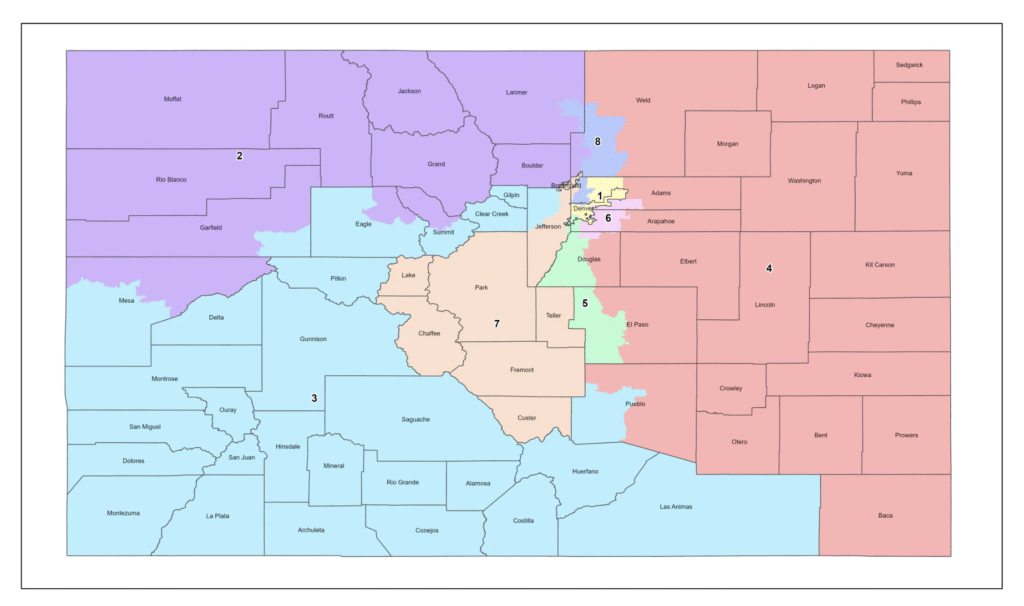
A proposed redistricting plan, which would give Colorado seven Democratic members of the U.S. House of Representatives and only one Republican, will split El Paso County into two parts and thereby weaken the county’s influence in Congress. El Paso County,...

Can deliberation save democracy? | Vince Bzdek
Vince Bzdek
vince.bzdek@gazette.com
Updated 20 hours ago
In September 2019, 523 Americans traveled to Dallas for an experiment called “America in One Room.” The gathering was designed to test a theory: Could representative citizens deliberate productively even in an era of intense polarization? The event focused on...
Redistricting scheme would give Colorado Democrats seven House members, split El Paso County | Bob Loevy
Bob Loevy
bob-loevy@coloradopolitics.com
Updated 2 days ago
A proposed redistricting plan, which could give Colorado seven Democratic members of the U.S. House of Representatives and only one Republican, would split El Paso County into two parts and thereby weaken the county’s influence in Congress. El Paso County,...

Is Trump a builder or just a latter-day headhunter? | SONDERMANN
By Eric Sondermann
by-eric-sondermann@coloradopolitics.com
Updated 5 days ago
It was well under 100 hours after President Donald Trump’s overly long, overly theatrical State of the Union speech that he unleashed American bombers across Iran. As I write, it is now less than 100 hours since those bombers started...