

State Supreme Court resumes oral arguments, a look at potential federal vacancies | COURT CRAWL
Welcome to Court Crawl, Colorado Politics’ roundup of news from the third branch of government.
The Colorado Supreme Court returns this week to hear oral arguments in eight civil and criminal cases, plus there’s a possibility the next president will have several vacancies to fill on the Denver-based trial and appeals courts.
Oral argument calendar
• Beginning on Tuesday, the Supreme Court will hold oral arguments and will even travel to the University of Colorado’s law school in Boulder for its “Courts in the Community” program on Thursday:
McDonald v. People and Ward v. People: Are defendants who are serving lengthy sentences under the state’s “three strikes” law entitled to re-sentencings thanks to a 2019 Supreme Court decision that clarified the process of gauging when punishments are disproportionate to the crime?
Fear v. GEICO Casualty Company: Is an insurance company’s internal estimate of benefits owed to an injured driver admissible as evidence in a lawsuit?
Hill Hotel Owner, LLC v. Hanover Insurance Company: Did a trial judge go too far in ordering the disclosure of documents that were generated at a time when litigation wasn’t anticipated?
People v. Mills: Are prosecutors barred from using drug evidence against a defendant because police waited several days between the man’s arrest and obtaining a warrant to search his car?
Snedeker v. People: Given that the Supreme Court previously ruled a person can’t be sentenced to prison plus probation in the same case, does that prohibit judges from resentencing defendants only to probation after they have already completed prison — in other words, maintaining the prison-plus-probation sentence?
Nonhuman Rights Project, Inc. v. Cheyenne Mountain Zoological Society et al.: Are five African elephants entitled to release from a Colorado Springs zoo?
People v. Rodriguez-Morelos: Can a defendant be convicted of identity theft when the “personal identifying information” he stole was that of a business, not of a person?

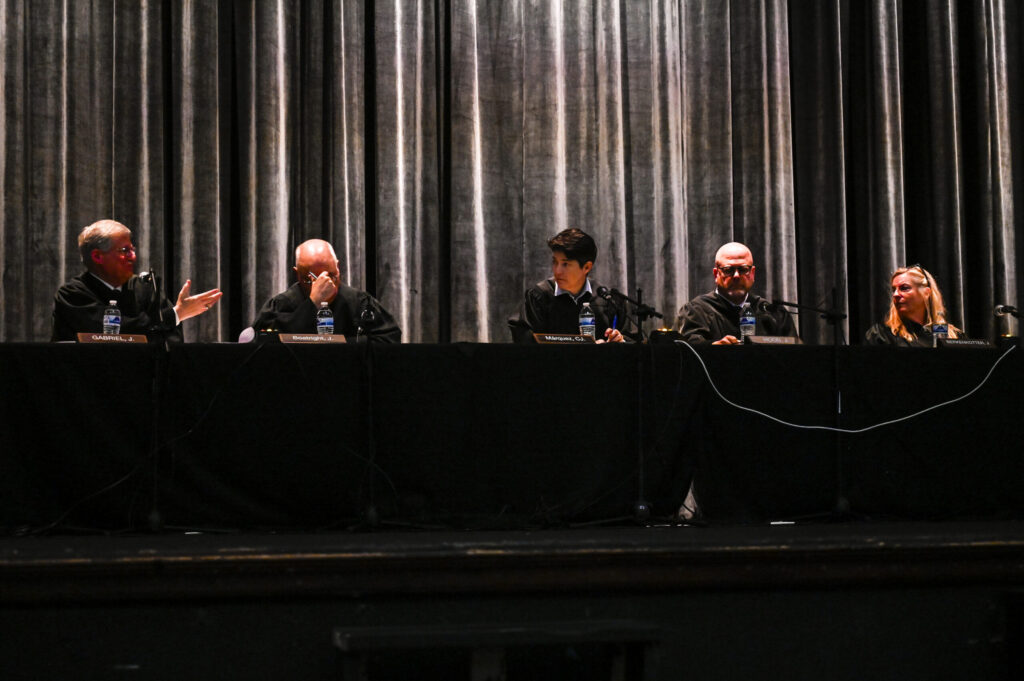
FILE PHOTO: Students from Pine Creek High School ask the justices of the Colorado Supreme Court questions after watching them hear arguments from two cases in the high school auditorium on Nov, 17, 2022. Pictured from left to right are Justice Richard L. Gabriel, Justice Monica M. Márquez, Chief Justice Brian D. Boatright, Justice William W. Hood III and Justice Melissa Hart.
In other appellate news
• The Supreme Court overrode attorney regulators and, without elaboration, admitted an applicant to practice law despite concerns he was withholding information about his background.
• The Supreme Court signaled it may intervene in two civil cases implicating the disclosure of potentially confidential information — including one lawsuit the justices already addressed earlier this year.
• The Court of Appeals declined to analyze whether a man was convicted under an unconstitutional firearms possession law because the U.S. Supreme Court’s landmark gun rights decision did not occur until after his trial, meaning any error wasn’t obvious.
The next president’s role in shaping the courts
• To date, the Biden administration has appointed seven judges to the federal trial and appeals courts headquartered in Denver. The next president will have nine judges across both courts who could potentially take a form of semi-retirement known as senior status. But it’s unlikely all will do so at the same time. Colorado Politics’ cover story examined the vacancies that might arise in the next four years. Here is an excerpt:
The main driver of judicial vacancies is a concept known as “senior status.” Federal judges receive lifetime appointments, but after they turn 65, have served for 10 years and the combination of their age and years of service totals 80, they may elect to become a senior judge operating with a reduced caseload.
Taking senior status also opens the seat for the president to appoint a full-time, active judge.
Since 2021, Biden appointed two 10th Circuit judges to succeed Bill Clinton appointees who went senior. He also installed five district judges to succeed a mixture of George W. Bush and Barack Obama appointees.

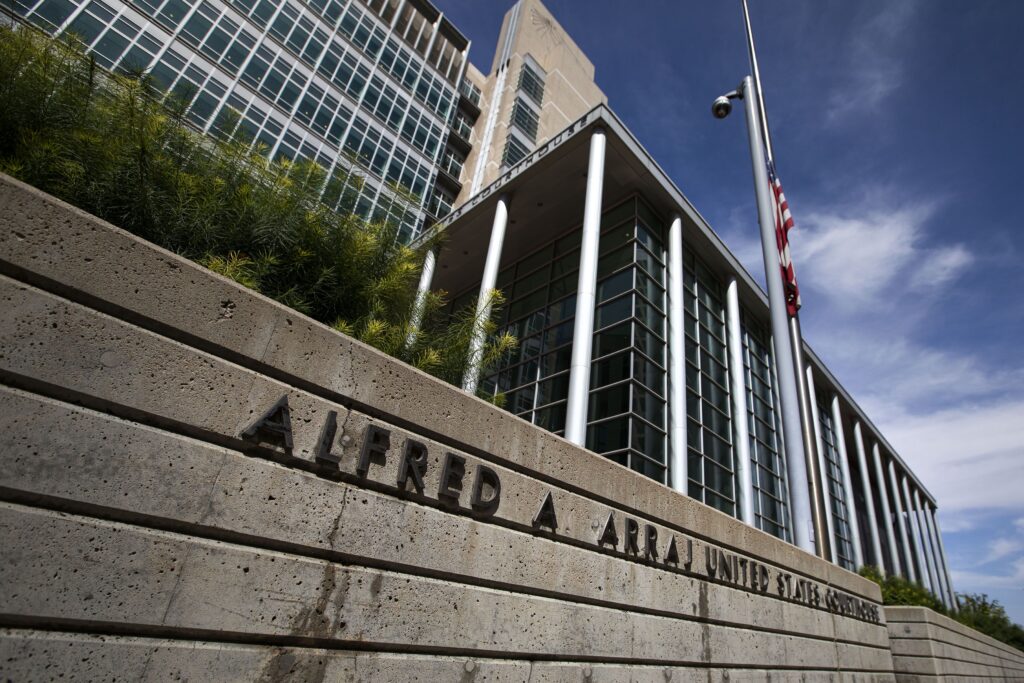
FILE PHOTO: The Alfred A. Arraj federal courthouse in Denver
Recent scholarship suggests judges tend to retire under presidents who can appoint an ideologically similar successor, but the process is not wholly partisan.
For example, Judge Richard E.N. Federico, appointed to the 10th Circuit from Kansas in December, received the support of his home state Republican senators. And U.S. District Court Judge Regina M. Rodriguez, appointed in 2021, was backed by Colorado’s then-U.S. Sen. Cory Gardner, a Republican, during her original unsuccessful nomination in 2016.
In federal news
• The U.S. Court of Appeals for the 10th Circuit addressed an oversight from earlier this year and vacated a lower court decision that the plaintiff argued contained an erroneous interpretation of the law.
• Although two property owners in Costilla County may want the process for permitting their septic tank to look different, the 10th Circuit concluded it doesn’t violate their constitutional rights.
• A federal judge threw a wrench into Denver Water’s two-decade pursuit of more water supplies by concluding the federal government improperly permitted the expansion of a Boulder County reservoir.
Historic courtroom is back in business
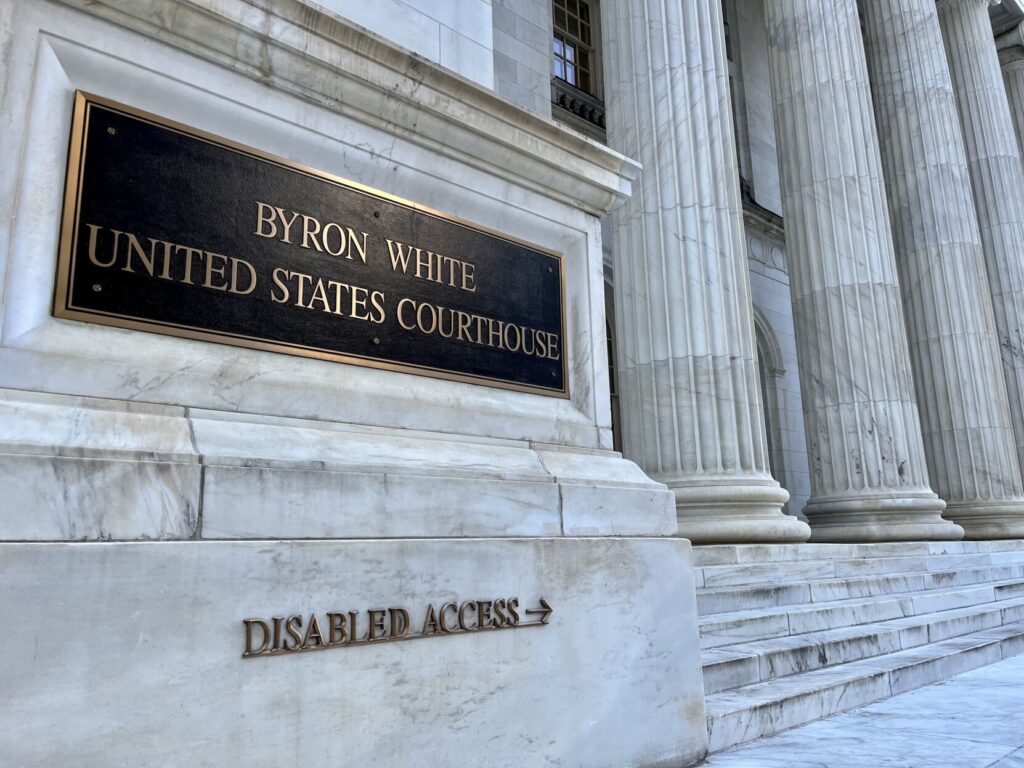
• Last month, judges from the district court and 10th Circuit gathered to reopen a historic courtroom in the Byron White U.S. Courthouse in Denver. The courthouse, which houses the 10th Circuit, contains one trial courtroom. U.S. District Court Chief Judge Philip A. Brimmer walked attendees through the history of its use.
• When the courthouse opened in 1916, it was mostly a post office with a district courtroom on the second floor. Colorado didn’t have a second federal trial judge until 1954, so judges handed off the courtroom to each other when they stepped down.

The jury box and public gallery in the restored trial courtroom of the Byron White U.S. Courthouse in downtown Denver.
• In 1966, the district court and 10th Circuit moved across the street to the Byron G. Rogers Federal Building. Then-U.S. District Court Judge Alfred A. Arraj wrote to the building’s landlord, the General Services Administration, to ask that the trial courtroom be maintained as a “monument of justice” and “a great treasure.” The GSA turned down the request and the courtroom became an auditorium.
• In 1983, the district court reclaimed the space and then-Judge Richard P. Matsch moved into it. U.S. Supreme Court Justice Byron White of Colorado — for whom the 10th Circuit courthouse would later be named — came to the dedication.

The doors leading into the restored trial courtroom of the Byron White U.S. Courthouse in downtown Denver.

The judge’s bench in the restored trial courtroom of the Byron White U.S. Courthouse in downtown Denver.
• “To him the courtroom was theater, a battlefield, an arena. It was where, through the adversarial system … all the people who were part of the judicial system were engaged, as he said,” recalled Matsch’s daughter, Katherine Matsch Daley.
• Judge Timothy M. Tymkovich of Colorado, who was the 10th Circuit’s chief judge when the restoration began, said he wanted to bring as many elements back to their original design as possible.
• “We did not find any bodies in the floor but we found just about everything else that could go wrong in a renovation project,” he quipped.

The jury box in the restored trial courtroom of the Byron White U.S. Courthouse in downtown Denver.

The ceiling and chandeliers in the restored trial courtroom of the Byron White U.S. Courthouse in downtown Denver.

The judge’s bench and decorations in the restored trial courtroom of the Byron White U.S. Courthouse in downtown Denver.
• Colorado Politics could not immediately confirm the total amount spent for the restoration. The district court indicated no judge has yet been assigned to the trial courtroom.
How federal judges do and don’t interact
• Last week, U.S. District Court Judge S. Kato Crews and U.S. Magistrate Judge N. Reid Neureiter spoke to a group of lawyers about how the various judges on Colorado’s federal trial court interact — and, as importantly, how they respect each other’s independence.
• How a district judge thinks a magistrate judge should rule on an issue, for example, “are discussions that don’t take place,” said Crews, a former magistrate judge until this year.
• Crews and Neureiter also spoke about the unwelcome incentives behind public disclosure of trial judges’ backlogs and about the impetus behind the creation of a “chief magistrate judge” position earlier this year.
• Finally, they disclosed that one semi-retired senior district judge appears to be transitioning to full retirement. As confirmed by the court’s clerk, Raymond P. Moore is not taking any new cases. Moore was appointed to the court in 2013 and took senior status in June 2023. Crews was his successor.

Raymond P. Moore testifies at his confirmation hearing in January 2013 to be a U.S. District Court judge for Colorado.
Vacancies and appointments
• Although the federal trial court announced his appointment several months ago, U.S. Magistrate Judge Timothy P. O’Hara was sworn in last week after his background check was completed. O’Hara, a former public defender, succeeds Crews. In a big milestone, all of the magistrate judge and district judge seats are filled on the court for the first time in a while.
• The governor appointed Dolores County Court Judge Ian J. MacLaren, who is also the Montezuma County attorney, to the Montezuma County Court. He succeeds JenniLynn E. Lawrence, who is now a district court judge in Mesa County.
Miscellaneous proceedings
• The state’s Judicial Department is hosting a series of free legal resource days in 12 locations for litigants representing themselves. Registration may be required and Spanish interpreters will be available. See the department’s list below for times and locations.
• Are you wondering how to vote on Amendment H, the judicial discipline reforms? Here is an overview for you. While we’re at it, here is Colorado Politics’ story from August about the judges who are up for retention this year, as well.
On break
• Court Crawl will be on break next week and will return in November.

Appeals court shuts down path to challenge convictions if lawyer tells jury that defendant is guilty
Michael Karlik
michael.karlik@coloradopolitics.com
Updated 6 hours ago
Colorado’s second-highest court concluded on Wednesday that defendants cannot challenge whether the evidence was sufficient to sustain their convictions if their lawyer argues to the jury that it should find the defendant guilty. The U.S. Supreme Court has provided guidance...
Colorado senator, local officials push for new Colorado Springs federal courthouse
Michael Karlik
michael.karlik@coloradopolitics.com
Updated 8 hours ago
Local officials and one of Colorado’s U.S. senators urged the judiciary earlier this year to explore placing a new federal courthouse and judge’s chambers in Colorado Springs, while the district court is cautioning that Congress must establish new judgeships before...
A year of developments in the CBI forensic lab scandal
Jenny Deam
jenny-deam@coloradopolitics.com
Updated 12 hours ago
As the scandal at the Colorado Bureau of Investigation forensic lab moved through its second year, a series of startling developments and revelations emerged with no clear end in sight and the full toll still unknown. At the heart of a scandal unlike any before in state history,...
Federal judge sides with Douglas County School District in ex-admin’s discrimination lawsuit
Michael Karlik
michael.karlik@coloradopolitics.com
Updated 5 hours ago
A federal judge concluded last week that a former high school administrator had not proven his claims of religious discrimination against the Douglas County School District. Corey McNellis had worked at Ponderosa High School since 2002 and served as the athletic...
Appeals court orders new menacing trial after faulty self-defense instruction
Michael Karlik
michael.karlik@coloradopolitics.com
Updated 1 day ago
Colorado’s second-highest court ordered a new trial last week for an El Paso County defendant convicted of felony menacing, concluding an erroneous self-defense instruction may have influenced the verdict. Under Colorado law, self-defense is an affirmative defense, meaning the prosecution...
Appeals court clarifies framework for parents’ First Amendment rights in child-naming disputes
Michael Karlik
michael.karlik@coloradopolitics.com
Updated 1 day ago
Colorado’s second-highest court overturned a Jefferson County judge’s order last week in a long-running dispute about whether two ex-spouses must call their child by his first name or middle name outside the home. In doing so, a three-judge Court of...
10th Circuit judges recap do’s and don’ts for lawyers
Michael Karlik
michael.karlik@coloradopolitics.com
Updated 1 day ago
Two members of the Denver-based federal appeals court spoke to attorneys on Monday about how to present cases effectively, and when it is helpful for outside entities to weigh in on pending appeals. Judges Robert E. Bacharach of Oklahoma and...
Divided appeals court overturns defendant’s $350,000 restitution obligation
Michael Karlik
michael.karlik@coloradopolitics.com
Updated 1 day ago
Colorado’s second-highest court overturned a defendant’s obligation to pay nearly $350,000 in crime victim restitution last week because an Arapahoe County judge issued the restitution order beyond the legal deadline. The divided decision of a three-judge Court of Appeals panel...
2025 Unfiltered: Colorado Supreme Court vacancy, surge in federal filings and more
Michael Karlik
michael.karlik@coloradopolitics.com
Updated 4 days ago
This year was awash in legal news nationally, with federal courts taking an outsize role in responding to executive branch actions. In Colorado, that effect was evident, but it was not the only factor at play. Here are the top...
$3 million penalty upheld against for-profit college following half-decade of appeals
Michael Karlik
michael.karlik@coloradopolitics.com
Updated 4 days ago
Colorado’s second-highest court upheld a $3 million penalty against a defunct for-profit college on Wednesday, agreeing the state had proven multiple violations of its consumer protection law. The Court of Appeals’ decision against CollegeAmerica followed a trial judge’s order in...