

State Supreme Court wraps up term, federal judge reflects on first year | COURT CRAWL
Welcome to Court Crawl, Colorado Politics’ roundup of news from the third branch of government.
The state Supreme Court is concluding its term with a final batch of decisions, plus one of Colorado’s newer federal judges spoke candidly about what she’s seeing from the bench.
Supreme Court business
• On purely technical grounds, the Supreme Court determined a proposed ballot initiative to ban gender-affirming care for minors is ineligible for the 2024 ballot, while a proposed initiative that would impose a blanket primary and ranked-choice voting in the general election is cleared for signature-gathering.
• Although all seven members of the court noted it was highly problematic that a defense lawyer seemingly didn’t tell his client he was simultaneously being prosecuted by the same district attorney’s office, the Supreme Court decided, 5-2, the attorney’s conflict of interest might not entitle the defendant to a new trial after all.
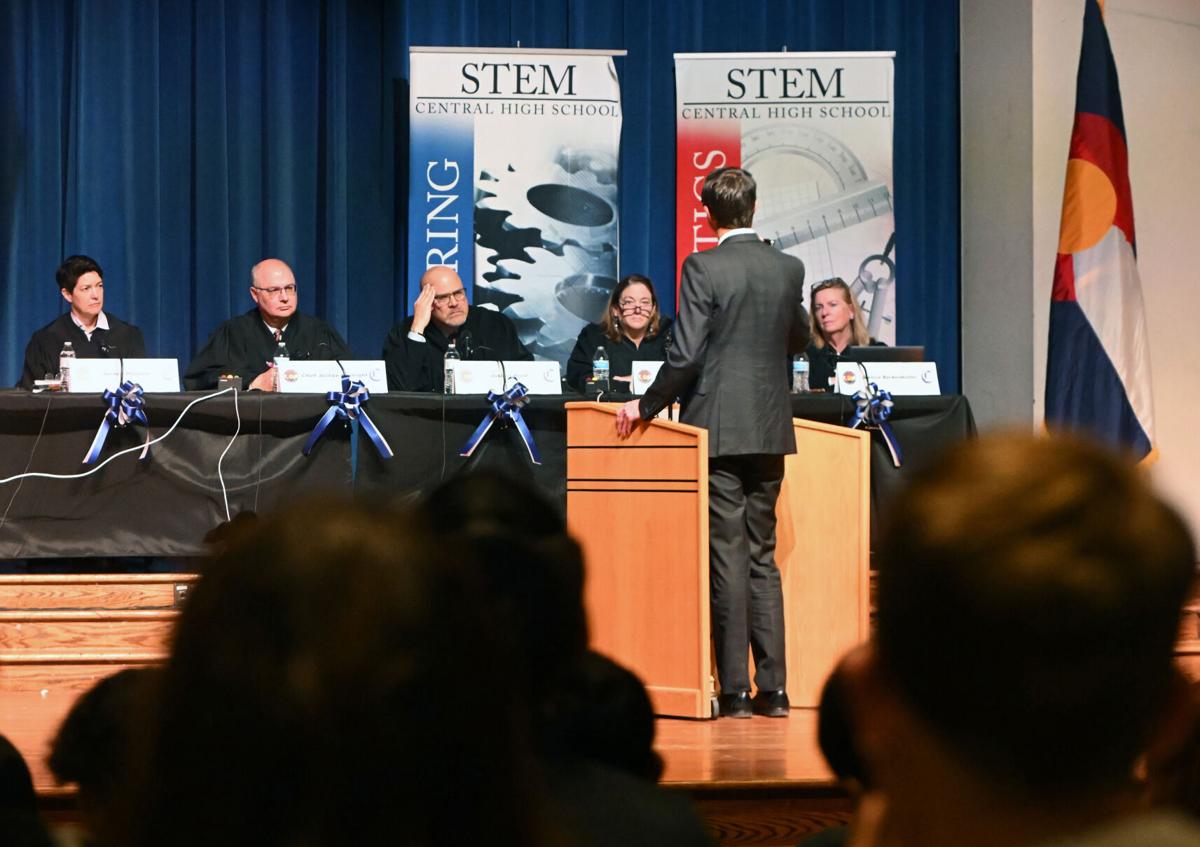
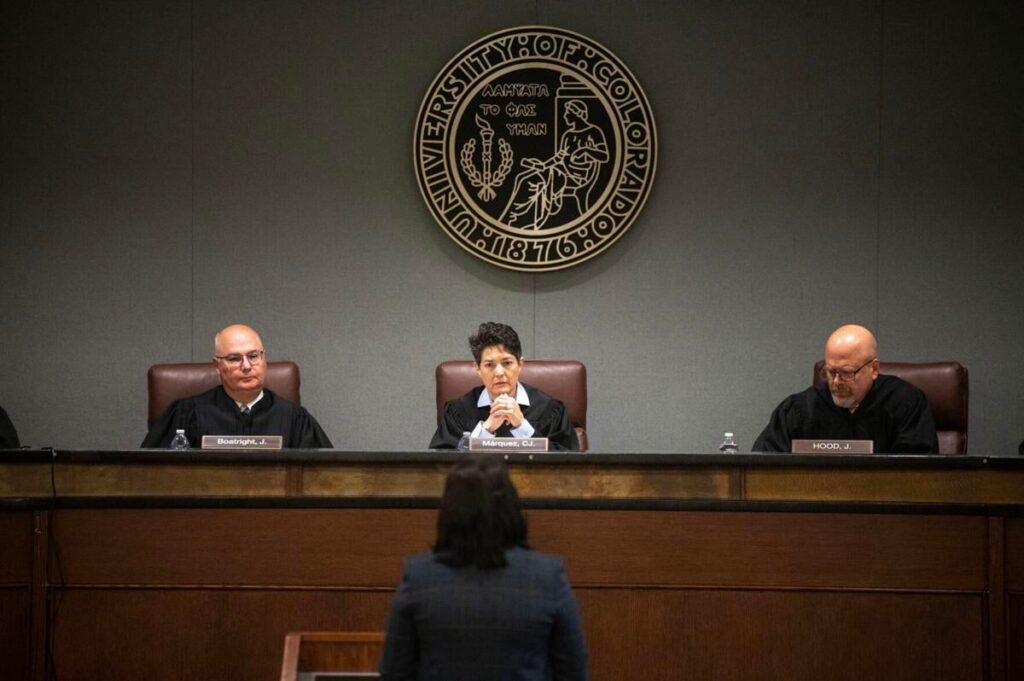
FILE PHOTO: Members of the Colorado Supreme Court listen to arguments from attorney Julian R. Ellis, Jr. during "Courts in the Community" at Pueblo's Central High School on Thursday, May 9, 2024. (Photo by Jerilee Bennett, The Gazette)
Jerilee Bennett/The Gazette

FILE PHOTO: Members of the Colorado Supreme Court listen to arguments from attorney Julian R. Ellis, Jr. during “Courts in the Community” at Pueblo’s Central High School on Thursday, May 9, 2024. (Photo by Jerilee Bennett, The Gazette)
• The justices clarified that whether a sex offender may have contact with minor relatives while on probation depends upon the nature of the relationship, with parent-child-like scenarios requiring the greatest protection.
• A Pueblo County judge believed state law obligated him to incarcerate a pretrial detainee until the man could undergo a sanity evaluation, even though he had posted bond and abided by his release conditions. The Supreme Court responded that the judge was wrong to jail the defendant.
• Colorado’s “Make My Day” law, which authorizes lethal force for home defense, doesn’t apply when the killing is reckless, the court ruled.
• Even though a Park County sheriff’s deputy didn’t corroborate a tip about hazardous driving before approaching a suspect’s vehicle, the Supreme Court determined the tip supplied reasonable suspicion to investigate.
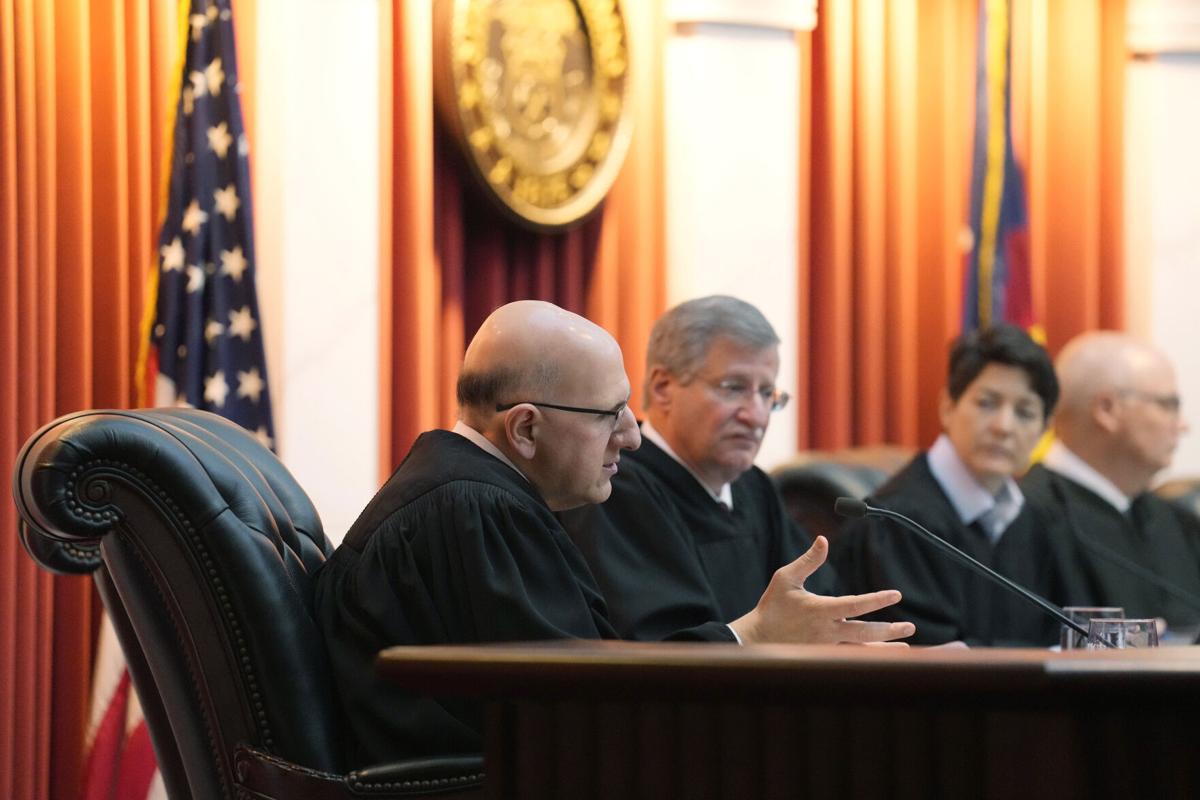
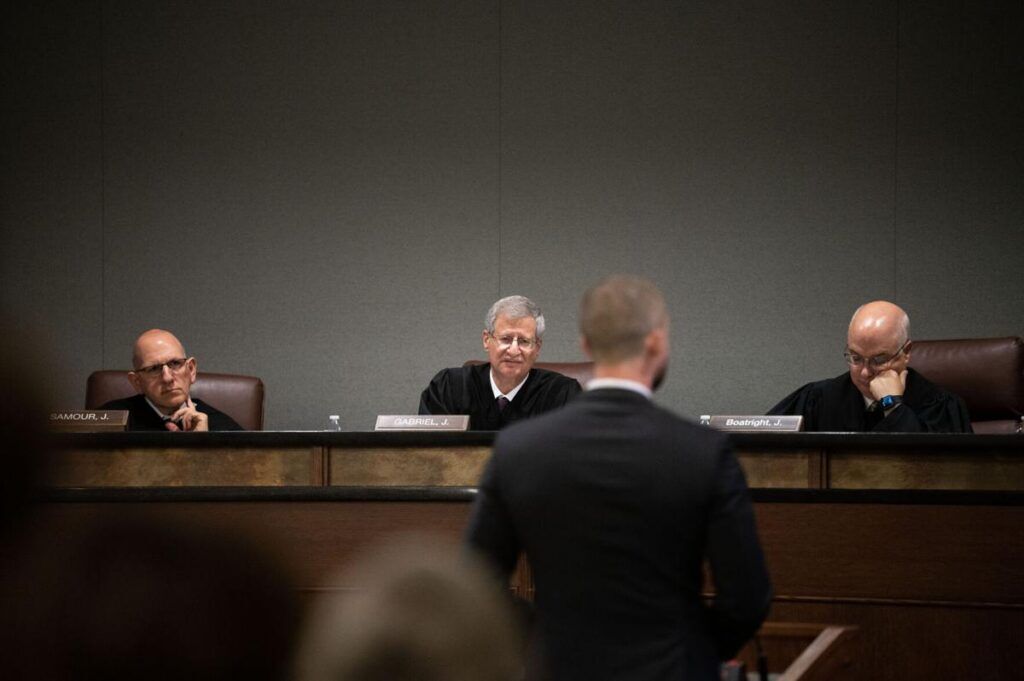
Colorado Supreme Court Justice Carlos Samour, Jr., left, asks a question during oral arguments before the court on Dec. 6 in Denver. Looking on are Justices Richard L. Gabriel, second from left, Monica M. Marquez, third from left, and Chief Justice Brian D. Boatright. Colorado Supreme Court justices have sharply questioned whether they could exclude former President Donald Trump from the state’s 2024 ballot.
the associated press

Colorado Supreme Court Justice Carlos Samour, Jr., left, asks a question during oral arguments before the court on Dec. 6 in Denver. Looking on are Justices Richard L. Gabriel, second from left, Monica M. Marquez, third from left, and Chief Justice Brian D. Boatright. Colorado Supreme Court justices have sharply questioned whether they could exclude former President Donald Trump from the state’s 2024 ballot.
• Two Boulder County sheriff’s detectives repeatedly disregarded a murder suspect’s assertion of his right to silence, prompting the Supreme Court to bar the prosecution from using the defendant’s statements in its case.
• During oral arguments, the justices seemed on board with a reading of the criminal rules that prohibits trial judges from restricting which postconviction claims appointed defense attorneys can pursue if their client has at least one plausible claim among their many allegations.
• Members of the Supreme Court seemed skeptical that a man who was aggressively interrogated outside his apartment building about a road rage encounter, but wasn’t physically restrained, needed a Miranda warning beforehand.
• On the other hand, the justices seemed more concerned about an intoxicated woman who was under police control for 2.5 hours, requested to leave multiple times and was subjected to questioning about her husband’s killing, all before receiving a Miranda warning.
Heard on appeal
• The state’s Court of Appeals couldn’t understand why an Arapahoe County magistrate held a man in jail and subjected him to potential jail time, noting the divorce agreement he supposedly violated didn’t support the magistrate’s conclusions.
In federal news
• U.S. Magistrate Judge Susan Prose, who has spent little over a year on Colorado’s federal trial court, spoke to an audience of lawyers about her observations, including that some parties don’t actually want a speedy trial and that government defendants are sometimes providing inadequate arguments for why they should receive qualified immunity.
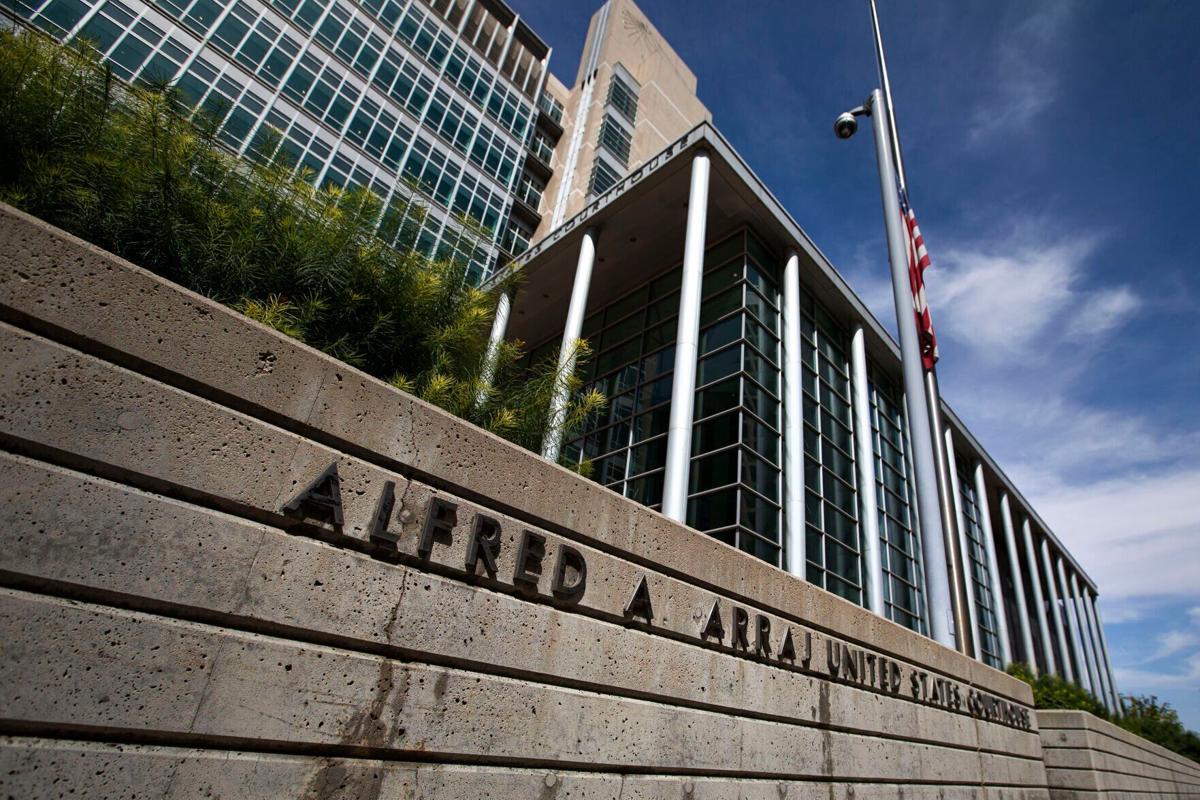
FILE PHOTO: The Alfred A. Arraj federal courthouse in Denver
Timothy Hurst, The Denver Gazette file

FILE PHOTO: The Alfred A. Arraj federal courthouse in Denver
• Prose, who formerly represented the Federal Bureau of Prisons against civil rights lawsuits from incarcerated plaintiffs, also spoke disapprovingly of defense counsel who submitted documentation to her without input from a self-represented plaintiff because he was incarcerated.
• “I just want to let you know,” Prose said, “my expectation is you will find yourself en route to Cañon City to confer with that gentleman, by phone or in person or on a video call.”
• A federal judge sent another set of claims to a jury trial over Denver’s police response to 2020 protesters.
On vacation
• Court Crawl will be on vacation next week for the July Fourth holiday.

Colorado Supreme Court concerned about police overreach in interrogations
Michael Karlik
michael.karlik@coloradopolitics.com
Updated 34 minutes ago
Some members of the Colorado Supreme Court appeared hesitant on Tuesday to endorse the ability of police to interrogate a suspect after they have obtained a court order authorizing only the collection of physical evidence. Under Colorado’s criminal rules, law...
Colorado Supreme Court considers new requirement for leaving-the-scene convictions
Michael Karlik
michael.karlik@coloradopolitics.com
Updated 1 day ago
In 2006, the Colorado Supreme Court ruled that leaving the scene of an accident resulting in serious injury is a “strict liability” offense, meaning a person is guilty solely through their conduct, without the need for prosecutors to prove the...
Colorado Supreme Court weighs transgender services case involving Children’s Hospital and federal threats
Michael Karlik
michael.karlik@coloradopolitics.com
Updated 10 hours ago
Some members of the Colorado Supreme Court expressed discomfort on Tuesday with having to decide whether to order Children’s Hospital Colorado to resume providing certain services to transgender children, which could trigger a “death sentence” if the federal government imposes...
Colorado justices weigh constitutionality of unique disclosure requirement for ballot measures
Michael Karlik
michael.karlik@coloradopolitics.com
Updated 2 days ago
Members of the Colorado Supreme Court considered on Tuesday whether a unique feature of the state’s campaign finance system categorically violates the First Amendment by requiring the disclosure of a ballot measure committee’s legal representative on advertisements. No on EE...

Colorado justices block injured plaintiff from suing, despite alleged concealment by Manitou Springs
Michael Karlik
michael.karlik@coloradopolitics.com
Updated 3 days ago
The Colorado Supreme Court ruled on Monday that a woman injured on a Manitou Springs sidewalk could not sue the allegedly responsible entity, the city of Colorado Springs, even though she did not learn until too late of an agreement...
Divided Colorado Supreme Court opens door to experts’ views on children’s truthfulness
Michael Karlik
michael.karlik@coloradopolitics.com
Updated 2 days ago
The Colorado Supreme Court ruled on Monday that experts may, in certain situations, tell jurors whether child witnesses exhibited signs of being coached by adults, without running afoul of the general prohibition on witnesses testifying about the truthfulness of other...

State Supreme Court to hold oral arguments, federal judges find fault with bond hearings | COURT CRAWL
Michael Karlik
michael.karlik@coloradopolitics.com
Updated 3 days ago
Welcome to Court Crawl, Colorado Politics’ roundup of news from the third branch of government. The state Supreme Court will resume hearing oral arguments tomorrow, plus some federal judges are raising the alarm about immigration judges’ handling of bond hearings....
Douglas County seeks state Supreme Court review in open meeting case
Nicholas Fogleman
nicholas.fogleman@denvergazette.com
Updated 3 days ago
The Douglas County Board of Commissioners intends to petition the Colorado Supreme Court to review a recent court decision that found the board had violated the Colorado Open Meeting Law. The case stems from 11 “closed, unnoticed” meetings held by...
10th Circuit provides guidance on police searches of cloud-based data
Michael Karlik
michael.karlik@coloradopolitics.com
Updated 6 days ago
The Denver-based federal appeals court provided guidance to law enforcement agencies on Monday for ensuring that searches of cloud-based accounts comply with the Fourth Amendment’s requirements. A three-judge panel of the U.S. Court of Appeals for the 10th Circuit noted...
Federal judge releases man after 2 immigration judges disobey order
Michael Karlik
michael.karlik@coloradopolitics.com
Updated 6 days ago
A federal judge released a man from immigration detention on Thursday after two different immigration judges disobeyed his order in the same case. “At this point, the Court has granted Respondents two bites at the apple to prove detention of...