

Polis should veto landlord-tenant tripwire | Colorado Springs Gazette
A bill saddling Colorado landlords with supposed safeguards for tenants is now on Gov. Jared Polis’ desk, awaiting his signature or veto. For the sake of affordable housing and the good of Colorado’s overall economy, let’s hope he vetoes House Bill 24-1098.
Just saying no to the bill would in fact make a lot of sense for a governor like Polis, who needs no lessons in Economics 101.
He must know renters are in no urgent need of additional legal protection from unwarranted evictions; there is no eviction “epidemic.” He also likely gets how the bill will strong-arm landlords into renewing leases in some cases, essentially conjuring up rights to which no tenants are entitled.
Stay up to speed: Sign up for daily opinion in your inbox Monday-Friday
And Polis, whose financial success attests to his keen grasp of markets, understands that all the bill really will accomplish is to shackle landlords. It will be harder to oust tenants who don’t pay the rent — eventually raising the rent for everyone else.
Its an easy veto, in other words — if Polis heeds his economics savvy and his basic instincts.
But can he resist the radical fringe of his party? His fellow Democrats rule both chambers of the Legislature and, on bill after bill, many of their members have distinguished themselves for their seeming obliviousness to economic realities. They are driven by dogma, not reason.
HB 24-1098 aims to limit the reasons for which a landlord may evict a tenant, and at first blush, it might seem modest in scope.
If enacted, landlords still would be allowed to evict when a tenant fails to pay rent; a rental property is going to be sold; provisions of the lease are violated; there are plans to demolish or make substantial repairs to a property, or when a tenant has engaged in conduct that creates a nuisance or damages the rental property.
Supporters of the bill contend its aim is to curb unjust or unwarranted evictions. They cite evictions purportedly carried out in retaliation for tenants who have complained about housing conditions, or who have quarreled with landlords or building managers. They say some tenants have been evicted after spurning unwanted advances from lecherous landlords, or after disagreeing with a landlord’s political views.
In reality, the bill has the potential to wreak havoc across the rental market — by serving as a legal tripwire for opportunistic tenants and their lawyers.
Given how the measure attempts to specify what is a just cause for eviction, it invites a new wave of claims by tenants that their evictions fell outside the new legal boundaries. A whole new standard for evictions would come into play.
Tenants facing eviction after months of unpaid rent, or after a history of disruptive, hostile or even criminal behavior, suddenly will have grounds for claiming retaliation by their landlords over some supposed slight — tying up eviction proceedings if not halting them outright.
That will lead to costly, protracted legal headaches for many landlords while other landlords shy away from evictions entirely, however much they may be warranted.
As critics also have noted of the legislation, it equates a landlord’s decision simply not to renew a lease, with an eviction. That means the standards the bill puts in place for evictions similarly would constrain a landlord who seeks simply to part ways with a problematic tenant when a lease period ends.
All of which ultimately serves to drive up the cost of housing. The bill will make it harder to replace nonpaying tenants with paying ones. It will discourage reinvestment in rental housing and investment in new rental construction. Supply will dwindle and demand continues to rise.
To repeat, Polis knows all this. He just needs to tune out the rabble-rousers at the Capitol — and tune into the true interests of the vast majority of tenants who play by the rules.
Colorado Springs Gazette Editorial Board


You get what you pay for in your state reps | Hal Bidlack
Hal Bidlack
hal-bidlack@coloradopolitics.com
Updated 5 hours ago
My regular readers will know of my affection for the Out West Roundup, a Colorado Politics feature that lets us keep up to date with the goings on out here in the western U.S., and draws attention to stories that...
A warrant should mean something — expedite carrying them out | OPINION
Colorado Politics
colorado-politics@coloradopolitics.com
Updated 5 hours ago
By Aaron Ping My name is Aaron Ping. I am a father from Washington state, and I am writing because my 16-year-old son, Avery, cannot. Avery died on Dec. 19, 2024. The drugs that killed him were ordered through Snapchat....

Lower Basin must adapt to Colorado River hydrology | OPINION
Colorado Politics
colorado-politics@coloradopolitics.com
Updated 5 hours ago
By Nick Peters A February deadline for determining future operating guidelines for the West’s two largest reservoirs came and went with no agreement on the table and clear lines drawn in the sand. A seven-state resolution to how Lake Mead and Lake Powell will...

Colorado’s GOP at its best — and worst | Dick Wadhams
Dick Wadhams
dick-wadhams@coloradopolitics.com
Updated 3 days ago
By Dick Wadhams Colorado Republicans are fighting to be relevant in the face of gross mismanagement by Democrats who totally control state government. While the Colorado Republican Party is mired in controversy, several Republican elected officials and candidates represent the...

Someone’s lying in latest activist embarrassment for Polis’ CPW Commission | Rachel Gabel
Rachel Gabel
rachel-gabel@coloradopolitics.com
Updated 3 days ago
Either Samantha Miller is lying, or Gov. Jared Polis is. If Miller is lying, she is so secure in the red carpet rolled out for animal activists by this administration she is willing to put words in the governor’s mouth....

Ask Secretary of State candidates if they’re in favor of independent election audits | Jon Caldara
Jon Caldara
jon-caldara@coloradopolitics.com
Updated 4 days ago
This part will disappoint angry people on Twitter: Relax. Put the pitchforks down. I am not relitigating the 2020 election or mail ballots or even Tina Peters. But I am saying people don’t trust elections like they used to. And...

Redistricting plan to give Colorado Dems 7 members of the U.S. House will split El Paso County | Bob Loevy
Bob Loevy
bob-loevy@coloradopolitics.com
Updated 3 days ago
A proposed redistricting plan, which would give Colorado seven Democratic members of the U.S. House of Representatives and only one Republican, will split El Paso County into two parts and thereby weaken the county’s influence in Congress. El Paso County,...

Can deliberation save democracy? | Vince Bzdek
Vince Bzdek
vince.bzdek@gazette.com
Updated 17 hours ago
In September 2019, 523 Americans traveled to Dallas for an experiment called “America in One Room.” The gathering was designed to test a theory: Could representative citizens deliberate productively even in an era of intense polarization? The event focused on...
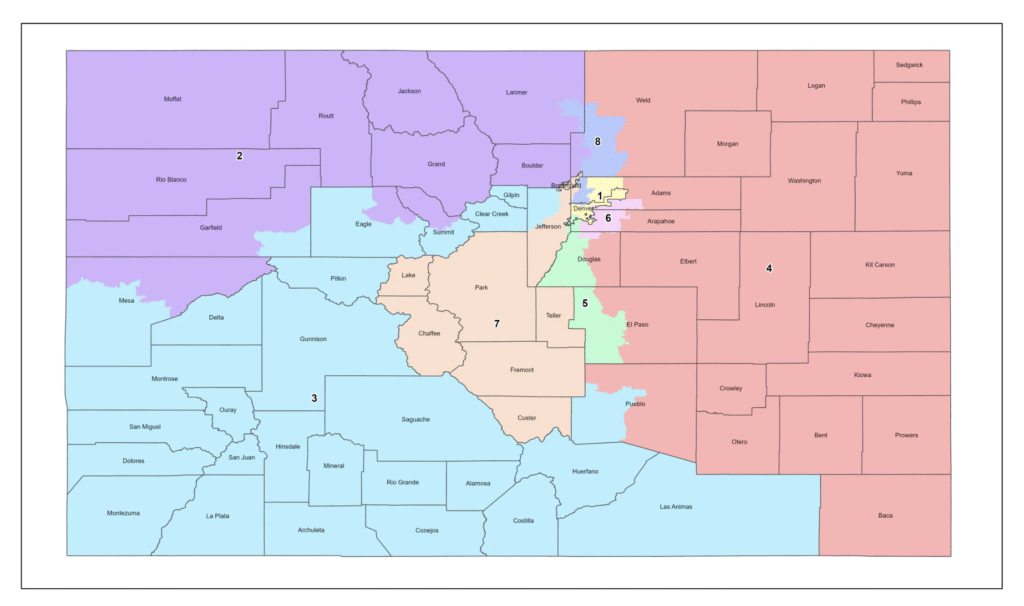
Redistricting scheme would give Colorado Democrats seven House members, split El Paso County | Bob Loevy
Bob Loevy
bob-loevy@coloradopolitics.com
Updated 2 days ago
A proposed redistricting plan, which could give Colorado seven Democratic members of the U.S. House of Representatives and only one Republican, would split El Paso County into two parts and thereby weaken the county’s influence in Congress. El Paso County,...

Is Trump a builder or just a latter-day headhunter? | SONDERMANN
By Eric Sondermann
by-eric-sondermann@coloradopolitics.com
Updated 5 days ago
It was well under 100 hours after President Donald Trump’s overly long, overly theatrical State of the Union speech that he unleashed American bombers across Iran. As I write, it is now less than 100 hours since those bombers started...