

Noise complaints, housing crisis spark debate over future of Boulder airport

Hep Ingram says pilots departing from Boulder Municipal Airport do not respect FAA rules about proper elevation for flying over homes and that their use of leaded fuels pose a human health risk.
Tom Hellauer/Denver GazetteTomHellauer
tom.hellauer@denvergazette.com
https://secure.gravatar.com/avatar/a3dc80c0a9d47d671f1f3da872cc0a06?s=100&d=mm&r=g
A small single-engine aircraft approaches Hep Ingram’s house in northeast Boulder recently, clawing for altitude. Its engine screams in defiance of gravity. And ever so slowly, it drifts closer and closer to flying right over the top of Ingram’s home.
“This guy is way north of where he should be,” Ingram said.
As it approaches, Ingram’s voice is drowned out. He has to wait for the plane to pass over before finishing his thought. During a 45 minute period, roughly 20 aircraft flew over, several of which were north of where Ingram said they should have been.
Ingram lives at the east end of the Boulder Municipal Airport (BDU). Recently, he has noticed an increase in air traffic from the airport, compelling him to sign a petition that supports closing the airport. In addition to that, he claimed that pilots regularly ignore the required flight paths that would take them over Boulder Creek, roughly 500 yards to the south.
While his story – thanks to his home’s location at the base of the runway – is somewhat unique, other Boulder residents have began circulating circulating a petition calling for its closure, complaining about the noise and other issues.
The petition includes residents who also question the usefulness of what they call “hobbyists’ airport.”

Ingram didn’t initially support closing the airport, he said.
He signed on to the petition after, he said, attempting the “official” channels of negotiating with pilots and the airport became futile.
The petition has led to a spirited defense from the aviation community, which argue that the airport is a valuable asset and is one of the aspects making Boulder unique along the Front Range.
Airport supporters also started their own counter-petition, gathering nearly 10 times the support as the airport critics.
Some signers blame new residents for wanting to close the airport, arguing it had been open long before Boulder grew. In addition, they say residents should have known moving close to an airport would mean an increase in airport related noise.
These dueling petitions prompted Boulder city officials and other groups to study the potential future of the airport.
Some argue for a full closure and the construction of a new neighborhood. Others point out that the airport provides a critical service to the city, serving as a base of operations for firefighting and rescue operations that came into the spotlight during a wildfire in 2010 and the major floods in 2013.
And there’s the elephant in the room: the Federal Aviation Administration refused to entertain the idea of closing the airport.
Boulder needs housing, but is airport land the solution?
Laura Kaplan sits on the Boulder Planning Board, a group that advises Boulder’s City Council. Kaplan is one of the creators of the petition to close the airport. She believes the 189 acres of city-owned land are not being effectively used as an airport and wants to see a new neighborhood built for those who may have been displaced from the city due to rising costs of living.

“City owned land poses a unique opportunity to make affordable housing happen, because the land itself can be used as a subsidy,” she said. “It can make the project financially feasible. They’re not financially feasible on private property, which is most of the city.”
The median home selling price in Boulder stood at $1.1 million in February, according to realtor.com.
But despite that eyepopping value, Kaplan praised Boulder’s permanent affordable housing program, claiming it has largely been successful. The problem isn’t there nor at market rate homes, but with middle-income residences, she argued. The median income for Boulder County residents was $99,770 between 2018 and 2022, according to the U.S. Census Bureau. Boulder’s poverty rate was also estimated to be 11.8%, roughly on par with Denver at 11.9%.
Several of Boulder’s affordable homes sold for under $400,000 over the last year, and many of those even sold for under $300,000. Kaplan, however, describes a “flight” of middle-income families, who, after having children, cannot afford a house in Boulder.
“That’s hollowing out our middle class, our school enrollment is dropping and the hospital has been cutting services or selling them off,” she said. “We have a real problem in Boulder with having housing that’s affordable to people with normal jobs who don’t make vast sums of money.”
The problems have become so acute that in the most recent iteration of the Boulder Valley comprehensive plan, adopted in 2021, the city committed to work with the community and reassess the usefulness of the airport. This will occur as the next airport master plan is created.
The most recent master plan for the airport is from January of 2007, but aspects of airport operation, such as maintenance, are included in the latest transportation master plan. The transportation master plan is updated every five years.
It is unclear when the next full blown airport master plan will be created. City and airport officials wouldn’t speculate on when that will happen.
But the airport is not the only available plot of city land, as airport supporters are quick to point out.
The planning reserve, northeast of U.S. Highway 36, is a plot of 469 acres that may be annexed into the city of Boulder but is currently not served by it. Adding to that, the city only owns about half of that land, with the remainder owned by private property owners.
Insofar as the airport, simply closing and redeveloping will likely never take off, said Andrew McKenna, one of the operators of Journeys Aviation, a flight school at BDU.

Because the city has accepted money from the FAA – about $12.7 million since 1982, according to a letter to Boulder’s mayor – it would have to pay that back. As a result, the value of the airport’s land would skyrocket, McKenna said.
“It will never be affordable because of the grant assurances and obligations to the FAA,” he said. “The most, most affordable land is land that the city already owns … Open the planning reserve.”
FAA officials said they only approve airport closures in rare circumstances, when it provides a net benefit to civil aviation, such as by funding a replacement airport. The FAA’s position is to strengthen airports throughout the nation, a spokesperson said in a statement to The Denver Gazette.
McKenna also pointed out the city owns more than 40,000 acres of land set aside as open space.
Boulder City Councilman Mark Wallach opposes that idea.
“If you’re going to suggest that we build on the open space, you’ve got to have a fast car because that’s not going to fly,” he said. “Or maybe own a plane.”
Wallach came to Boulder 40 years ago, and as a former developer and real estate attorney, is a fan of what he calls “measured growth.” Rather than just axing the airport and shutting it down on a whim, he wants to investigate what is best for Boulder’s future.
Wallach said he understands how developers think and echoed many of Kaplan’s ideas regarding the land. As a city-owned parcel, it can allow developers a little more freedom in how they price their completed homes, he said.
Building on less expensive land means they can offer more affordable homes, townhomes or apartments, he added.
“If the market itself is not going to get you what you really need, which is not ultra-expensive, one bedroom or small two-bedroom places at super high prices, but family oriented housing, you’ve got to do something else,” he said. “And to me, this is the opportunity. Whether it pans out or not, we’ll see. But it’s the opportunity to do that something else and to move the needle.”
What are residents saying?
Michael Deragisch, who has lived in the north Boulder area for almost 50 years and is not a pilot, said he believes the airport should remain open. He would be the first to tell anyone that “air travel is pretty cool,” he said.
“I think it’s a great asset for the community, and I think that, just because I don’t really use it, and probably never will, doesn’t mean it’s not a good thing for other people to use,” he said. “There’s a few businesses that use the airport regularly that are great contributors to the community.”
Deragisch said he thinks many of the complaints are stemming from new Boulder residents.
This is an oft-repeated complaint from the pro-airport crowd, who argue that residents knew the airport was there before moving and should have prepared themselves for aircraft noise.
The Boulder airport was first opened in 1928, when Boulder County’s population was about 32,000. Between 1950 and 2020, the county population increased from 48,000 to 330,000, roughly 600%, according to CU Boulder’s Center for Sustainable Landscapes and Communities.
Since the 1930s, airplanes have evolved quite dramatically. But many of the aircraft using the airport still rely on piston engines – ostensibly the same as World War I era aircraft. Though improvements have been made in many regards, the physics of powered flight and internal combustion haven’t changed.
Nor has the noise and fuel used.
Ingram said this frustrates him.
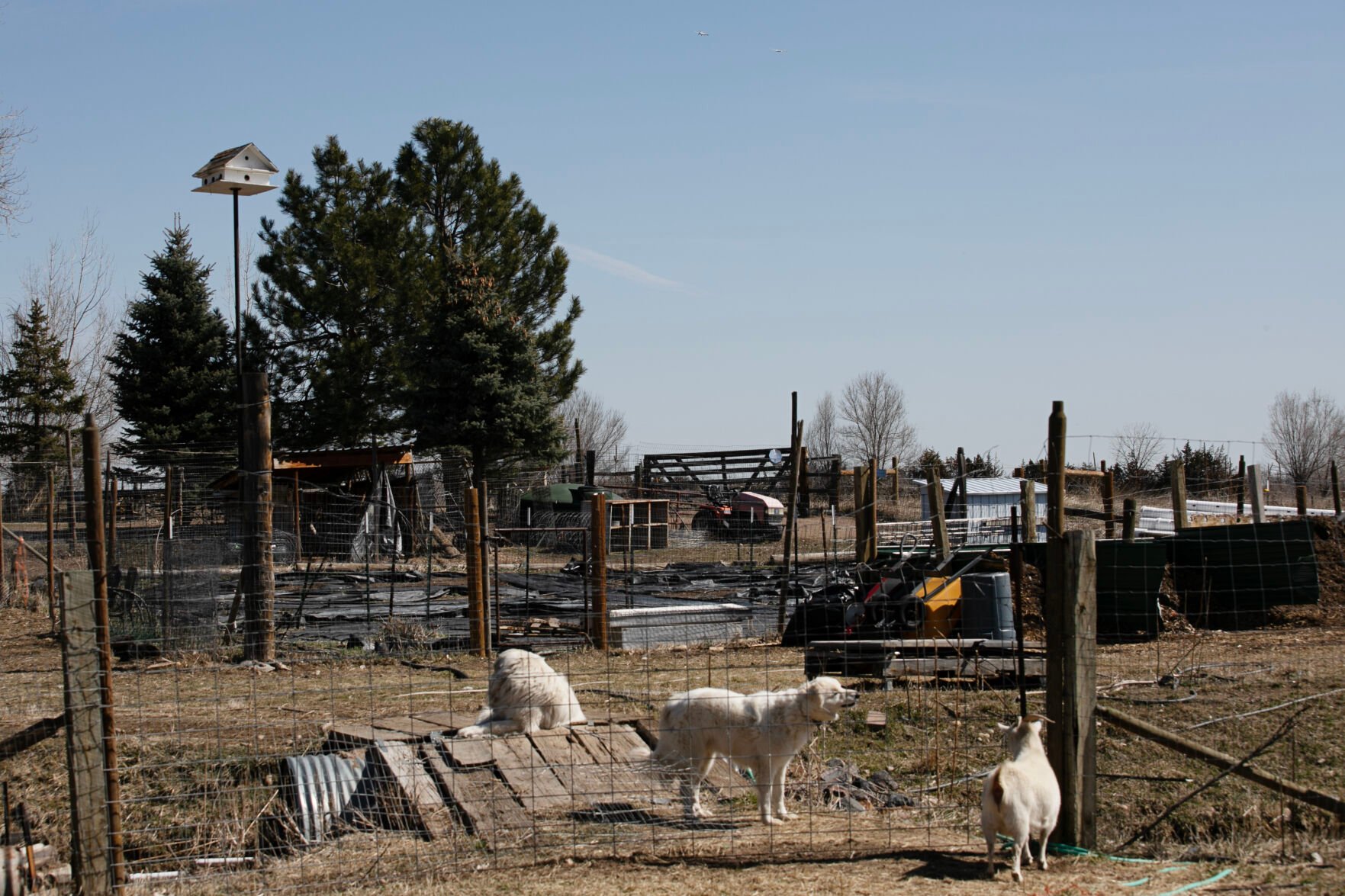
Ingram, who bought his land in 2005, said the property has existed since before the airport was built. He worked out of San Francisco and rented his land before moving back in 2020 due to the COVID-19 pandemic. In 2014, the tenant at the time noted a huge uptick in flights out of the airport, he said.
He tried every “official” avenue to get pilots to follow the rules, he said. He went so far as to contact the FAA, which set up a Zoom call, in which representatives tracked fights at the airport. The two flights they observed didn’t appear to violate any rules, but Ingram said he challenged them and asked why they “cherrypicked results,” insisting there were about 50 other flights to choose from that, he claimed, broke the rules.
After this pushback, one of the FAA representatives told Ingram it would no longer be in the public’s interest for the FAA to pursue complaints, according to Ingram. He’d be welcome to make them, but he would not receive a response, Ingram said.
Calling that “steamrolling,” Ingram said the interaction demonstrated to him that he would need to take other action.
The FAA’s response to Ingram, obtained by The Denver Gazette, said there is no need to expand the investigation further. The safety inspectors assigned did not find any regulatory or aviation safety concerns stemming from his complaints.
“Additional time expended on this investigation would be contrary to our public service obligation to not waste, abuse, or mismanage FAA assets – to include the time of FAA personnel,” the response said. “Multiple Aviation Safety Inspectors have reviewed your complaints and supporting data. These inspectors’ investigative findings do not support your desire to expand the scope of this investigation.”
When asked to comment on Ingram’s statements, the FAA replied: “The FAA continuously works to help reduce the number of people exposed to aviation noise in communities around airports. Addressing this concern requires collaboration among the FAA, airports, aircraft operators, local communities and elected officials.”
Boulder requires pilots climb to at least 500 feet after takeoff “before turning crosswind.” Ingram alleged that pilots routinely ignore this.
Boulder has a noise abatement program in place, but it’s voluntary, according to the airport’s webpage.
Ingram became one of 650 people who signed the petition calling for closure of the airport.
Deragisch siad he worries closure could be disastrous, and likened it to losing open space.
“If you do take away the airport from Boulder, there’s never going to be another one that we can put back in,” he said. “It’s almost as bad as people wanting to build on open space… Once open space is gone, it’s not coming back.”
If the airport were to close, the Colorado Department of Transportation estimated $100 million in area economic impact would be lost. Additionally, 299 people would likely be out of a job. And business would go to other nearby airports in Longmont, Erie or Broomfield.
Fuel type cause for concern locally and nationally
The fuel offered by Boulder Municipal Airport is 100 octane avgas, which is a leaded fuel. Leaded fuel has been the center of almost every debate around general aviation airports and has been banned for use in cars since 1996.
Last year, the EPA determined that lead emissions from aircraft “cause or contribute to air pollution which may reasonably be anticipated to endanger public health and welfare under the Clean Air Act.” A study commissioned by the Santa Clara, California found that blood lead levels of children “increase in proximity to (Reid-Hillview Airport), are higher among children east and predominantly downwind of the airport, and increase with the volume of PEA traffic and quantities of avgas sold at the airport.”
While no studies have been done at Boulder, a group conducted a study at the nearby Rocky Mountain Metropolitan Airport. This study did not find any airborne traces of lead at four different locations in Superior, which lies under the climb path of the airport.
The findings did not persuade Wallach, who insisted his concern is people’s health.
“I’m not concerned with the soil,” he said.
Even if BDU requires unleaded avgas, as a few California airports do, someone could fly in from a different airport on unleaded gasoline and land in Boulder, Wallace said, adding the airport would still have to offer the 100 octane, leaded fuel.
Members of the Colorado House have proposed a bill tackling the use of leaded avgas. In particular, House Bill 1235 creates financial incentives – an income tax credit and a grant program – to reduce use of leaded avgas. In addition, the bill imposes a fee on buying leaded avgas, using the revenue to support the use of unleaded avgas use. As envisioned, the new “enterprise” will help raise money to create further incentives for pilots to convert their aircraft to run on unleaded gas.
Under the bill, airports that don’t meet certain requirements won’t be eligible to get any funds arising out of the measure’s enactment – unless they have, for example, adopted a plan by January 2026 to phase out the sale of leaded avgas and established a noise mitigation plan.
FAA requirements, wildfires and a national pilot shortage
The airport may be owned and operated by the city, but some money it accepts comes with terms and conditions.
Notably, the Federal Aviation Administration has several grants up for grabs annually. These can be awarded to airports in need as they seek to improve their facilities or expand services. The Boulder airport is no different, and in 2018 it accepted $5.5 million for what is known as an airport improvement project (AIP).
There is an out, but it’s difficult to secure those exceptions from the FAA.
“Airports that accept federal grants can ask the FAA to release them from their obligations, but the agency has approved these requests only in highly unusual circumstances,” the federal agency told The Denver Gazette.
The airport has accepted several grant agreements with the FAA that require the airport to continue operating for 20 years after receiving the money.
One agreement from 2011, which is still in effect, approved almost $1 million in federal funds. Another from 2018 approved $341,000, which paid for 90% of engineering design and other work needed for Boulder’s runway repaving project. This would ultimately cost over $5 million.
In accepting the money, Boulder assured the FAA the airport would continue operating for 20 years after accepting their money. In other words, operations at BDU are guaranteed until at least 2038 based on the 2018 grant.
Wallach fears it may prompt an ugly legal fight if the city decides to decommission the airport, but admits he doesn’t really know.
Meanwhile, airport advocates point to the critical role it plays during major disasters like floods and wildfires.
During the 2010 Fourmile Canyon Fire, BDU offered a landing strip for rescue and firefighting helicopters. Since then, the airport has been used to support air operations in 2020s Cal-Wood and Left-Hand Canyon fires.
At one point, McKenna remembered seeing the field almost overflowing with helicopters, and residents haven’t forgotten.
In 2013, Colorado saw extreme rainfall that dumped between 12 and 18 inches of rain in Boulder County, the worst hit area. Then-Gov. John Hickenlooper declared a disaster emergency in 14 counties on Sept. 12 and the National Guard was tapped to assist with rescue operations.
Boulder’s airport became the site of the second largest humanitarian airlift done by the U.S. military since Hurricane Katrina, McKenna said.
“Something like 45% of the people who have left comments say we need this airport because during the next big fire or the next big flood, we need that emergency response,” McKenna said. “You can’t have eight heavy firefighting helicopters, their tanker trucks and support personnel on a postage stamp.”
A sticking point for Kaplan and Wallach is that the airport doesn’t serve as home base for any major air tanker units. Those are all based at Rocky Mountain Metro.
This is part of why they want to at least study four alternative futures for the Boulder airport, they said. One option preserves and updates the airport; a second largely does the same but adds green space; the third adds a small neighborhood on the southern extreme of the airport; and, the fourth completely shuts it down and builds a massive new neighborhood.
Additionally, the airport is home to a pair of flight schools, which are critical steps in training pilots for major U.S. airlines, such as Delta and United. A shortage of pilots will likely come about soon, stemming from what national outlets like CNN call a future “tsunami of pilot retirements,” despite large airlines hiring 13,000 pilots in 2022.
“Most people have a misconception that pilots come out of the military, which this was once true, but it is no longer true,” McKenna said. “We don’t have a surplus of pilots coming out of the military anymore. And so where do they come from? Well, they come from places like Boulder airport.”
When asked how he’d vote if closing the airport were on his next council agenda, Wallach said he keeps an open mind.
“We’re not ready to have that vote,” he said. “The vote we’re ready to have is are we prepared to study and analyze the potential uses of the airport? We’re a long ways away from simply saying, ‘Shut it down’.”





Colorado Democrats react to Alex Pretti’s death in Minnesota
Wire Services
wire-services@coloradopolitics.com
Updated 7 hours ago
Colorado’s Democrats called for an “impartial” investigation into the death of a man shot by a federal agent during an immigration operation on Saturday. Meanwhile, the chief of the Border Patrol defended the shooting, saying Alex Pretti inserted himself in...

Colorado is shrinking — time for our elected officials to take notice | Jon Caldara
Jon Caldara
jon-caldara@coloradopolitics.com
Updated 3 days ago
By Jon Caldara Something strange is happening in Colorado — strange enough that the political class should notice. People are leaving Colorado. After years of being one of the fastest-growing states in the nation, net in-migration has stopped and may...

National Western Junior Livestock Auction sets record
Marianne Goodland
marianne.goodland@coloradopolitics.com
Updated 1 day ago
The 120th National Western Stock Show, which closes Sunday, saw a standing-room only crowd in the CoBank auction arena at the new Sue Anschutz-Rodgers Livestock Center. Bidders set a record Friday for the top eight livestock – steers, lambs, goats...
Governor’s lobbyists should be banned from the house floor, legislator argues | A LOOK BACK
Rachael Wright
rachael.wright@coloradopolitics.com
Updated 3 days ago
Forty-Five Years Ago This Week: State Rep. Bob Stephenson, R-Colorado Springs, created an uproar in the chambers of the House of Representatives after he proposed a rule change that would ban the governor’s lobbyists from the House floor during the...

Sundance kicks off in Utah with premieres, emotional tributes to Robert Redford | OUT WEST ROUNDUP
Ernest Luning
ernest.luning@coloradopolitics.com
Updated 3 days ago
UTAH Redford hailed at Sundance kick-off PARK CITY — Robert Redford liked to say that everybody has a story. He’s not the only person who said it, but he is one of the few who did something to celebrate it,...
Capitol M: Return to Gold Dome High, 2026 edition, and a salute to old IU
Marianne Goodland
marianne.goodland@coloradopolitics.com
Updated 3 days ago
Welcome back, campers! The 2026 legislative session is upon the good citizens of Colorado, and for a few, the first Monday of the session, Jan. 19, was pretty special. There are at least four folks in the Capitol who are...

The biggest accelerant of our political tribalism | SONDERMANN
Eric Sondermann
eric-sondermann@coloradopolitics.com
Updated 4 days ago
In years past, my go-to word in describing our political condition was “polarization.” I used it endlessly and still do on occasion. But as time has moved on, and the divide has only grown in depth and toxicity, polarization no...

Republican candidates debate how to win the governor’s seat in Colorado — a position the GOP last secured in 2002
Thelma Grimes
thelma.grimes@coloradopolitics.com
Updated 2 days ago
Colorado has not elected a Republican governor since 2002. On Thursday night, four candidates offered competing visions for how the party can reverse its 20-plus years of failing to secure the seat. The discussion hosted by the Women of Weld...

Colorado’s charitable gaming board to study Denver Gazette’s findings
David Migoya
david.migoya@gazette.com
Updated 2 days ago
Colorado’s freshman board overseeing the state’s $110 million charitable gaming industry on Friday created a committee to tackle issues raised in a Denver Gazette investigation that exposed, among other issues, poor supervision and illegal operators. The Colorado Charitable Gaming Board,...

10th Circuit to address resentencing of probation violators in rare all-judges hearing
Michael Karlik
michael.karlik@coloradopolitics.com
Updated 1 day ago
The Denver-based federal appeals court agreed on Thursday to hold a rare all-judges hearing to determine the proper procedure for resentencing a criminal defendant who has violated the terms of his probation. In the federal appellate courts, the vast majority...