

Federal judge green-lights jury trial for Denver police response to 2020 protests
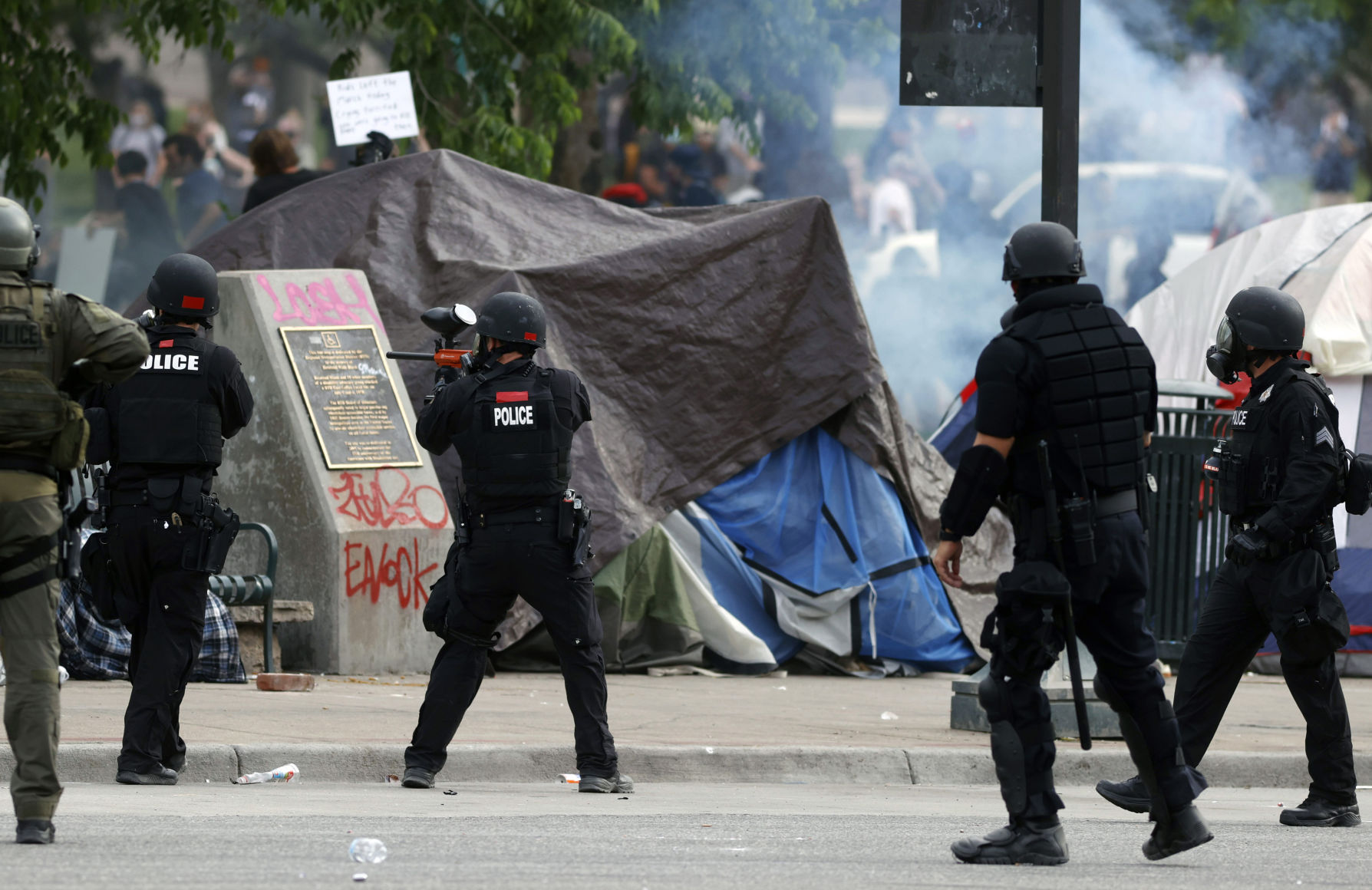
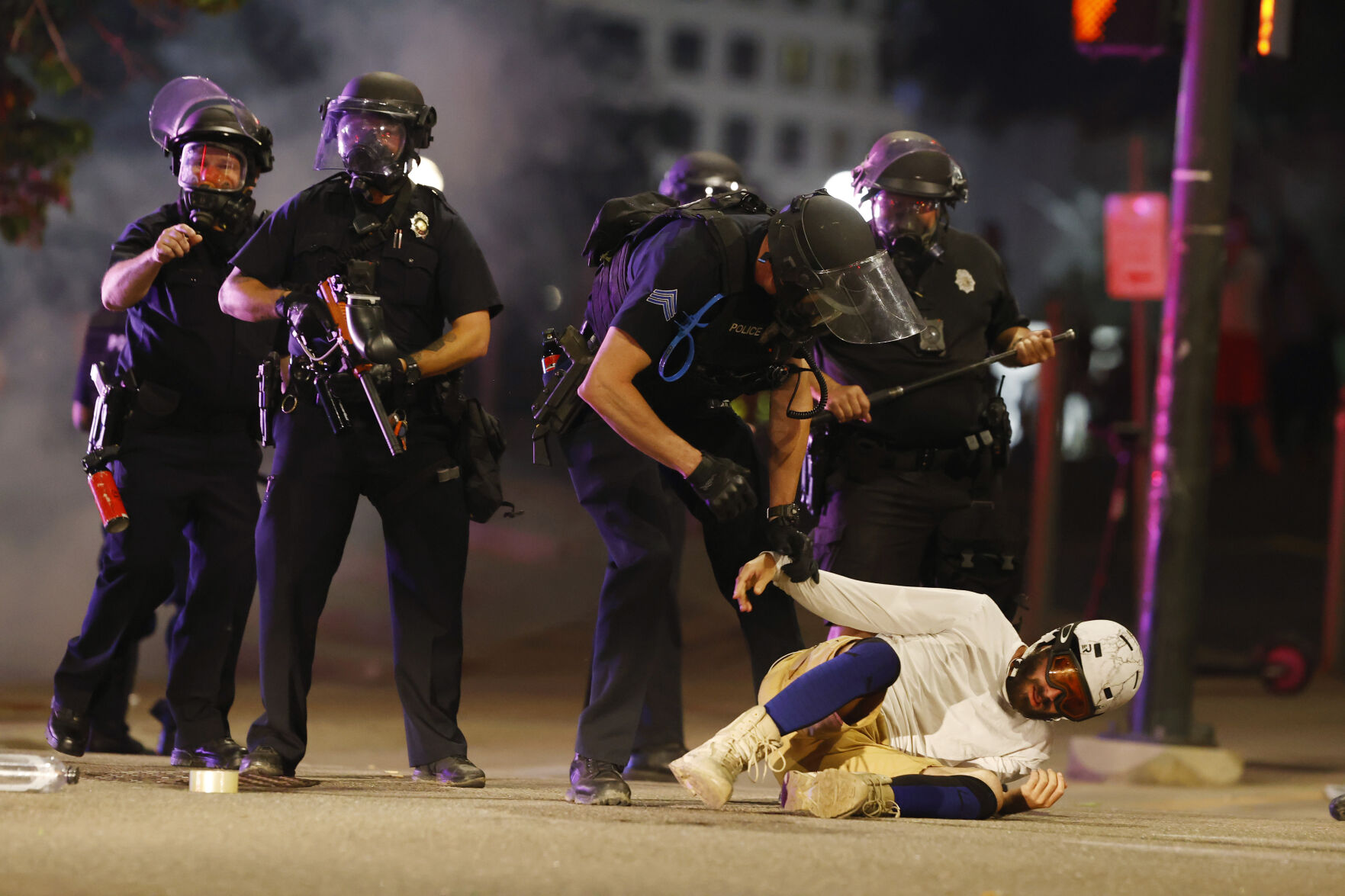
A federal judge decided earlier this month that a jury will evaluate whether the City and County of Denver and one Aurora police officer violated the constitutional rights of 13 plaintiffs who were injured during the police response to protests in downtown Denver in May 2020.
In a pair of March 1 orders, U.S. District Court Judge Nina Y. Wang concluded jurors could find the use of force against peaceful protesters was a response to First Amendment-protected activity, and that Denver’s own policies motivated officers to use excessive force. She also allowed plaintiff Tyson McCormick to procced with his specific claims against Aurora Officer Joshua Winters, who allegedly shot him with a beanbag while assisting Denver.
“Accepting Plaintiff’s version of events, a reasonable jury could conclude that Mr. McCormick did not pose a threat to officers, had not committed a serious offense, and was not attempting to flee or resist arrest,” Wang wrote.
She also decided there would be two trials in the case: one to address Denver’s alleged constitutional violations and the other focusing on Winters.
The lawsuit is one of several that have asserted Denver police and neighboring law enforcement agencies violated the constitutional rights of protesters in late May and early June 2020. After bystander video captured Minneapolis police Officer Derek Chauvin murdering George Floyd by kneeling on Floyd’s neck for nine minutes, demonstrations erupted internationally, including in Denver.
In 2022, a federal jury awarded a group of plaintiffs nearly $14 million for Denver’s excessive use of force in responding to the protests. The city has also approved millions of dollars in settlements stemming from its arrests of protesters for violating an overnight curfew and the use of crowd control tactics allegedly without warning.
In the lawsuit assigned to Wang, 13 attendees of the protests similarly alleged Denver, through its policies, was responsible for police injuring them with beanbags and chemical munitions. In addition to excessive force, the plaintiffs claimed the defendants retaliated against them for exercising their First Amendment rights.
The defendants moved for summary judgment, asking Wang to resolve the case in their favor without a trial. Reviewing the evidence applicable to each of the plaintiffs, Wang surgically defined the contours of which claims may proceed against which defendants, allowing only some portions of the original lawsuit to move ahead.
Claims against Denver
Wang concluded jurors could find the police use of teargas and projectiles was motivated by the plaintiffs’ constitutionally protected protesting. Therefore, she permitted the First Amendment claims against the city to face a jury.
As for the excessive force claims, Wang clarified the use of chemical weapons alone could not support a constitutional violation. Instead, only if the teargas “restricted the freedom of movement,” as it allegedly did for three plaintiffs, could Denver be liable.
Evaluating the alleged role Denver had in promoting the use of excessive force, Wang agreed six plaintiffs could argue at trial that Special Operations Commander Patrick Phelan, acting as a “policymaker,” approved the crowd control techniques or teargas used against them. Also, the city not requiring officers to activate their body-worn cameras or file use-of-force reports could have motivated officers’ actions.
Those unwritten policies “caused the officers to feel more comfortable using force on protestors and, in turn, caused Plaintiffs’ injuries,” Wang wrote in summarizing the plaintiffs’ theory of liability. She allowed the excessive force claims to proceed on that basis, as well.
Claims against Aurora officer
Winters, the Aurora officer, allegedly shot McCormick with a beanbag near E. Colfax Ave. and N. Washington Street on May 31. McCormick suffered a concussion, hearing loss and other injuries from the impact.
There was no dispute that at the time Winters shot McCormick, McCormick had picked up a teargas canister in the street and tossed it. The parties disagreed whether McCormick had thrown it “back toward police” or simply “away from the other protesters.”

Winters invoked qualified immunity, which generally shields government employees from civil liability unless they violate a person’s clearly established legal rights.
Reviewing the video evidence, Wang found it plausible that Winters’ force could be deemed excessive and the result of McCormick’s First Amendment-protected activity. She declined to grant qualified immunity.
“One jury has already found that Denver used excessive force and violated protesters’ First Amendment rights at the George Floyd protests in 2020,” said plaintiffs’ attorney Elizabeth Wang, who has no relation to Judge Wang. “The plaintiffs in this case are very much looking forward to presenting their claims to a jury at trial.”
Separate trials
Finally, in an order issued on Friday, Judge Wang addressed how the case would proceed to trial logistically. The plaintiffs’ attorneys requested McCormick’s claims against Winters be separated from the rest of the litigation, resulting in two cases and two trials. The defendants did not oppose the idea.
The plaintiffs’ concern was that Winters could exercise his ability to immediately appeal Wang’s decision to deny him qualified immunity. Although Denver cannot benefit from qualified immunity, Winters’ potential appeal could delay the entire case while the parties wait for the U.S. Court of Appeals for the 10th Circuit to weigh in.
Wang agreed the claims against Denver and those against Winters should be tried separately because there was “little to no overlap” between them.
“Indeed, trying all claims in one trial would result in the jury hearing a large amount of evidence that is ultimately not relevant,” she reasoned.
Although Wang declined to formally split the lawsuit into two separate cases, she signaled that if Winters ultimately files an appeal by the April 1 deadline, her preference would be to forge ahead with a trial for just the Denver claims. She ordered the parties to propose a time between October 2024 and February 2025 to set trial dates.
The case is Cousik et al. v. City and County of Denver et al.

Federal judge lifts public access restriction on Children’s Hospital Colorado’s challenge to DOJ subpoena
Michael Karlik
michael.karlik@coloradopolitics.com
Updated 4 hours ago
A federal judge ordered last month that the public be able to access the filings in Children’s Hospital Colorado’s legal challenge to a U.S. Department of Justice subpoena seeking a broad range of documents about patients, employees and communications. Children’s...

10th Circuit rules 20-year-old DUI convictions may be factor in deportation proceedings
Michael Karlik
michael.karlik@coloradopolitics.com
Updated 12 hours ago
The Denver-based federal appeals court concluded last month that it was appropriate for immigration authorities to consider a man’s 20-year-old impaired driving convictions when determining if he recently exhibited “good moral character.” Under federal law, an immigrant seeking to remain...
Mesa County judge wrong to conclude hatchet not a ‘knife,’ says appeals court
Michael Karlik
michael.karlik@coloradopolitics.com
Updated 15 hours ago
Colorado’s second-highest court determined last week that a Mesa County judge incorrectly reduced a defendant’s menacing charge from a felony to a misdemeanor after finding his hatchet did not meet the definition of “knife.” A person commits menacing as a...
10th Circuit rules Greeley officer unconstitutionally detained man standing outside home
Michael Karlik
michael.karlik@coloradopolitics.com
Updated 1 day ago
The Denver-based federal appeals court concluded last week that a Greeley police officer lacked reasonable suspicion to detain a man who was standing outside the door of a residence and not engaging in any indicators of criminal activity. A three-judge...

‘Utterly no precedent’: Federal judge expresses concerns about Jeffco’s early appeal in jail death case
Michael Karlik
michael.karlik@coloradopolitics.com
Updated 1 day ago
A federal judge shared his concerns on Monday about Jefferson County’s appeal of a routine procedural order in a constitutional rights case, which the plaintiffs argued could spawn appeal-related delays in countless lawsuits against the government. During a hearing, U.S....

Justice Hart’s absence continues, state Supreme Court hears oral arguments | COURT CRAWL
Michael Karlik
michael.karlik@coloradopolitics.com
Updated 1 day ago
Welcome to Court Crawl, Colorado Politics’ roundup of news from the third branch of government. One member of the Colorado Supreme Court remains on an unusual leave of absence, plus the court heard oral arguments in eight more cases last...

Suspect in 5-person fatal crash near Franktown faced dozen previous criminal charges, including assault
Sage Kelley
sage.kelley@denvergazette.com
Updated 2 days ago
The man accused of carjacking a vehicle from a Regional Transportation District station, then crashing into a family of five and causing five deaths — including his own — has been identified. The Denver Gazette confirmed with multiple sources that...
Colorado Supreme Court to examine whether corporations can be liable for ‘felonious killing’
Michael Karlik
michael.karlik@coloradopolitics.com
Updated 2 days ago
The Colorado Supreme Court recently announced that it will determine whether corporations can be liable for a “felonious killing,” meaning there is no limit to the damages they might pay for pain and suffering after causing a wrongful death. At...
Panel member ejected from one judge’s discipline case, as second judge challenges protocols in his proceeding
Michael Karlik
michael.karlik@coloradopolitics.com
Updated 4 days ago
One member of a panel adjudicating the misconduct allegations against a county court judge has been replaced due to her alleged non-responsiveness, at the same time a different county court judge is objecting to the intended protocols in his own...
Colorado justices ponder scope of law curbing insurers’ ability to allege failure to cooperate
Michael Karlik
michael.karlik@coloradopolitics.com
Updated 6 days ago
Members of the Colorado Supreme Court pondered a question last week that could have sweeping ramifications for those making insurance claims: When the legislature required insurance companies to take certain steps before accusing policyholders of failing to cooperate in an...
PREV
PREVIOUS
Colorado lawmakers eye regulation of dating apps to prevent assault, rape
The number of couples who have met on a dating app or website has skyrocketed since online dating services first debuted over two decades ago. While many find happy and healthy relationships through the online services, others looking for love have not been so lucky. Currently, Colorado is ranked as the fifth-most dangerous state for […]

Q&A with Jeff Rupp | Judicial advocacy group's director talks about common goals, differences with judicial branch
The Colorado Judicial Institute is a 45-year-old nonprofit originally founded to focus on the state’s relatively new system of appointing and retaining judges, which voters enacted to replace partisan judicial elections. Now, CJI’s work also includes advocating on behalf of the judiciary, informing the public about the courts and supporting the continuing education of judges. […]