

Hoping for Haley’s comet in the GOP primary | SLOAN

Most of the relevant headlines this week have been some form of what might be called a journalistic coronation, declaring former President Donald Trump’s 11-point victory in the New Hampshire primary Tuesday night all but solidified his nomination as the Republican presidential candidate. This is a forgivable analysis, inasmuch as the polls have Trump leading rather comfortably, and the conventional wisdom in any case holds first-place wins in both the Iowa caucuses and the New Hampshire primary ought to seal it up nicely.
But there is a reason Trump’s victory speech was so rife with rage-filled invective toward Haley, (who uses a victory speech to criticize your opponent’s dress?) beyond simple personality disorder; Tuesday’s New Hampshire results did not place Trump entirely out of reach, and sounded some pretty important warning tocsins for his campaign and the GOP in November.
First, let’s all admit 11 points is closer than most anyone expected Haley to get to the former president. It’s not the single-point gap she and her campaign may have hoped for, but it’s also not that far off. And she garnered that after what virtually everyone in the political-watching world characterized as a lackluster campaign effort in the Granite State.
Stay up to speed: Sign up for daily opinion in your inbox Monday-Friday
Second, while Trump clearly has the backing of the new populist Republican base – Haley only won the support of about a quarter of primary voters who identified as Republican, and that is obviously a problem – she just as clearly has the backing of independents, having won 60% of the independent vote. The independent vote, you will recall, is what will decide the general election. And in the meantime, a great deal of those independents are Republicans who left the party for any of a number of reasons, a big one being Donald Trump.
And finally, it is helpful to remember this is just the beginning of the primary. Yes, Trump has two victories and a lead in the polls, but he also only has 32 of the 1,215 delegates needed to win the nomination. Haley has 18. Want some more statistics? The Iowa Caucus only drew about 15% of the state’s Republicans, meaning Trump won the support of 8%. And he barely managed to win a majority in New Hampshire – 54% to Haley’s 48%. Yes, I know, numbers are interesting, but all that matters at the end of the day in politics is who wins. Fair enough, but the figures help construct the full picture, and those figures do not paint a contest that is over.
None of which is to say Trump is not, by any rational measure, the clear frontrunner, or that Haley’s somewhat-better-than-expected showing on Tuesday has suddenly propelled the campaign into a closely competitive one. What it did do was abort her exit from the race and make the contest a two-person sparring match. The factors to be consulted when considering whether to quit or push forward can be pared down to practicality, pride and politics, and all three categories can cut either way.
In practical terms, there is very little point in continuing on if no path for success exists. Yet the inverse is also true: if there is a chance, no matter how slender, it may be worth pursuing. Politics is a strange, dynamic game, it is still quite early in the process, and seldom if ever has a wilder card than Donald Trump been in the mix.
Pride necessarily plays a role; it has to be easier to bow out gracefully when beat than to hang on like Brett Favre, daily absorbing the vituperative ad hominem attacks of Trump. On the other hand, no one, as they say, likes a quitter.
Which leaves the political question. The conventional logic is either party would be well advised to wrap up the primary process as quickly as possible, coalesce around a single candidate, and get on with the business of the general election. The logic encounters difficulties in this instance, when the presumptive nominee is Trump.
For starters, a considerable segment of the Republican Party doesn’t want him, and is looking for a suitable, conservative and adult alternative, which Haley provides. That alone may provide a valid argument for carrying on to the convention, even if it becomes a rather Quixotic exercise. More to the political point is the fact Trump is perhaps the only person in the country who could lose the election to President Joe Biden.
So Haley is not out of it just quite yet. But for her to have any realistic chance at the nomination, and rescuing the country from another Biden reign, she needs to refocus her campaign on detailed policy, to which she can attack Trump from the right. Trump is, arguably, the most liberal Republican since John Lindsey, to the left on trade, foreign policy, spending, entitlements, criminal justice reform and other issues which don’t fire up attendees at rallies. Haley is strong on those issues, and needs to project that.
In short, at this point the nomination is Trump’s to lose. But that is a task to which he has previously proven up to.
Kelly Sloan is a political and public affairs consultant and a recovering journalist based in Denver.


Are our overlords normalizing power outages? | Jon Caldara
Jon Caldara
jon-caldara@coloradopolitics.com
Updated 3 days ago
I’ve lived in Colorado since 1970. And you know what Colorado had back in 1970? High winds blowing down the Front Range. I moved to Boulder in 1984 and have been there ever since. And you know what Boulder has...

Who has the power to declare war? | Cronin and Loevy
Tom Cronin Bob Loevy
tom-cronin-bob-loevy@coloradopolitics.com
Updated 1 day ago
Our constitutional framers boldly and ambitiously granted Congress the power to declare war yet granted the executive the responsibility, after war is declared, to supervise war as the commander-in-chief. That worked well until the Cold War began. The U.S. has been...

The delicate, ever-changing dance between politics and religion | SONDERMANN
By Eric Sondermann
by-eric-sondermann@coloradopolitics.com
Updated 1 day ago
The dance, really a marathon that brings to mind the classic movie “They Shoot Horses, Don’t They?”, has been going on as long as there have been governments and organized religion. That is to say that this delicate tango has...
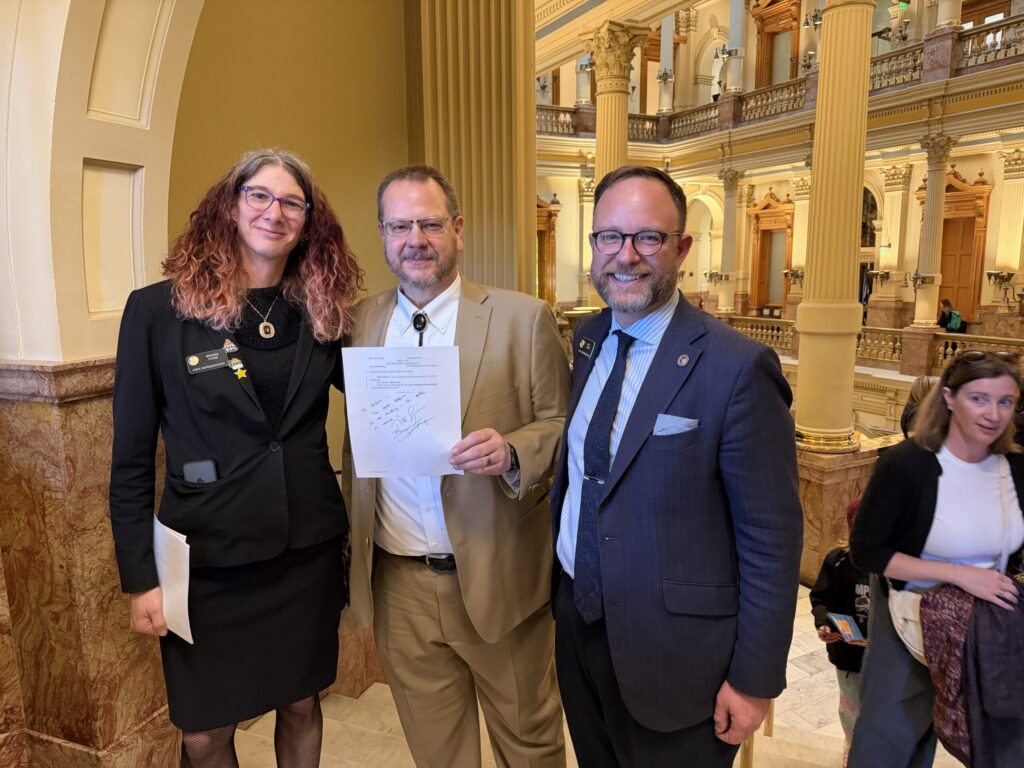
Roasts, get yer roasts, here: Capitol M | Week of March 14, 2026
Marianne Goodland
marianne.goodland@coloradopolitics.com
Updated 5 days ago
The lighter side of the Capitol, especially in the past week Apparently, the pending and eventual switch to daylight stupid time has put people in some pretty funny moods. And thank goodness! On March 4, the Senate approved the appointments...

Colorado’s election audits are built on math, not politics | IN RESPONSE
Colorado Politics
colorado-politics@coloradopolitics.com
Updated 3 days ago
By Amanda Gonzalez You don’t build a secure election system overnight. You build it over years — layer by layer — reinforcing it with stronger safeguards, better technology and more transparency. In Colorado, one of those safeguards is a little-known...
The backstory behind the school-funding TABOR ballot initiative | Paula Noonan
Paula Noonan
paula-noonan@coloradopolitics.com
Updated 4 days ago
Last session, the General Assembly took in a report on K-12 public school funding. The legislature ordered the report because an idea circulated Colorado was among the bottom five states in dollars allocated per student even though it is one...
Senate Bill 22 critical to keeping energy costs affordable, power reliable | PODIUM
Colorado Politics
colorado-politics@coloradopolitics.com
Updated 3 days ago
By Brian Wortinger I love Colorado’s outdoors. I’m an avid skier and hiker and my happiest days are spent deep in the mountains with no one around for miles. I want to protect that environment as much as anyone along...

Swipe-fee ban a giveaway to big boxes, mega-chains | IN RESPONSE
Colorado Politics
colorado-politics@coloradopolitics.com
Updated 5 days ago
By Jenifer Waller Four Colorado lawmakers recently published an op-ed in Colorado Politics calling for legislation to prohibit interchange fees on the sales tax portion of credit and debit card transactions (“Why Colorado should stop charging swipe fees on sales...

Leveling the playing field —why Colorado must fight fire with fire on redistricting | OPINION
Colorado Politics
colorado-politics@coloradopolitics.com
Updated 5 days ago
By Curtis Hubbard So Dick Wadhams suddenly cares about mid-decade redistricting — hyperventilating about efforts to “hijack Colorado’s congressional map” and calling those of us involved with the effort “amazingly naive.” Where was his outrage last year when President Donald...
You get what you pay for in your state reps | Hal Bidlack
Hal Bidlack
hal-bidlack@coloradopolitics.com
Updated 6 days ago
My regular readers will know of my affection for the Out West Roundup, a Colorado Politics feature that lets us keep up to date with the goings on out here in the western U.S., and draws attention to stories that...
PREV
PREVIOUS

Zoom bombing must be managed for robust public participation | Durango Herald
City Council meetings anywhere can go off the rails. But Tuesday’s regular meeting in Durango went down in history as the city’s first to be Zoom bombed by about seven intruders who signed up online to comment. The bombers didn’t have anything to say about the proposed Tree Farm Village housing development, the reason for […]

A Dem agrees with Colorado GOP — primaries should be closed | BIDLACK
Hal Bidlack Back in 1904, when my grandmother was six years old – so not that long ago – a fairly liberal fellow named Robert LaFollette was governor of Wisconsin. He was tired of the back-room deals that selected candidates for office, the famous “smoke-filled rooms” that dominated a long period of our political history. LaFollette […]