

‘Housing first’ is a dead end for Denver’s homeless | Denver Gazette

Tom Wolf was a homeless drug addict roaming the streets of San Francisco five years ago. Today, he’s an outspoken advocate for an approach to homelessness that is strikingly different from the “housing first” policies now in place in a lot of U.S. cities, including Denver.
Last week, as reported by The Gazette, he stopped by with an important message for Mayor Mike Johnston and other local policymakers bent on housing the homeless without first requiring them to make changes: It won’t work.
“Johnston is going to be scratching his head as to why homelessness isn’t gone in four years,” Wolf said at a town hall last Tuesday hosted by The Denver Gazette and Colorado Politics.
“There is an addiction crisis amongst the homeless community,” Wolf said. “I like Mayor Johnston. I think he has an opportunity to pivot because he’s new.”
Stay up to speed: Sign-up for daily opinion in your inbox Monday-Friday
If he is to succeed, Denver’s mayor must do just that – pivot – and boldly defy the conventional wisdom of the progressive chattering class when addressing homelessness. Notably, he has to face up to what keeps much of the hardcore homeless population on the streets. It’s not lack of opportunity, hard luck or an unfeeling economic system. It’s addiction.
“We are now facing a situation where in Denver you have 5,000 homeless people,” Wolf said at Tuesday’s forum. “If 80% of them are addicted to drugs (according to a UCLA study)… that severely complicates the issue of actually ending that individual’s homelessness, and you can’t just end it by just putting them in a house or in a tiny home or in a shelter.”
Wolf’s view amounts to an about-face from Denver’s perennial – and perennially unsuccessful – policy of throwing ever more money at housing the homeless, come what may. The city spent $152 million last year and has budgeted $254 million for 2023. That’s more than 30 times the $8 million spent a dozen years ago when former Mayor Michael Hancock took office.
While the money funds wide-ranging services, including addiction rehab for those willing to participate, the principle focus is putting roofs of some sort over the heads of the diehard street dwellers. The city has gone to lengths like helping a nonprofit buy a motel to house them as well as setting up city-run tent camps that have drawn push-back from irate neighbors.
Some cities have gone even further down the same path. The Los Angeles City Council, incredibly, will ask that city’s voters next spring to require hotels to house the homeless.
Meanwhile, for all the expense and effort, the homeless throng Denver’s streets in ever-greater numbers. As a Gazette headline noted not long ago, the number of Denver metro homeless this year leapt by a third over last year.
And yet, the fledgling Johnston administration appears headed down that same road – toward the same dead end. The administration plans “to evaluate and integrate four main types of housing/shelter options,” including rental properties, hotels, commercial structures and “micro-communities/shelter alternatives such as tiny home villages, safe outdoor camping spaces and safe parking spaces.” By all indicators, there won’t be any screening for addiction or mental health issues and no requirement for treatment prior to placing people in housing.
Paul Scudo is another recovering former addict who once was homeless and now sees the light; he heads the groundbreaking Step Denver addiction-recovery organization. Scudo wrote in a commentary in The Gazette last year, “…Housing is NOT the be-all, end-all answer.”
“…Enabling homeless people who are addicted to drugs and alcohol is not helping them,” Scudo wrote. “We are causing more harm than good.”
It’s time to shift tack, Mr. Mayor.
Denver Gazette Editorial Board



You get what you pay for in your state reps | Hal Bidlack
Hal Bidlack
hal-bidlack@coloradopolitics.com
Updated 4 hours ago
My regular readers will know of my affection for the Out West Roundup, a Colorado Politics feature that lets us keep up to date with the goings on out here in the western U.S., and draws attention to stories that...
A warrant should mean something — expedite carrying them out | OPINION
Colorado Politics
colorado-politics@coloradopolitics.com
Updated 4 hours ago
By Aaron Ping My name is Aaron Ping. I am a father from Washington state, and I am writing because my 16-year-old son, Avery, cannot. Avery died on Dec. 19, 2024. The drugs that killed him were ordered through Snapchat....

Lower Basin must adapt to Colorado River hydrology | OPINION
Colorado Politics
colorado-politics@coloradopolitics.com
Updated 4 hours ago
By Nick Peters A February deadline for determining future operating guidelines for the West’s two largest reservoirs came and went with no agreement on the table and clear lines drawn in the sand. A seven-state resolution to how Lake Mead and Lake Powell will...

Colorado’s GOP at its best — and worst | Dick Wadhams
Dick Wadhams
dick-wadhams@coloradopolitics.com
Updated 3 days ago
By Dick Wadhams Colorado Republicans are fighting to be relevant in the face of gross mismanagement by Democrats who totally control state government. While the Colorado Republican Party is mired in controversy, several Republican elected officials and candidates represent the...

Someone’s lying in latest activist embarrassment for Polis’ CPW Commission | Rachel Gabel
Rachel Gabel
rachel-gabel@coloradopolitics.com
Updated 3 days ago
Either Samantha Miller is lying, or Gov. Jared Polis is. If Miller is lying, she is so secure in the red carpet rolled out for animal activists by this administration she is willing to put words in the governor’s mouth....

Ask Secretary of State candidates if they’re in favor of independent election audits | Jon Caldara
Jon Caldara
jon-caldara@coloradopolitics.com
Updated 4 days ago
This part will disappoint angry people on Twitter: Relax. Put the pitchforks down. I am not relitigating the 2020 election or mail ballots or even Tina Peters. But I am saying people don’t trust elections like they used to. And...
Redistricting plan to give Colorado Dems 7 members of the U.S. House will split El Paso County | Bob Loevy
Bob Loevy
bob-loevy@coloradopolitics.com
Updated 3 days ago
A proposed redistricting plan, which would give Colorado seven Democratic members of the U.S. House of Representatives and only one Republican, will split El Paso County into two parts and thereby weaken the county’s influence in Congress. El Paso County,...

Can deliberation save democracy? | Vince Bzdek
Vince Bzdek
vince.bzdek@gazette.com
Updated 16 hours ago
In September 2019, 523 Americans traveled to Dallas for an experiment called “America in One Room.” The gathering was designed to test a theory: Could representative citizens deliberate productively even in an era of intense polarization? The event focused on...
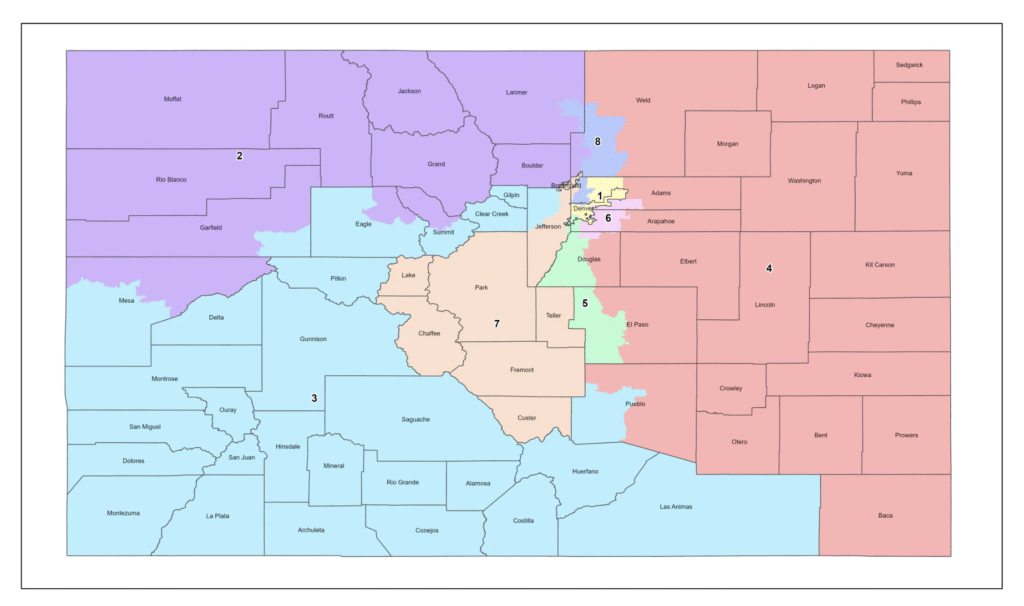
Redistricting scheme would give Colorado Democrats seven House members, split El Paso County | Bob Loevy
Bob Loevy
bob-loevy@coloradopolitics.com
Updated 2 days ago
A proposed redistricting plan, which could give Colorado seven Democratic members of the U.S. House of Representatives and only one Republican, would split El Paso County into two parts and thereby weaken the county’s influence in Congress. El Paso County,...

Is Trump a builder or just a latter-day headhunter? | SONDERMANN
By Eric Sondermann
by-eric-sondermann@coloradopolitics.com
Updated 5 days ago
It was well under 100 hours after President Donald Trump’s overly long, overly theatrical State of the Union speech that he unleashed American bombers across Iran. As I write, it is now less than 100 hours since those bombers started...
PREV
PREVIOUS
Who can Coloradans trust? | HUDSON
Miller Hudson It’s been 40 years since a therapist and close friend, advised me, “You know, Miller, you seem to have an anti-authoritarian mindset. Why is that?” Her observation came without knowing I had reported my commanding officer to the Judge Advocate General’s staff for diverting funds. I still recall the precise words included in […]

Colorado's GOP must embrace unaffiliated voters | OPINION
Pete Wood The Republican and Democrat parties are teeing up exactly what Americans and Coloradans don’t want in 2024 – a rematch of the 2020 presidential election. Among Republicans, Donald Trump maintains a major lead against his nearest rival by nearly 40 points. Among Democrats, President Biden maintains a nearly 50-point lead over his nearest […]