

Court: Man entitled to review police personnel file in assault case

A man convicted of assaulting a police officer has the right to review the two use-of-force reports against the officer he punched — and whom he accused of fabricating the incident, the Court of Appeals decided on Thursday.
Greeley police officers arrived at an apartment building early on a Sunday in July 2015 after receiving a call of a medical emergency and domestic dispute with the possibility of a gun inside the home. One of the parties to the dispute, Lorenzo Cardenas, Jr., told officers they needed a warrant. However, numerous other occupants of the apartment asked police to come inside for assistance.
Cardenas, identified as “Junior” by the court, pushed two of the officers as they entered and resisted arrest. One officer tased Cardenas as a result. Cardenas’ father, Lorenzo Cardenas-Villescas, Sr., appeared in the hallway and elbowed Sgt. Zach St. Aubyn. The officer tried to pull Cardenas-Villescas away from the others and his son.
Testimonies conflicted between whether Cardenas-Villescas hit Officer Seth Luedtke in the face or not. Cardenas-Villescas alleged some of the officers invented the story to justify Luedtke’s use of force against him and his son.
Weld County prosecutors charged Cardenas-Villescas with two counts of second-degree assault on the police officers. A jury convicted him only of assaulting Luedtke, and he received an eight-year prison sentence.
Because the defendant alleged excessive force against him, his attorney issued a subpoena for the disciplinary records of the officers. Cardenas-Villescas believed the officers’ “honesty and credibility” was an issue. The Greeley Police Department countered that his accusations were vague and Cardenas-Villescas sought information about officers who did not interact with him in the apartment.
Weld County District Judge Thomas J. Quammen sided with Cardenas-Villescas on producing the files of three of the officers, concluding the police department’s argument “would effectively immunize a police officer from ever facing impeachment for a pattern of ongoing bad behavior during the criminal trial of a defendant” were it to succeed. Quammen conducted a closed-door review of St. Aubyn and Luedtke’s files.
Subsequent to the judge’s inspection, Quammen denied the disclosure of the officers’ personnel information. He subsequently ordered further closed-door review for all officers who “placed hands” on Cardenas-Villescas, but only for personnel incidents resulting in discipline. Quammen ultimately decided the defendant needed a “greater showing of need” to inspect the records, and Cardenas-Villescas appealed the lack of review for the latter officers as well as the lack of disclosure for the files of St. Aubyn and Luedtke.
The Colorado Supreme Court has established that police officers have an expectation of privacy for their personnel files, and trial court judges must weigh that confidentiality against the need for disclosure. A related 1983 decision determined a defendant charged with assaulting a police officer may be able to learn whether any complaints of excessive force exist against the officer involved, reasoning that the officers’ credibility is relevant to the case.
To refine the issue further, the Supreme Court later listed the precise factors a trial court must consider to compel the documents from a law enforcement agency. Those include the relevance to the case, the good faith of the request and the need to prepare for trial using those files.
The appeals panel in Cardenas-Villescas’s case agreed that he was allowed to see the file only for Luedtke.
“Because Cardenas-Villescas disputes that he punched Officer Luedtke before Officer Luedtke struck him nine times with his baton, and the principal testimony of the assault was from the officers on the scene, the information was material and relevant to Cardenas-Villescas’s defense,” wrote Judge Sueanna P. Johnson for the three-member panel.
The judges ordered the trial court to hand over Luedtke’s two incident reports to the defense, and allow Cardenas-Villescas the opportunity to argue a “reasonable probability” that the trial would have ended differently if he had access to those records at the time. If the district court decides in the affirmative, it must order a new trial.
Michael Fairhurst, an attorney with Killmer, Lane & Newman, LLP, said that officers’ personnel files, are “relevant to assessing at least their credibility, training, discipline, experience, quality of supervision and motive to testify in a particular way.” In civil cases, he added, such information can form a basis for holding municipalities liable for their training, supervision and discipline of employees.
The panel did not, however, agree with Cardenas-Villescas that he was entitled to view the personnel information of all officers who laid hands on him.
“Some officers were outside the apartment and did not even witness the interactions between Cardenas-Villescas and Sergeant St. Aubyn and Officer Luedtke that led to the assault charges,” Johnson noted. “Instead, he claims that all officers cover for each other and protect one another.”
She believed it would be burdensome to every criminal case to rely on that standard for disclosure. The panel also did not agree with Cardenas-Villescas’s argument that the trial could have changed materially had he been present at a conference with his lawyer early in the trial in which the prosecutor disclosed an unrelated civilian shooting that involved some of the officers in his case. Cardenas-Villescas’ lawyer did not insist on disclosure of the shooting, and Johnson observed it was a “close call” about whether the situation harmed the defendant.
Given that the prosecutor had very little information other than publicly-reported accounts, however, “any questions Cardenas-Villescas would have asked would not have produced any useful information for his case during that hearing,” the panel decided.
The case is People v. Carenas-Villescas.

Primary rival sues to prevent Democrat Eileen Laubacher from going through assembly in Colorado’s 4th CD
Ernest Luning
ernest.luning@coloradopolitics.com
Updated 8 hours ago
Democratic congressional candidate Trish Calvarese on Monday asked a judge to prevent one of her primary rivals, Eileen Laubacher, from participating in the caucus and assembly process to seek the nomination to challenge Republican U.S. Rep. Lauren Boebert in Colorado’s...
Colorado lawmakers tackle legislation on sexual assault
Jenny Deam
jenny-deam@coloradopolitics.com
Updated 8 hours ago
A panel of Colorado lawmakers on Monday unanimously approved a bill that supporters say will offer protections and support to victims of domestic violence, stalking, sex trafficking and sexual assault, including mandatory training for law enforcement on trauma. The measure,...
Colorado Supreme Court clarifies restraining order violations can always support burglary charge
Michael Karlik
michael.karlik@coloradopolitics.com
Updated 11 hours ago
The Colorado Supreme Court’s majority ruled on Monday that a violation of a restraining order can also serve as a basis for finding a defendant guilty of burglary. Under state law, a person commits second-degree burglary by unlawfully entering or...

Big week ahead for major legislation to address housing affordability woes
Zach Halaschak, Washington Examiner
zach.halaschak.washington.examiner@gazetteedit.wpenginepowered.com
Updated 13 hours ago
The Senate is pushing ahead with a bipartisan bill to improve housing affordability, teeing up a critical week for housing on Capitol Hill and raising major questions about what provisions will be included. Senate Majority Leader John Thune (R-SD) filed cloture on legislation from the...

Macron goes nuclear with increases to French warhead arsenal
Timothy Nerozzi, Washington Examiner
timothy.nerozzi.washington.examiner@gazetteedit.wpenginepowered.com
Updated 14 hours ago
French President Emmanuel Macron is channeling the atomic spirit of his predecessor Charles de Gaulle with orders for the French military to “increase the number of nuclear warheads” in the nation’s arsenal. Macron announced the seismic shift in France’s defensive...

Who has been killed so far during US-Israel mission in Iran?
David Zimmermann and Keely Bastow, Washington Examiner
david.zimmermann.and.keely.bastow.washington.examiner@gazetteedit.wpenginepowered.com
Updated 14 hours ago
There have been numerous casualties on all sides since the joint U.S.-Israel strikes against Iran commenced over the weekend, with more lives expected to be lost as the campaign continues. The Islamic regime’s leadership is currently bearing the brunt of...
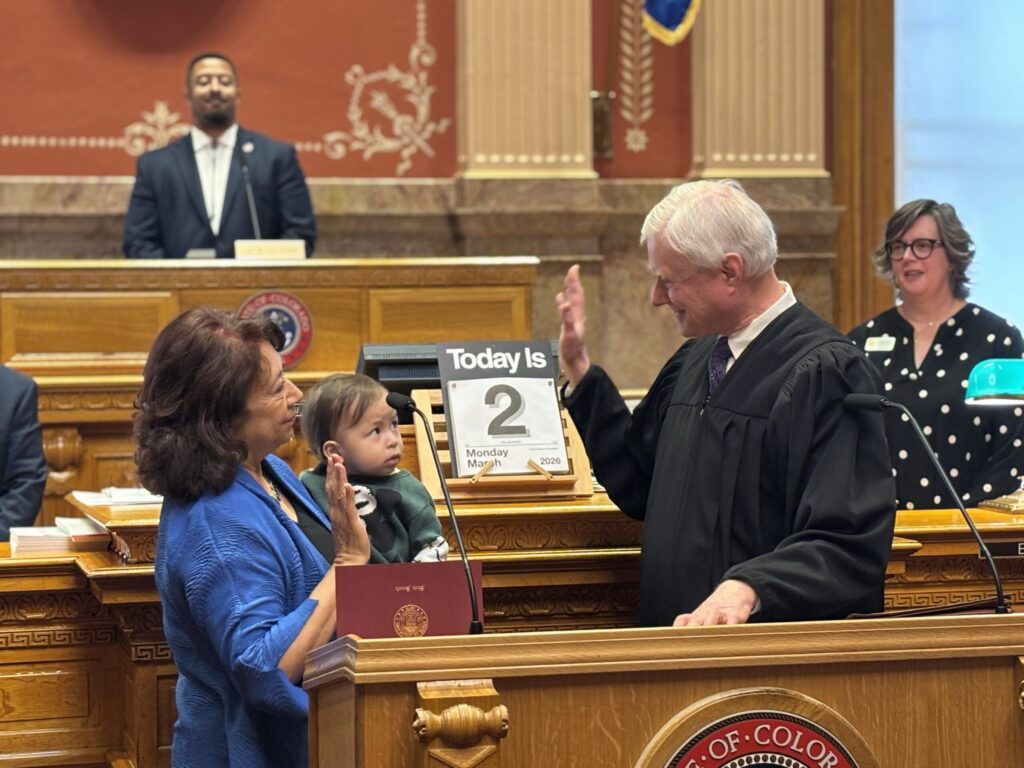
Colorado Senate swears in Adrienne Benavidez after district vacancy win
Marianne Goodland
marianne.goodland@coloradopolitics.com
Updated 14 hours ago
Sen. Adrienne Benavidez, a Democrat from Adams County, was sworn in Monday to the Colorado Senate, just four days after winning a vacancy election in District 21. She was sworn in by Colorado Court of Appeals Justice Lino S. Lipinsky...

10th Circuit judge creates vacancy, district court gets new chief judge | COURT CRAWL
Michael Karlik
michael.karlik@coloradopolitics.com
Updated 15 hours ago
Welcome to Court Crawl, Colorado Politics’ roundup of news from the third branch of government. A longtime member of the Denver-based federal appeals court will give the president a vacancy to fill, plus Colorado’s federal trial court will see a...

Denver mayor says his commute time tripled following ‘road diet’ change
Mark Samuelson Special to The Denver Gazette
mark.samuelson@denvergazette.com
Updated 13 hours ago
Mayor Mike Johnston is pushing back sharply against the claim by Denver councilmembers and bike activists that the city succumbed to lobbying pressure in revising a “road diet” plan for East Alameda Avenue, while noting that his own commute time...

Rural legislators, Colorado farmers defeat pollinator bill backed by Gov. Polis
Marianne Goodland
marianne.goodland@coloradopolitics.com
Updated 14 hours ago
A proposal to limit the use of neonicotinoid-coated crop seeds collapsed in the Senate Agriculture and Natural Resources Committee last week, as rural lawmakers, including two Democrats, joined Republicans to reject what they called an expensive, impractical mandate on farmers....
PREV
PREVIOUS

DeGette amendments on methane, environmental cleanups included in renewable energy bill
Two amendments from U.S. Rep. Diana DeGette will be included in a clean energy bill under consideration, one to limit methane emissions from extraction operations on public land and the second to require the U.S. Environmental Protection Agency to identify and remediate at least 100 communities suffering under violations of environmental law. “These aren’t radical […]

State commission sets rules monitoring, decreasing emissions at oil and gas sites
The Colorado Air Quality Control Commission approved new rules Wednesday to require emissions monitoring during early stages of operations at oil and gas sites. The monitoring program, reducing emissions of ozone precursors, is the first state regulatory system of its kind in the country. “Today is further proof that Colorado leads the way in regulating […]