

Denver grant program plans to distribute $2 million to micro, small business in most vulnerable communities

To try and aid the “most vulnerable communities” in Denver, the city is launching the Priority Neighborhood Small Business Fund, a grant program meant to support micro and small businesses in “priority” neighborhoods.
These neighborhoods, selected through the Denver Economic Development and Opportunity’s division of the Neighborhood Equity and Stabilization, include East Colfax, Elyria-Swansea, Globeville, Montbello, Northeast Park Hill, Sun Valley, Valverde, Villa Park, West Colfax and Westwood. These communities have been identified as some of the city’s “most under-represented communities to experience rapid socio-economic changes and are the most impacted by the COVID-19 pandemic.”
“Small businesses are a big part of the heart and soul of Denver’s neighborhoods,” said Eric Hiraga, executive director of DEDO. “We …want to ensure that they have access to the resources they need to help them survive through this pandemic.”
This fund will be an extension of DEDO’s Small Business Emergency Relief Fund, which has, to date, distributed $7 million to nearly 1,100 small businesses, according to a recent release.
“We know that people are hurting, that they are struggling, and we are here to help with the best of our abilities,” said Leesly Leon, a marketing and communications administrator with DEDO. “We want to help.”
To be eligible for the program, a business must have a 2019 annual revenue of $2 million or below, have no more than 25 employees, have experienced at least a 25% decline in revenue this year due to COVID-19, be registered with the Colorado Secretary of State’s Office with a certificate of Good Standing or Fact of Trade Name and have not received COVID-19-related funding from the City and County of Denver.
“We have been talking to the business community and we know the impacts,” said Carla Castedo Ribero, the director of economic mobility at DEDO. “Our job is to make sure we are making this process as accessible as possible.”
Castedo Ribero added that their main focus is addressing those businesses who have had to operate at a reduced capacity due to public health requirements. Other prioritization characteristics that are being considered include percentage of revenue decline, number of employees, businesses that have an annual revenue of $250,000 or less and rent instability.
Funding for the program will be provided from the city’s allocation of federal COVID-19 money under the Coronavirus Aid, Relief and Economic Security Act.
This planned funding comes months after some members of the community were denied the first round of relief funds.
The Colorado Independent reported in late April that members of the East Colfax Community Collective began a relief fund for small businesses that had shut down or faced financial difficulties due to the COVID-19 pandemic. Many of these businesses, the Independent reported, are owned by women, immigrants and refugees.
“We saw a humongous gap in equity and access to the first round of funding, both at the city and the federal levels,” said Brendan Greene, co-founder of the ECCC. “A large majority of the businesses that were trying to navigate these programs were not getting through and not getting funding.”
To date the fund created by the ECCC has raised $38,000, and $29,000 of that has already been distributed to East Colfax businesses in the form of $1,000 grants.
Phase 1 of PNSBF funding will distribute $1 million to around 125 micro and small business through a one-time grant assistance up to a maximum of $7,500 per grantee to eligible businesses in the 10 identified neighborhoods.
Greene said that while the ECCC and small businesses would have loved to see a program targeted at small and micro businesses earlier on, because many small businesses struggled against larger organizations with more power and access, this fund is a positive move in the right direction.
“I think if we are serious about stopping displacement and gentrification in our communities, all city programs must be created with equity at the center of how resources are allocated,” Greene said. “The Priority Neighborhood Small Business Fund is a step in the right direction in recognizing that neighborhoods at risk of displacement need dedicated programs that give them preferential access to city funding to offset historic inequities to access and resources.”
The funding has been approved for phase 2 of this project, but much of the final plan for this phase will come after phase 1 has been complete and DEDO sees how that plays out.
“We are flying the plane a little bit as we build it,” Castedo Ribero said. “Much of that phase 2 is going to depend on how businesses respond in these specific neighborhoods.”
“It is an extra step that we are taking as a city,” Leon said. “If we are talking about being equitable, diverse and inclusive, we have to demonstrate it.”
Greene said that a big aspect going forward in this program is addressing how eligible businesses even access the application.
“The more streamlined we can make the application the better,” Greene said. “It has taken our organization and the businesses of East Colfax corridor two or three rounds just to figure out how to get through the process and really give people the best shot at getting the funding. As much as they can front load that technical assistance before the program’s launch the better.”
Greene noted that beyond these programs, small businesses like the ones in East Colfax need “aggressive programs coming from the city,” such as ones to help businesses with property taxes, adding “no business should be getting put out by rising property taxes.”
He also said that for this program and ones to come, he thinks that organizations like the ECCC should be brought in to help construct how programs will function.
“We understand the city is doing everything it can and doing an amazing job getting resources out into the neighborhoods,” Greene said. “But use the relationships and the partnerships that you have to help guide this so we can identify the opportunities for better directive funding streams at the front end of these programs rather than at the back.”
Opening day, DEDO received 15 interest forms from different businesses. Applications for the program are open from Aug. 10 through Sept. 11, and awards are expected to be announced the week of Sept. 28.

Primary rival sues to prevent Democrat Eileen Laubacher from going through assembly in Colorado’s 4th CD
Ernest Luning
ernest.luning@coloradopolitics.com
Updated 1 hour ago
Democratic congressional candidate Trish Calvarese on Monday asked a judge to prevent one of her primary rivals, Eileen Laubacher, from participating in the caucus and assembly process to seek the nomination to challenge Republican U.S. Rep. Lauren Boebert in Colorado’s...

Colorado lawmakers tackle legislation on sexual assault
Jenny Deam
jenny-deam@coloradopolitics.com
Updated 1 hour ago
A panel of Colorado lawmakers on Monday unanimously approved a bill that supporters say will offer protections and support to victims of domestic violence, stalking, sex trafficking and sexual assault, including mandatory training for law enforcement on trauma. The measure,...
Colorado Supreme Court clarifies restraining order violations can always support burglary charge
Michael Karlik
michael.karlik@coloradopolitics.com
Updated 4 hours ago
The Colorado Supreme Court’s majority ruled on Monday that a violation of a restraining order can also serve as a basis for finding a defendant guilty of burglary. Under state law, a person commits second-degree burglary by unlawfully entering or...

Big week ahead for major legislation to address housing affordability woes
Zach Halaschak, Washington Examiner
zach.halaschak.washington.examiner@gazetteedit.wpenginepowered.com
Updated 7 hours ago
The Senate is pushing ahead with a bipartisan bill to improve housing affordability, teeing up a critical week for housing on Capitol Hill and raising major questions about what provisions will be included. Senate Majority Leader John Thune (R-SD) filed cloture on legislation from the...

Macron goes nuclear with increases to French warhead arsenal
Timothy Nerozzi, Washington Examiner
timothy.nerozzi.washington.examiner@gazetteedit.wpenginepowered.com
Updated 7 hours ago
French President Emmanuel Macron is channeling the atomic spirit of his predecessor Charles de Gaulle with orders for the French military to “increase the number of nuclear warheads” in the nation’s arsenal. Macron announced the seismic shift in France’s defensive...

Who has been killed so far during US-Israel mission in Iran?
David Zimmermann and Keely Bastow, Washington Examiner
david.zimmermann.and.keely.bastow.washington.examiner@gazetteedit.wpenginepowered.com
Updated 7 hours ago
There have been numerous casualties on all sides since the joint U.S.-Israel strikes against Iran commenced over the weekend, with more lives expected to be lost as the campaign continues. The Islamic regime’s leadership is currently bearing the brunt of...
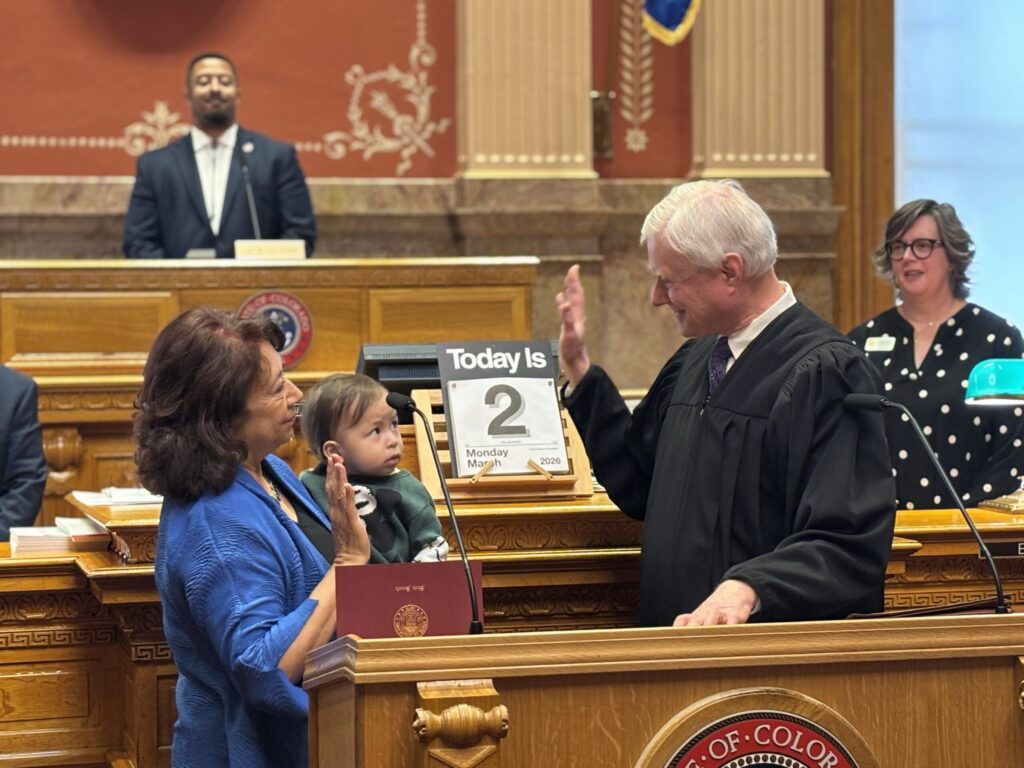
Colorado Senate swears in Adrienne Benavidez after district vacancy win
Marianne Goodland
marianne.goodland@coloradopolitics.com
Updated 7 hours ago
Sen. Adrienne Benavidez, a Democrat from Adams County, was sworn in Monday to the Colorado Senate, just four days after winning a vacancy election in District 21. She was sworn in by Colorado Court of Appeals Justice Lino S. Lipinsky...

10th Circuit judge creates vacancy, district court gets new chief judge | COURT CRAWL
Michael Karlik
michael.karlik@coloradopolitics.com
Updated 8 hours ago
Welcome to Court Crawl, Colorado Politics’ roundup of news from the third branch of government. A longtime member of the Denver-based federal appeals court will give the president a vacancy to fill, plus Colorado’s federal trial court will see a...
War in the Mideast widens as Trump says strikes on Iran could last several weeks
Jon Gambrell
jon.gambrell@associatedpress.com
Updated 9 hours ago
DUBAI, United Arab Emirates (AP) — The war in the Middle East spiraled further Monday as Israel and the United States pounded Iran in a campaign that U.S. President Donald Trump said would likely take several weeks. Tehran and its...

Denver mayor says his commute time tripled following ‘road diet’ change
Mark Samuelson Special to The Denver Gazette
mark.samuelson@denvergazette.com
Updated 6 hours ago
Mayor Mike Johnston is pushing back sharply against the claim by Denver councilmembers and bike activists that the city succumbed to lobbying pressure in revising a “road diet” plan for East Alameda Avenue, while noting that his own commute time...