

SLOAN | Do Polis’ emergency powers reach too far?

The Colorado state legislature is back in session this week, albeit in a rather surreal manner, mostly cleaning up the remnants of the interrupted regular session, carving out a budget with a $3 billion-and-then-some hole to contend with, and introducing a handful of other bills in one way or another connected with the pandemic. I would expect that the legislature will be dealing with the fallout to some extent for the next several years. One thing that should be on the agenda in the foreseeable future is an examination of the executive branch’s emergency powers.
I have said before, and will reiterate, that I firmly believe Gov. Polis invoked his emergency powers in good faith and out of necessity. I also believe that it is clear that either a) he has exceeded them at times, or b) that the laws extending him his emergency authority grant too much leeway.
This opens up a very old debate, one that stretches back far beyond the heady days of the American founding. The system we have been vouchsafed provides, wisely, for a separation of powers so that lawmaking is not concentrated in the hands of the executive. This has prevented much of the mischief and tragedy seen elsewhere around the world throughout history.
Yes, but on the other hand the need for strong executive action during an emergency has been just as self-evident. Usually these have been short-lived – i.e., during natural disasters where immediate relief and restoration of order is needed for a week or two – or fairly specific in their direction; national security crises, for instance, which demand executive decisions of a military nature. And few, I wager, would seriously question the need for the executive to execute plans and protocols quickly in the face of an emergency like a pandemic.
The question is – has always been – how to reconcile these two non-exclusive alternatives. The extent of these emergency powers has never been tested (like much of the rest of our collective pandemic response for that matter), and it is therefore proper that they now face adjustments, or even major surgery, where required.
There are problems inherent with over-extension, even deeper than the surface ones related to the restriction of civil liberties which are getting all the attention at the moment. One of the more astringent issues is that which could ultimately arise from mass non-compliance. The problem was illustrated quite ably by University of Pennsylvania Law Professor Paul Robinson in an op-ed published in the Wall Street Journal earlier in the month, in which he makes the allegorical reference to Prohibition. The 18th Amendment failed, in large part, because it was mostly ignored. But as Robinson points out, that bit of civil disobedience led to an increasing comfort with defiance of the law – not just laws against drinking, but other “real” laws, if you will, as well.
It’s simply human nature – once you break a rule the first time, the second time is easier. Do you recall the first time you skipped class? And how it felt like you were simultaneously breaking every one of the Ten Commandments? The second or third time were much easier. And then, perhaps, you move on to trying a cigarette on one of your illicit outings (not my angelic self, of course.) And on it may easily go. That is part of the fear associated with having laws that are unsustainable and which invite mass defiance.
This is also precisely the problem with vast application of broad emergency powers. Government is comprised of fallible humans guided by the same human nature as the rest of us, after all. Once broad executive power is, however reluctantly, invoked once, the risk arises that the next time will be easier. Measures that were unthinkable two months ago are now thinkable.
Reductionist thinking, fueled by social media, allows polarized imaginations to run wild, so that some on the right fear a future Democratic administration may, in the name of a climate emergency, imprison and kill anyone with disposable income and permit abortion up to five years old; while some on the left may fear a future Republican administration could, in the name of national security, prohibit dancing, hang homosexuals, and give every CEO in the state a machine gun. The reality will be less melodramatic, which is not to say that future excesses will not be injurious to the fabric of society. Reviewing the emergency power statutes, and installing necessary guiderails, makes abundant sense, and makes for good government.
Kelly Sloan is a political and public affairs consultant and a recovering journalist based in Denver.

You get what you pay for in your state reps | Hal Bidlack
Hal Bidlack
hal-bidlack@coloradopolitics.com
Updated 8 hours ago
My regular readers will know of my affection for the Out West Roundup, a Colorado Politics feature that lets us keep up to date with the goings on out here in the western U.S., and draws attention to stories that...
A warrant should mean something — expedite carrying them out | OPINION
Colorado Politics
colorado-politics@coloradopolitics.com
Updated 9 hours ago
By Aaron Ping My name is Aaron Ping. I am a father from Washington state, and I am writing because my 16-year-old son, Avery, cannot. Avery died on Dec. 19, 2024. The drugs that killed him were ordered through Snapchat....

Lower Basin must adapt to Colorado River hydrology | OPINION
Colorado Politics
colorado-politics@coloradopolitics.com
Updated 9 hours ago
By Nick Peters A February deadline for determining future operating guidelines for the West’s two largest reservoirs came and went with no agreement on the table and clear lines drawn in the sand. A seven-state resolution to how Lake Mead and Lake Powell will...

Colorado’s GOP at its best — and worst | Dick Wadhams
Dick Wadhams
dick-wadhams@coloradopolitics.com
Updated 3 days ago
By Dick Wadhams Colorado Republicans are fighting to be relevant in the face of gross mismanagement by Democrats who totally control state government. While the Colorado Republican Party is mired in controversy, several Republican elected officials and candidates represent the...

Someone’s lying in latest activist embarrassment for Polis’ CPW Commission | Rachel Gabel
Rachel Gabel
rachel-gabel@coloradopolitics.com
Updated 3 days ago
Either Samantha Miller is lying, or Gov. Jared Polis is. If Miller is lying, she is so secure in the red carpet rolled out for animal activists by this administration she is willing to put words in the governor’s mouth....

Ask Secretary of State candidates if they’re in favor of independent election audits | Jon Caldara
Jon Caldara
jon-caldara@coloradopolitics.com
Updated 5 days ago
This part will disappoint angry people on Twitter: Relax. Put the pitchforks down. I am not relitigating the 2020 election or mail ballots or even Tina Peters. But I am saying people don’t trust elections like they used to. And...
Redistricting plan to give Colorado Dems 7 members of the U.S. House will split El Paso County | Bob Loevy
Bob Loevy
bob-loevy@coloradopolitics.com
Updated 3 days ago
A proposed redistricting plan, which would give Colorado seven Democratic members of the U.S. House of Representatives and only one Republican, will split El Paso County into two parts and thereby weaken the county’s influence in Congress. El Paso County,...

Can deliberation save democracy? | Vince Bzdek
Vince Bzdek
vince.bzdek@gazette.com
Updated 20 hours ago
In September 2019, 523 Americans traveled to Dallas for an experiment called “America in One Room.” The gathering was designed to test a theory: Could representative citizens deliberate productively even in an era of intense polarization? The event focused on...
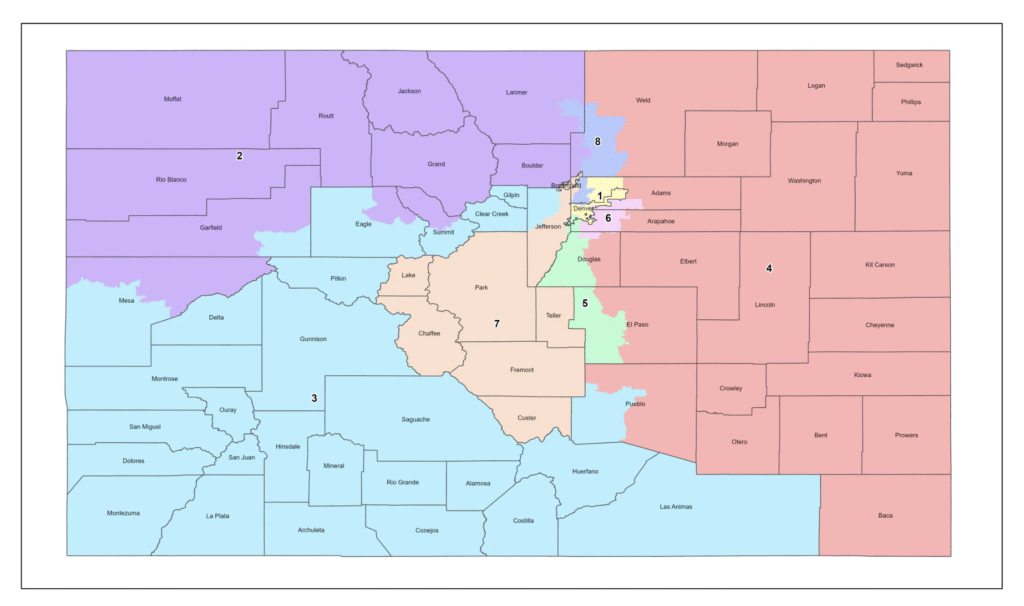
Redistricting scheme would give Colorado Democrats seven House members, split El Paso County | Bob Loevy
Bob Loevy
bob-loevy@coloradopolitics.com
Updated 2 days ago
A proposed redistricting plan, which could give Colorado seven Democratic members of the U.S. House of Representatives and only one Republican, would split El Paso County into two parts and thereby weaken the county’s influence in Congress. El Paso County,...

Is Trump a builder or just a latter-day headhunter? | SONDERMANN
By Eric Sondermann
by-eric-sondermann@coloradopolitics.com
Updated 5 days ago
It was well under 100 hours after President Donald Trump’s overly long, overly theatrical State of the Union speech that he unleashed American bombers across Iran. As I write, it is now less than 100 hours since those bombers started...
PREV
PREVIOUS

THE PODIUM | Advancing voting rights in Colorado
Nicholas Monck After Democrats regained control of the U.S. House of Representatives in 2018, the For the People Act was the very first piece of legislation proposed in the 116th Congress. H.R. 1, as it came to be known, promised to make it easier for Americans to vote, get dark money out of politics, and […]

NOONAN | CU regents race draws big bucks
Paula Noonan Elections for the University of Colorado Board of Regents are collecting buckets of money. These positions have mostly been low-funded affairs, but like so many others these days, they’re now attracting big-gun political attention. Two CU Regent spots, CD2 and CD6, have expensive and competitive races. The most expensive is the Democratic primary […]