

Chalkbeat: Colorado State Board calls for more teacher training on reading, not less

Hoping to push up Colorado’s persistently low reading scores, the State Board of Education on Wednesday opted for tougher rules around teacher training on reading instruction. In calling for higher standards, the board lined up with advocates for students with dyslexia, despite objections from groups representing teachers, district administrators, and rural educators.
The new rules will govern the rollout of legislation that updates a major 2012 law – the READ Act – requiring districts to help struggling readers in the early grades. Many lawmakers and advocates are frustrated with the slow rate of progress, and many educators report that their preparation programs did not teach them how to teach reading.
While the board won’t take a final vote on the proposed rules till March, most members urged state education department leaders to keep a provision that requires trainings to be at least 45 hours long. They also opted – at least for now – to keep language indicating that the state education department would designate in advance which college reading classes count toward the training requirement.
Several key education groups, including the Colorado Association of School Executives, the state’s largest teachers union, and the Colorado Rural Schools Alliance, objected to the proposed 45-hour requirement in written comments.
Amie Baca-Oehlert, president of the Colorado Education Association, said in a letter that the rule adds “additional workload and stress to educators and an educational system that is already significantly under resourced.”
But most board members weren’t swayed by such arguments.
“If we don’t have rigorous requirements … then the ones who bear the burden are the children who do not get effective reading instruction,” said Board Member Rebecca McClellan.
Board Member Joyce Rankin said she recently took a 48-hour online class on reading instruction that convinced her of the need for the time requirement.
“I would like to stick with 45 hours,” she said. “I didn’t know what we were talking about with this bill until I took this course.”
Rankin was referring to Senate Bill 199, the new law that updated the READ Act and included the new teacher training requirements.
Teachers would have until the beginning of the 2021-22 school year to meet the new training requirement, with extensions allowed in some cases. A 45-hour course is roughly equivalent to a college class worth three credit hours.
The board talked more briefly about the criteria for college classes that satisfy the training requirement. Draft rules originally indicated that the state education department would approve classes in advance, but state officials worried that would create confusion given that there’s a separate process for reauthorizing entire teacher preparation programs.
So state officials proposed a tweak that effectively meant college classes would be approved or rejected once individual teachers had already taken them and submitted proof to the education department. Some board members raised concerns about that change, noting that inadequate college classes on reading instruction have contributed to low reading proficiency rates and shouldn’t get a pass on the front end of the process.
“Where’s the leverage then?” asked Board Member Deb Scheffel. “I don’t know that it raises the bar, really.”


Primary rival sues to prevent Democrat Eileen Laubacher from going through assembly in Colorado’s 4th CD
Ernest Luning
ernest.luning@coloradopolitics.com
Updated 2 hours ago
Democratic congressional candidate Trish Calvarese on Monday asked a judge to prevent one of her primary rivals, Eileen Laubacher, from participating in the caucus and assembly process to seek the nomination to challenge Republican U.S. Rep. Lauren Boebert in Colorado’s...

Colorado lawmakers tackle legislation on sexual assault
Jenny Deam
jenny-deam@coloradopolitics.com
Updated 2 hours ago
A panel of Colorado lawmakers on Monday unanimously approved a bill that supporters say will offer protections and support to victims of domestic violence, stalking, sex trafficking and sexual assault, including mandatory training for law enforcement on trauma. The measure,...

Colorado Supreme Court clarifies restraining order violations can always support burglary charge
Michael Karlik
michael.karlik@coloradopolitics.com
Updated 5 hours ago
The Colorado Supreme Court’s majority ruled on Monday that a violation of a restraining order can also serve as a basis for finding a defendant guilty of burglary. Under state law, a person commits second-degree burglary by unlawfully entering or...

Big week ahead for major legislation to address housing affordability woes
Zach Halaschak, Washington Examiner
zach.halaschak.washington.examiner@gazetteedit.wpenginepowered.com
Updated 7 hours ago
The Senate is pushing ahead with a bipartisan bill to improve housing affordability, teeing up a critical week for housing on Capitol Hill and raising major questions about what provisions will be included. Senate Majority Leader John Thune (R-SD) filed cloture on legislation from the...

Macron goes nuclear with increases to French warhead arsenal
Timothy Nerozzi, Washington Examiner
timothy.nerozzi.washington.examiner@gazetteedit.wpenginepowered.com
Updated 7 hours ago
French President Emmanuel Macron is channeling the atomic spirit of his predecessor Charles de Gaulle with orders for the French military to “increase the number of nuclear warheads” in the nation’s arsenal. Macron announced the seismic shift in France’s defensive...

Who has been killed so far during US-Israel mission in Iran?
David Zimmermann and Keely Bastow, Washington Examiner
david.zimmermann.and.keely.bastow.washington.examiner@gazetteedit.wpenginepowered.com
Updated 8 hours ago
There have been numerous casualties on all sides since the joint U.S.-Israel strikes against Iran commenced over the weekend, with more lives expected to be lost as the campaign continues. The Islamic regime’s leadership is currently bearing the brunt of...
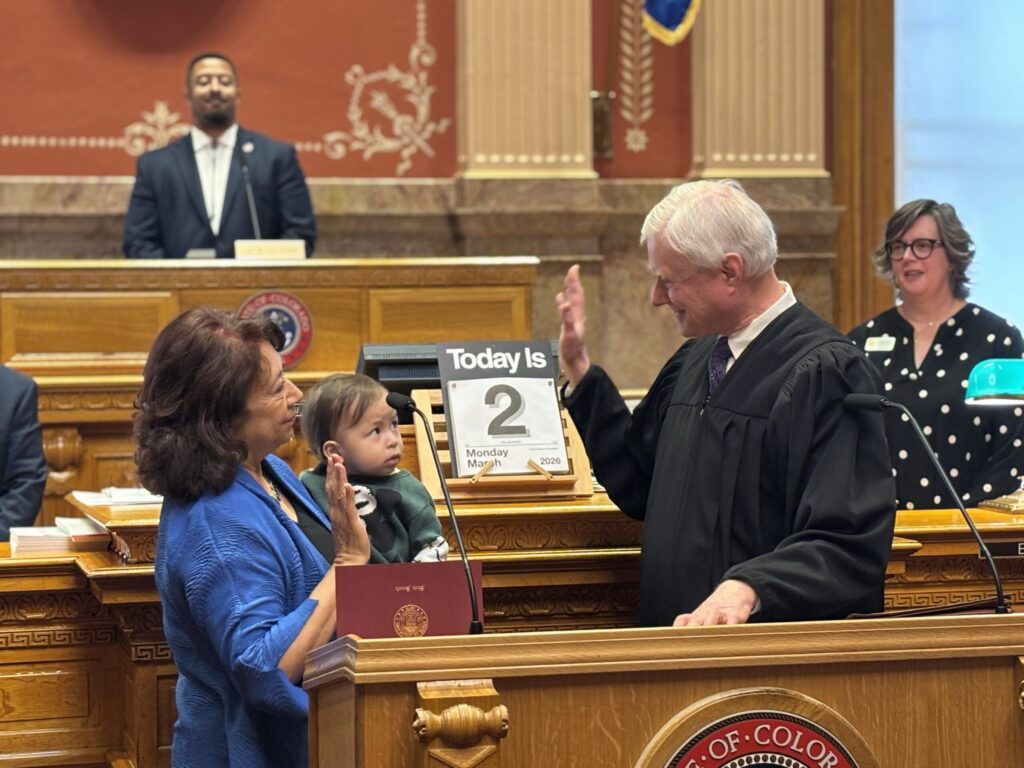
Colorado Senate swears in Adrienne Benavidez after district vacancy win
Marianne Goodland
marianne.goodland@coloradopolitics.com
Updated 7 hours ago
Sen. Adrienne Benavidez, a Democrat from Adams County, was sworn in Monday to the Colorado Senate, just four days after winning a vacancy election in District 21. She was sworn in by Colorado Court of Appeals Justice Lino S. Lipinsky...

10th Circuit judge creates vacancy, district court gets new chief judge | COURT CRAWL
Michael Karlik
michael.karlik@coloradopolitics.com
Updated 9 hours ago
Welcome to Court Crawl, Colorado Politics’ roundup of news from the third branch of government. A longtime member of the Denver-based federal appeals court will give the president a vacancy to fill, plus Colorado’s federal trial court will see a...

Denver mayor says his commute time tripled following ‘road diet’ change
Mark Samuelson Special to The Denver Gazette
mark.samuelson@denvergazette.com
Updated 7 hours ago
Mayor Mike Johnston is pushing back sharply against the claim by Denver councilmembers and bike activists that the city succumbed to lobbying pressure in revising a “road diet” plan for East Alameda Avenue, while noting that his own commute time...

Rural legislators, Colorado farmers defeat pollinator bill backed by Gov. Polis
Marianne Goodland
marianne.goodland@coloradopolitics.com
Updated 8 hours ago
A proposal to limit the use of neonicotinoid-coated crop seeds collapsed in the Senate Agriculture and Natural Resources Committee last week, as rural lawmakers, including two Democrats, joined Republicans to reject what they called an expensive, impractical mandate on farmers....
PREV
PREVIOUS

RTD considers putting contractors on notice for N Line delays
The Regional Transportation District may issue a notice of default to the two contractors working on the N Line commuter rail extension to Thornton after blowing past its scheduled 2018 opening date. “The fact that this project is still not complete is completely unacceptable and frustrating to not only us at RTD, but to our […]

Carpenters union endorses Democrat John Hickenlooper in Colorado's US Senate race
Calling the former two-term governor a champion for working families, the Southwest Regional Council of Carpenters on Wednesday endorsed Democrat John Hickenlooper in Colorado’s U.S. Senate race. The union, which operates in six western states, represents 1,800 carpenters and others involved in construction trades in Colorado. “Throughout his career, John Hickenlooper has stood with workers […]