

AP source: GOP committee suffers midterm election email hack

WASHINGTON – Thousands of emails were stolen from aides to the National Republican Congressional Committee during the 2018 midterm campaign, a major breach exposing vulnerabilities that have kept cybersecurity experts on edge since the 2016 presidential race.
The email accounts were compromised during a series of intrusions that had been spread over several months and discovered in April, a person familiar with the matter told The Associated Press. At least four different party aides had their emails surveilled by hackers, said the person, who was not authorized to discuss the details publicly and spoke on condition of anonymity.
The committee said an “unknown entity” was behind the hack but provided few other details. A cybersecurity firm and the FBI have been investigating the matter, the committee said. The FBI declined to comment.
Politically motivated cyberespionage is commonplace across the world, but Americans have become particularly alert to the possibility of digital interference since Russia’s meddling in the 2016 election. The theft of Democrats’ emails is still fresh in the minds of many political operatives and lawmakers, who have stepped up defensive measures but still struggle to protect themselves.
Foreign spies routinely try to hack into politicians’ emails to gain insight, ferret out weaknesses and win a diplomatic edge. But hackers often launch sweeping spear-phishing campaigns to gain access to a variety accounts – with no political motivation. With no immediate suspects and few technical details, it’s unclear what the significance of this latest incursion is.
In August, the Democratic National Committee thought it had thwarted an attempt to break into its massive voter database – but the effort turned out to be unauthorized test that mimicked what an attack would look like.
CrowdStrike, a California-based cybersecurity company, said Tuesday the NRCC asked the company in April to “perform an investigation related to unauthorized access” to the committee’s emails. Before that, the company had been helping the committee protect its internal corporate network, which wasn’t compromised.
“The cybersecurity of the committee’s data is paramount, and upon learning of the intrusion, the NRCC immediately launched an internal investigation and notified the FBI, which is now investigating the matter,” the committee said in a statement. The hack was first reported by Politico.
Earlier this year, NRCC Chairman Steve Stivers said the committee – which raises money to support Republican candidates for the House – hired multiple cybersecurity staffers to work with its candidates and promised to do more.
“We’re starting to advise campaigns, but we’re not ready to roll the whole thing out. We’re working on it,” Stivers said in March. “We’re working on the technology-based stuff to try and make sure that we know what’s out there – which is hard, too – and then we try to defend against it the best we can.”
During the 2016 presidential campaign, Russian state-aligned hackers organized the leak of more than 150,000 emails stolen from more than a dozen Democrats. The FBI later said that the Russians had targeted more than 300 people affiliated with the Hillary Clinton campaign and other Democratic institutions over the course of the presidential contest.
Special counsel Robert Mueller is now investigating the whether people close to Donald Trump’s presidential campaign had advance knowledge of WikiLeaks’ plans.
U.S. officials have expressed concern about foreign interference in U.S. elections. This weekend, Defense Secretary Jim Mattis accused Russia of trying to “muck around” in the November midterm elections. Mattis did not offer specifics and would not elaborate.
In October, the Justice Department unsealed criminal charges detailing a yearslong effort by a Russian troll farm to “sow division and discord in the U.S. political system” by creating thousands of false social media profiles and email accounts that appeared to be from people inside the United States. The complaint provided a clear picture that there is still a hidden but powerful Russian social media effort aimed at spreading distrust for American political candidates and causing divisions on social issues such as immigration and gun control.
The campaign season saw several examples of digital mischief, although none with the impact of the 2016 hacks.
In August, Microsoft alerted the public to attempts by government-backed Russian hackers to target U.S. conservatives’ email by creating fake websites that appeared to belong to a pair of think tanks, the Hudson Institute and International Republican Institute. It also confirmed an attempt similarly attributed to Russian hackers to infiltrate the Senate computer network of Sen. Claire McCaskill, the Missouri Democrat who lost a re-election bid in November.
Google later confirmed in September that the personal Gmail accounts of multiple senators and staffers had recently been targeted by foreign hackers, though it did not specify the cyberspies’ nationality nor the party affiliations of the targets.


Primary rival sues to prevent Democrat Eileen Laubacher from going through assembly in Colorado’s 4th CD
Ernest Luning
ernest.luning@coloradopolitics.com
Updated 13 hours ago
Democratic congressional candidate Trish Calvarese on Monday asked a judge to prevent one of her primary rivals, Eileen Laubacher, from participating in the caucus and assembly process to seek the nomination to challenge Republican U.S. Rep. Lauren Boebert in Colorado’s...

Colorado lawmakers tackle legislation on sexual assault
Jenny Deam
jenny-deam@coloradopolitics.com
Updated 2 hours ago
A panel of Colorado lawmakers on Monday unanimously approved a bill that supporters say will offer protections and support to victims of domestic violence, stalking, sex trafficking and sexual assault, including mandatory training for law enforcement on trauma. The measure,...

Colorado Supreme Court clarifies restraining order violations can always support burglary charge
Michael Karlik
michael.karlik@coloradopolitics.com
Updated 16 hours ago
The Colorado Supreme Court’s majority ruled on Monday that a violation of a restraining order can also serve as a basis for finding a defendant guilty of burglary. Under state law, a person commits second-degree burglary by unlawfully entering or...

Big week ahead for major legislation to address housing affordability woes
Zach Halaschak, Washington Examiner
zach.halaschak.washington.examiner@gazetteedit.wpenginepowered.com
Updated 19 hours ago
The Senate is pushing ahead with a bipartisan bill to improve housing affordability, teeing up a critical week for housing on Capitol Hill and raising major questions about what provisions will be included. Senate Majority Leader John Thune (R-SD) filed cloture on legislation from the...

Macron goes nuclear with increases to French warhead arsenal
Timothy Nerozzi, Washington Examiner
timothy.nerozzi.washington.examiner@gazetteedit.wpenginepowered.com
Updated 19 hours ago
French President Emmanuel Macron is channeling the atomic spirit of his predecessor Charles de Gaulle with orders for the French military to “increase the number of nuclear warheads” in the nation’s arsenal. Macron announced the seismic shift in France’s defensive...

Who has been killed so far during US-Israel mission in Iran?
David Zimmermann and Keely Bastow, Washington Examiner
david.zimmermann.and.keely.bastow.washington.examiner@gazetteedit.wpenginepowered.com
Updated 19 hours ago
There have been numerous casualties on all sides since the joint U.S.-Israel strikes against Iran commenced over the weekend, with more lives expected to be lost as the campaign continues. The Islamic regime’s leadership is currently bearing the brunt of...
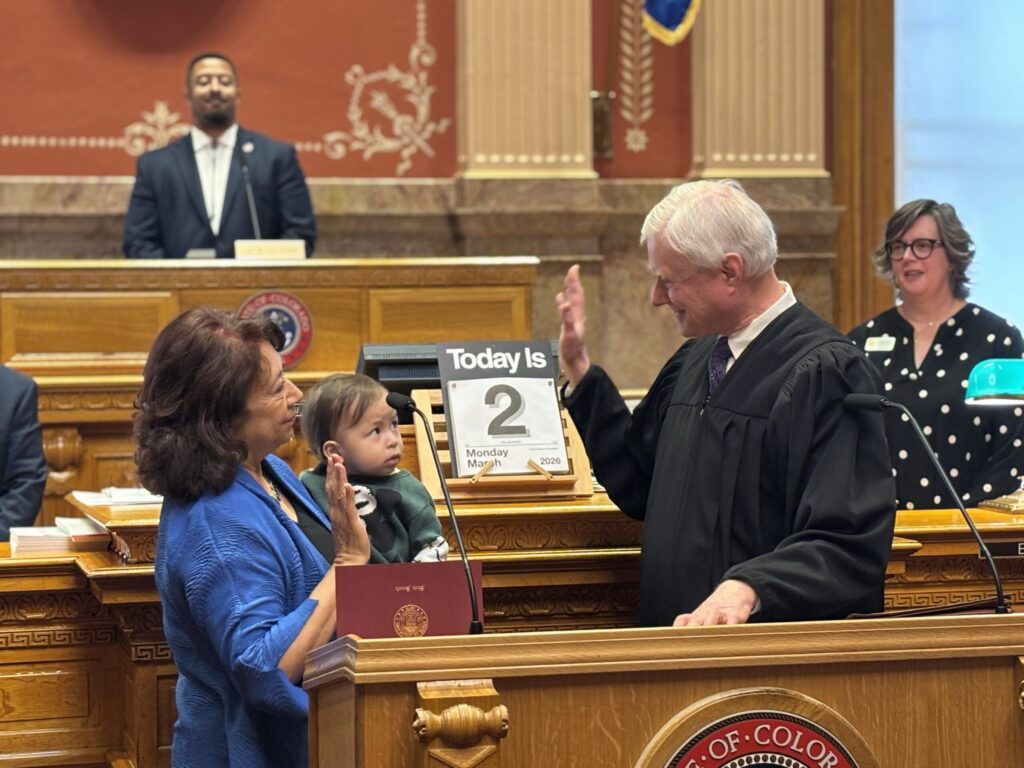
Colorado Senate swears in Adrienne Benavidez after district vacancy win
Marianne Goodland
marianne.goodland@coloradopolitics.com
Updated 19 hours ago
Sen. Adrienne Benavidez, a Democrat from Adams County, was sworn in Monday to the Colorado Senate, just four days after winning a vacancy election in District 21. She was sworn in by Colorado Court of Appeals Justice Lino S. Lipinsky...

10th Circuit judge creates vacancy, district court gets new chief judge | COURT CRAWL
Michael Karlik
michael.karlik@coloradopolitics.com
Updated 20 hours ago
Welcome to Court Crawl, Colorado Politics’ roundup of news from the third branch of government. A longtime member of the Denver-based federal appeals court will give the president a vacancy to fill, plus Colorado’s federal trial court will see a...

Denver mayor says his commute time tripled following ‘road diet’ change
Mark Samuelson Special to The Denver Gazette
mark.samuelson@denvergazette.com
Updated 18 hours ago
Mayor Mike Johnston is pushing back sharply against the claim by Denver councilmembers and bike activists that the city succumbed to lobbying pressure in revising a “road diet” plan for East Alameda Avenue, while noting that his own commute time...

Rural legislators, Colorado farmers defeat pollinator bill backed by Gov. Polis
Marianne Goodland
marianne.goodland@coloradopolitics.com
Updated 19 hours ago
A proposal to limit the use of neonicotinoid-coated crop seeds collapsed in the Senate Agriculture and Natural Resources Committee last week, as rural lawmakers, including two Democrats, joined Republicans to reject what they called an expensive, impractical mandate on farmers....
PREV
PREVIOUS

US coal consumption drops to lowest level since 1979
WASHINGTON – Americans are consuming less coal in 2018 than at any time since Jimmy Carter’s presidency, a federal report said Tuesday, as cheap natural gas and other rival sources of energy frustrate the Trump administration’s pledges to revive the U.S. coal industry. A report by the U.S. Energy Information Administration projected Tuesday that 2018 […]

McNulty adds to ethics complaint against Hickenlooper
Former Republican Speaker of the House Frank McNulty has filed a second ethics complaint against Gov. John Hickenlooper, referring to the term-limited Democrat as “Jet-set John” in the Nov. 29 filing with the state Independent Ethics Commission. In this latest complaint, McNulty, a longtime Hickenlooper nemesis who runs the newly-formed Public Trust Institute, claimed Hickenlooper […]