

INSIGHTS | Democrats should be careful what they wish for

The political seeds have been sown for months, and the harvest is ready if you’re a Democrat in Colorado these days.
President Donald Trump is unpopular and can’t keep himself out of the midterm elections, a time that’s typically inhospitable to the party holding the White House. That’s why candidates such as Republican incumbent Mike Coffman of Aurora seek to localize the race, not fight a referendum over an unpopular president.
Trump got only 43 percent of the vote in Colorado in 2016, and a poll last June showed nearly seven in 10 Coloradans don’t like him. That’s a lot of weight for Republicans on the ticket this year to carry to Election Day.
The #MeToo movement roiled the statehouse the past year after six male legislators were accused of misconduct. Nationally, the movement got its second wind over the Brett Kavanaugh Supreme Court confirmation process and investigation.
But how bad is this environment for Republicans this year? Sen. Tim Neville, as Republican as a Ronald Reagan bumper sticker, is supported by an outside group that used a mailer in district that boasted of his cooperation with Gov. John Hickenlooper and gave the mistaken impression that he and the Democratic governor are of equally moderate minds.
Republicans have only a one-seat majority in the Senate, and the upper chamber could be the only GOP firebreak if Democrats keep the House and the governor’s office. The Hickenlooper-Neville mailer comes across as a Republican Hail Mary.
But come January, if the Democrats control all the legislature and the governor’s office – and potentially four of the seven members of the state’s U.S. House delegation, if Coffman loses to Democrat Jason Crow – the good times will roll to the left.
And if you’re a moderate Democrat, you should be worried.
The morning after the victory parties on Nov. 6, the race for 2020 begins. And love affairs with parties don’t last long. This one is likely to sour fast.
In the 2012 election, Democrats held the state Senate and took a one-seat majority in the House to control both chambers under Hickenlooper. When the 2013 legislative session got going, so did liberal policies that Hickenlooper tried to moderate, sometimes not successfully.
Democrats took aim at regulating the oil and gas industry, but Hickenlooper, a former energy industry geologist, stood in the way. Hickenlooper also played a behind-the-scenes role in turning back an effort to repeal the state’s death penalty.
In 2014, Democrats lost the Senate majority and Hickenlooper found himself in an unexpectedly tough fight for re-election.
In 2020, Hickenlooper could be running for president. Though Colorado’s issues will be in his rear-view mirror, a fractious state won’t play well for him on the national stage.
It won’t play well for him or any other Democrat who might take on Republican U.S. Sen. Cory Gardner in two years. If Democrats sour the political mood with over-reach, that’s good for Gardner and bad for Democrats’ hope of taking or holding the U.S. Senate in 2020.
If Democrats manage to take the House and Senate next month, then overplay their hand on impeachment, they won’t have Trump to kick around in 2020. Mike Pence would rev up the GOP base, but a Marco Rubio, Carly Fiorina or, heck, Mitt Romney might be the GOP tonic Democrats should hope to avoid.
Jared Polis, the Democrat running for governor this year, is no Hickenlooper. He’s not likely to curb the party’s progressive excesses, if his history representing a Boulder-based district is any measure. Colorado would have a much more activist and liberal governor who hasn’t clearly laid out a way of paying for his promises.
In the early debates, Republican Walker Stapleton has tried to pin Polis down on how he plans to pay for universal health care, all-day kindergarten and preschool and a fast shift to renewable energy, and the expense of a $32 billion energy sector in Colorado.
Polis, in a KCNC-CBS4 debate with Stapleton on Oct. 5, said he’s not proposing tax increases and he won’t bankrupt the state. It’s only Stapleton who is talking about going in debt for transportation without a source of repayment, Polis said.
A “dedicated revenue source” is what Democrats say when they’re trying not to say tax increase.
The oil and gas industry this year largely has stayed on the sideline in races involving individual candidates, trying to maintain a fragile peace in case Democrats are in charge. That includes the governor’s race. Colorado Politics was the first to tell you that Polis had informal meetings and at least one lunch with local oil and gas executives.
If Democrats come in with a perceived mandate to take out the industry, however, they won’t be so lucky in two years. Democrats running in two years won’t be able to count on Polis’ private fortune when Anadarko and Noble Energy start stroking million-dollar checks to take down state legislators.
Liberal voters could make things even tougher on Colorado Democrats in 2020 by passing Proposition 112, the 2,500-foot setback rule that the industry says will cripple its oil and gas production in Colorado.
When a $32 billion industry with more than 230,000 employees pulls up stakes, the political ground rumbles, said Dick Wadhams, the Republican strategist and state political historian.
“The effect of 112 will be immediate, and it will get worse as the year goes on,” he said on panel of political experts assembled at the University of Denver on Oct. 2. “As companies start pulling out of Colorado, jobs will be lost. Local governments will have revenue problems as we get into 2019 and 2020. There will be a backlash going into the 2020 election.
“If that’s piled onto massive tax increases for transportation … and education, it might not fun to be a Democrat in the 2020 election.”
Republicans know this. The question is, will Democratic voters reaching too far to the left this November know it?


Primary rival sues to prevent Democrat Eileen Laubacher from going through assembly in Colorado’s 4th CD
Ernest Luning
ernest.luning@coloradopolitics.com
Updated 13 hours ago
Democratic congressional candidate Trish Calvarese on Monday asked a judge to prevent one of her primary rivals, Eileen Laubacher, from participating in the caucus and assembly process to seek the nomination to challenge Republican U.S. Rep. Lauren Boebert in Colorado’s...
Colorado lawmakers tackle legislation on sexual assault
Jenny Deam
jenny-deam@coloradopolitics.com
Updated 2 hours ago
A panel of Colorado lawmakers on Monday unanimously approved a bill that supporters say will offer protections and support to victims of domestic violence, stalking, sex trafficking and sexual assault, including mandatory training for law enforcement on trauma. The measure,...

Colorado Supreme Court clarifies restraining order violations can always support burglary charge
Michael Karlik
michael.karlik@coloradopolitics.com
Updated 16 hours ago
The Colorado Supreme Court’s majority ruled on Monday that a violation of a restraining order can also serve as a basis for finding a defendant guilty of burglary. Under state law, a person commits second-degree burglary by unlawfully entering or...

Big week ahead for major legislation to address housing affordability woes
Zach Halaschak, Washington Examiner
zach.halaschak.washington.examiner@gazetteedit.wpenginepowered.com
Updated 18 hours ago
The Senate is pushing ahead with a bipartisan bill to improve housing affordability, teeing up a critical week for housing on Capitol Hill and raising major questions about what provisions will be included. Senate Majority Leader John Thune (R-SD) filed cloture on legislation from the...

Macron goes nuclear with increases to French warhead arsenal
Timothy Nerozzi, Washington Examiner
timothy.nerozzi.washington.examiner@gazetteedit.wpenginepowered.com
Updated 18 hours ago
French President Emmanuel Macron is channeling the atomic spirit of his predecessor Charles de Gaulle with orders for the French military to “increase the number of nuclear warheads” in the nation’s arsenal. Macron announced the seismic shift in France’s defensive...

Who has been killed so far during US-Israel mission in Iran?
David Zimmermann and Keely Bastow, Washington Examiner
david.zimmermann.and.keely.bastow.washington.examiner@gazetteedit.wpenginepowered.com
Updated 18 hours ago
There have been numerous casualties on all sides since the joint U.S.-Israel strikes against Iran commenced over the weekend, with more lives expected to be lost as the campaign continues. The Islamic regime’s leadership is currently bearing the brunt of...
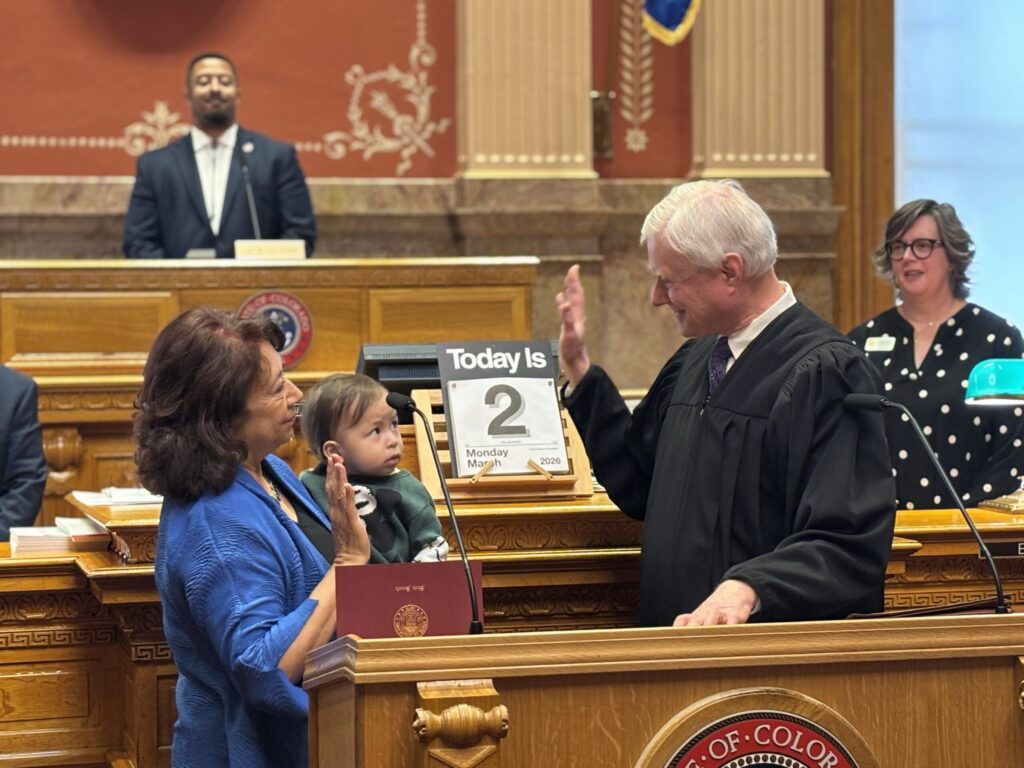
Colorado Senate swears in Adrienne Benavidez after district vacancy win
Marianne Goodland
marianne.goodland@coloradopolitics.com
Updated 18 hours ago
Sen. Adrienne Benavidez, a Democrat from Adams County, was sworn in Monday to the Colorado Senate, just four days after winning a vacancy election in District 21. She was sworn in by Colorado Court of Appeals Justice Lino S. Lipinsky...

10th Circuit judge creates vacancy, district court gets new chief judge | COURT CRAWL
Michael Karlik
michael.karlik@coloradopolitics.com
Updated 20 hours ago
Welcome to Court Crawl, Colorado Politics’ roundup of news from the third branch of government. A longtime member of the Denver-based federal appeals court will give the president a vacancy to fill, plus Colorado’s federal trial court will see a...

Denver mayor says his commute time tripled following ‘road diet’ change
Mark Samuelson Special to The Denver Gazette
mark.samuelson@denvergazette.com
Updated 18 hours ago
Mayor Mike Johnston is pushing back sharply against the claim by Denver councilmembers and bike activists that the city succumbed to lobbying pressure in revising a “road diet” plan for East Alameda Avenue, while noting that his own commute time...

Rural legislators, Colorado farmers defeat pollinator bill backed by Gov. Polis
Marianne Goodland
marianne.goodland@coloradopolitics.com
Updated 19 hours ago
A proposal to limit the use of neonicotinoid-coated crop seeds collapsed in the Senate Agriculture and Natural Resources Committee last week, as rural lawmakers, including two Democrats, joined Republicans to reject what they called an expensive, impractical mandate on farmers....
PREV
PREVIOUS

Election Preview 2018 | Voters to choose new attorney general, treasurer
After the November election, besides a new governor, Colorado also will have a new chief legal officer and a new state financial manager. The attorney general seat is open because the Republican who currently holds the office, Cynthia Coffman, ran for governor instead, though she failed to secure her party’s nomination in the primary. That […]

Colorado Springs on front lines of cyber Cold War with Russia
The Russians have come, and Colorado Springs is a bit shaken after learning that a Putin-directed military intelligence operation purloined data from a local nonprofit. For decades, Colorado Springs was on the lookout for Soviet spies. But when the Cold War ended, locals lightened up. With federal indictments this month against Russian hackers who targeted […]