

Q&A w/Paul Kashmann: Newsman turned councilman brings a community journalist’s perspective to the job
Paul Kashmann isn’t the only former journalist ever to be elected to a political office he once covered. Then again, the first-term Denver City Council member, who won his seat in 2015, isn’t just another ex-newsman who entered public life; he was the decades-long publisher of the Washington Park Profile. Which means he was plugged into just about every political development in south Denver for generations. That included reporting on the council and commenting on its actions. In some circles, he probably got to be even better known than some of the council members. Now, he’s one of them, and he brings a wealth of perspective and knowledge to the job
Colorado Politics: For 36 years, you ran a hyper-local and highly respected community newspaper in Denver. You must have picked up a lot of insights as well as a heck of a contact network, both of which would be helpful for anyone running for office. But why did you make the leap? Was it frustration after decades of having a lot of influence but no actual vote on the council? Or, did you simply see the move from journalism to politics as the continuation of activism by another means
Paul Kashmann: Yeah, my kids and my friends always teased me because it seemed wherever we’d go in Denver, or even the surrounding area, I’d end up knowing someone. I’d always tell my kids that it’s not that I’m anything special, but if you run around the same small neck of the woods for four decades, you do get to know some folks. As far as why I ran for office: I had a fabulous time with The Profile for a lot of years. It was a great job in a great community. It was a great run. But as the golden days of print journalism faded, and on line publications began to drain advertising revenue, the job became a whole lot more about “How the heck do I sell enough ads to keep the doors open?” and a whole lot less about covering the news. As you know, newspapers don’t print the number of pages they need to report the news, they print the number of pages the advertising revenue covers.
To tell you the truth, I’d had Council kind of in the back of my mind for a while, but I’d go back and forth about whether or not it would be the right fit for me. In early 2014, the forces of the universe just seemed to coalesce. As I realized it was time for me to seek fresh guidance for The Profile, the District 6 seat was coming open. I was concerned about the growing challenges I saw our city facing, and did not think they were being adequately addressed. So, I decided to take the plunge, and seek the opportunity to take the knowledge and perspective I’d acquired over the years and help guide city policy at such a fascinating time in Denver’s history.
CP: What, if anything, was the biggest surprise – or, at least, required the most adjustment – after you took office in 2015?
PK: My greatest surprise is how very hard-working and competent are the vast majority of city employees with whom I work. As a private citizen, like many folks I would sit back and look at what I viewed as the shortfalls in city services and wonder, “Why don’t these folks get off their behinds and do something? Don’t they have a clue about what they’re doing? Don’t they care?” Every few years it seems some news channel finds some poor exhausted city employee catching a nap in his truck, and all city workers get branded as overpaid and lazy. Since being in office, I’ve found the opposite is true. Most city staffers are paid less than they could get in the private sector and are working their tails off to keep our city functioning.
As far as the greatest challenge: As a journalist, I prided myself in presenting a balanced view of whatever issue I was covering, to give equal voice to both sides of the story, and keep my own opinions under wraps. I did write an editorial column, but there was no real weight or consequence in expressing my opinion. Now, every Monday night we’re presented with major decisions that matter greatly in terms of how we spend people’s tax dollars and how we affect their quality of life. It gets to the point of “That balanced view thing is real cute, pal, but it’s time to pull the trigger. How are you going to vote?” You realize quickly that on any major issue you are likely going to upset a lot of folks, but as Abe Lincoln said, “You can’t please all the people all the time.”
CP: Were you concerned that someone you may have ticked off through you newspaper work would become an adversary once you ran for office?
PK: Not really. I don’t think I made a lot of enemies in my time as a journalist, because I didn’t take a lot of cheap shots at people. I really did try to be fair and balanced in my reporting. While I am confident in my point of view, and my ability to assess a situation, I always try to keep in the back of my mind the possibility that I might be wrong.
CP: Like some other candidates on the 2015 Denver ballot you had expressed concern about uncontrolled development and said you regarded it as a top challenge for the city. This year, a growth-control proposal could be on Lakewood’s local ballot, and as in many years, there was a push for a statewide ballot measure along those lines. Should Denver adopt a growth-control policy? Or, is it not so much the quantity of growth as the quality and nature of development that concerns you? And has the council majority been too close to developers, as some contend?
PK: I don’t think population control by ordinance is healthy. I do believe it is the quality and the context of development that is the key. What I would like to see is a discussion of exactly where it is that we want our city to go. Denver is hovering at a population of some 700,000 people. What is Denver’s maximum population – is it 900,000 or is it 4 million? What can our water supply handle? What can our power grid handle? How about our transportation network?
If we decide that Denver’s top end is 4 million people, we need to be looking at different policies than if it is 900,000. We need to remain flexible in accommodating those who want to join us here in the Mile-High city, but I believe just having that discussion will shine a light on how we move forward as a community. I had dinner with a legislator from Indianapolis about a year ago, and I asked her, “So how are things in Indianapolis?” Her response intrigued me, “You know,” she said, “there’s something comforting about being a second-tier city.” Now I don’t know if I’d categorize Indianapolis as second-tier, but that thought obviously has stayed with me. Is it critical that we continue on this manic drive to be a “world-class” city, with no clear community conscience on what that even means, or is there a sustainable sweet spot we can find that is better suited to our long-term benefit?
And “Has the Council majority been too close to developers?” I do think some of my colleagues are a good bit more driven by a “Let the market rule” mentality than some others of us. I think government should guide the discussion of what we want our city to be, then guide the development community into building that community, not have developers determine how things should be, and then provide the zoning to allow that to happen.
CP: Technically speaking, all municipal posts in Colorado are nonpartisan though there’s also some inevitable tilt by city council members toward a community’s overall political alignment. How would you describe your political world view, and how much does it influence your work on the council?
PK: As I mentioned above, as a reporter I did my best to be balanced and report all sides to a debate, but I also told folks regularly that if you read my paper you’ll know my politics in about 20 minutes by looking at what gets focused on, what gets left out and what my editorial column reveals.
My political world view is I believe a community is only as strong as its weakest link, and we have a responsibility to care for those who can’t care for themselves. I think we need to be far more aggressive in stimulating the affordable housing market, and in providing services to not only house those without homes, but to raise them up to as independent a lifestyle as possible. Denver’s economy is doing very well right now, but not all sectors of our economy and not all quadrants of our city are sharing in the bounty equally. This needs to be addressed.
I’m a registered Democrat and I learned in my career as a small business owner that it takes a lot of hard work to bring in the revenue needed to balance a budget, and it is very easy to lose focus and spend that money inefficiently in a way that brings that budget out of balance. I am very aware of the costs involved in the programs we consider and in the importance of keeping our city on firm financial footing.
CP: What functions or services of Denver government are most in need of an update?
PK: We need to continue to improve our permitting and plan review services. We need to upgrade technology, and bring on additional properly trained personnel. The development boom we have experienced in recent years has pushed our people and our systems to the breaking point, and Community Planning and Development (CPD) is working hard to address their needs. However, I heard regularly for the 36 years I was in the news business – long before our rocket ride into the 21st century – that Denver is a difficult city to deal with from a permitting point of view. We need to change that once and for all.
We need to stop relying on RTD to provide the answers to moving people around the City and County of Denver. Similar to my answer above to how we should approach development, we must create a viable transportation plan and bring together the players needed to implement that plan. RTD will always be a major player in that plan, but their focus is regional, and they have not shown the interest or ability to fully engage in more hyper-local solutions. I am excited that the mayor has instructed the Department of Public Works to begin moving towards splitting off its mobility functions into a separate department that would think about nothing else but moving people 24/7. Close relationships with ride-sharing companies; shuttle services like Boulder’s Hop, Skip and Jump; online information sharing; and concepts not yet off the drawing board will all play a role in unlocking our mobility solutions, but we must take matters into our own hands.
CP: Name a way in which Denver has changed for the better since you moved to the city in the 1970s – and a way in which it has changed for the worse.
PK: Denver is just a wonderful place to live. Since the 1970s, our air is cleaner, our waterways are cleaner, the earth on which we build – while still with its challenges – is cleaner. We have a much more diversified economy to insulate us from the whims of the national/global marketplace. We have a vibrant cultural life of museums, theaters, galleries and music venues that can stand proudly in the cadre of America’s top cities.
For the worse? The lack of affordable housing is changing the face of our city. If we don’t get a grip on it very, very soon, Denver will become a city where only the wealthy can afford to live. We are losing teachers, cops, firefighters, restaurant servers, etc., because they simply can’t afford to live in Denver on the money they’re making.
Our road system cannot adequately handle the traffic that takes to the streets every day. We do not have too many people – we have too many cars. You can go to the grocery and check out in a reasonable amount of time. You can buy paint at Ace Hardware, get your hair done, go to a local restaurant, go to the movies and get served in short order. But when you get on the roads, the wheels – if I may – come off the bus. Not too many people – too many cars. We must create a mass transit system that works.
We must get the population of people without homes off the streets. A number of us went to Portland last May to speak with their elected officials about how they are addressing city problems. Mayor Ted Wheeler began his comments with, “We have a humanitarian crisis on our streets.” He did not speak about how the encampments on Portland’s sidewalks looked to tourists; he recognized a crisis of people in need. We need to address Denver’s humanitarian crisis with the same passion. A lot of good work is being done. We need to do much better.

Primary rival sues to prevent Democrat Eileen Laubacher from going through assembly in Colorado’s 4th CD
Ernest Luning
ernest.luning@coloradopolitics.com
Updated 4 hours ago
Democratic congressional candidate Trish Calvarese on Monday asked a judge to prevent one of her primary rivals, Eileen Laubacher, from participating in the caucus and assembly process to seek the nomination to challenge Republican U.S. Rep. Lauren Boebert in Colorado’s...
Colorado lawmakers tackle legislation on sexual assault
Jenny Deam
jenny-deam@coloradopolitics.com
Updated 4 hours ago
A panel of Colorado lawmakers on Monday unanimously approved a bill that supporters say will offer protections and support to victims of domestic violence, stalking, sex trafficking and sexual assault, including mandatory training for law enforcement on trauma. The measure,...
Colorado Supreme Court clarifies restraining order violations can always support burglary charge
Michael Karlik
michael.karlik@coloradopolitics.com
Updated 7 hours ago
The Colorado Supreme Court’s majority ruled on Monday that a violation of a restraining order can also serve as a basis for finding a defendant guilty of burglary. Under state law, a person commits second-degree burglary by unlawfully entering or...

Big week ahead for major legislation to address housing affordability woes
Zach Halaschak, Washington Examiner
zach.halaschak.washington.examiner@gazetteedit.wpenginepowered.com
Updated 9 hours ago
The Senate is pushing ahead with a bipartisan bill to improve housing affordability, teeing up a critical week for housing on Capitol Hill and raising major questions about what provisions will be included. Senate Majority Leader John Thune (R-SD) filed cloture on legislation from the...

Macron goes nuclear with increases to French warhead arsenal
Timothy Nerozzi, Washington Examiner
timothy.nerozzi.washington.examiner@gazetteedit.wpenginepowered.com
Updated 9 hours ago
French President Emmanuel Macron is channeling the atomic spirit of his predecessor Charles de Gaulle with orders for the French military to “increase the number of nuclear warheads” in the nation’s arsenal. Macron announced the seismic shift in France’s defensive...

Who has been killed so far during US-Israel mission in Iran?
David Zimmermann and Keely Bastow, Washington Examiner
david.zimmermann.and.keely.bastow.washington.examiner@gazetteedit.wpenginepowered.com
Updated 10 hours ago
There have been numerous casualties on all sides since the joint U.S.-Israel strikes against Iran commenced over the weekend, with more lives expected to be lost as the campaign continues. The Islamic regime’s leadership is currently bearing the brunt of...
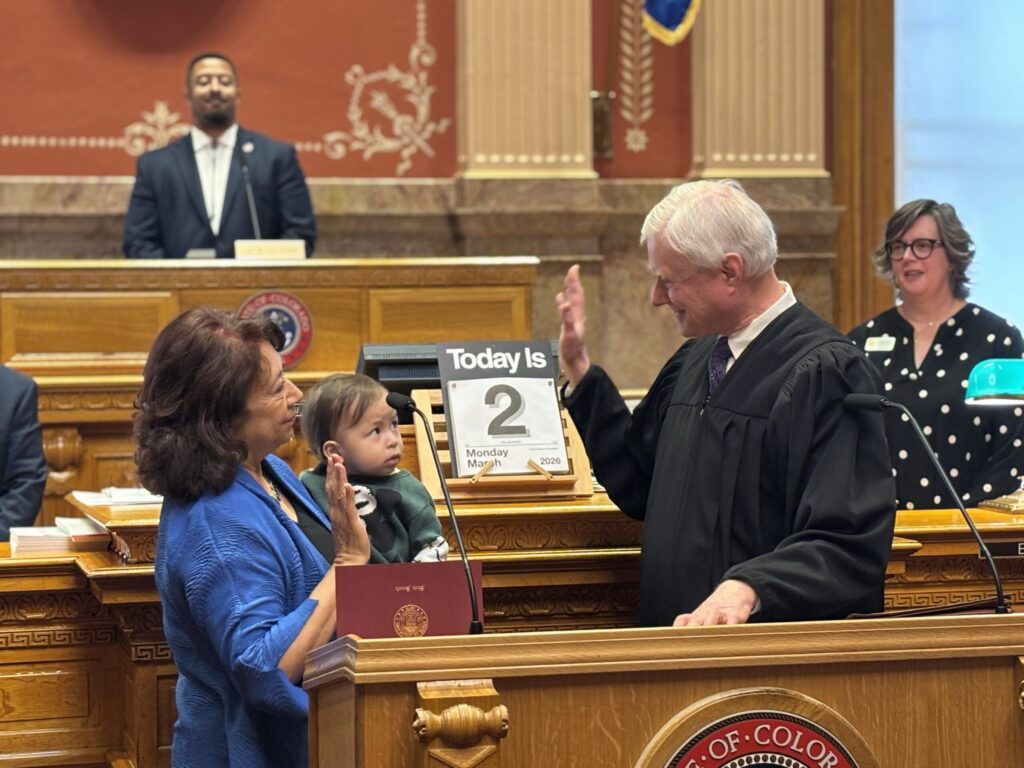
Colorado Senate swears in Adrienne Benavidez after district vacancy win
Marianne Goodland
marianne.goodland@coloradopolitics.com
Updated 10 hours ago
Sen. Adrienne Benavidez, a Democrat from Adams County, was sworn in Monday to the Colorado Senate, just four days after winning a vacancy election in District 21. She was sworn in by Colorado Court of Appeals Justice Lino S. Lipinsky...

10th Circuit judge creates vacancy, district court gets new chief judge | COURT CRAWL
Michael Karlik
michael.karlik@coloradopolitics.com
Updated 11 hours ago
Welcome to Court Crawl, Colorado Politics’ roundup of news from the third branch of government. A longtime member of the Denver-based federal appeals court will give the president a vacancy to fill, plus Colorado’s federal trial court will see a...

Denver mayor says his commute time tripled following ‘road diet’ change
Mark Samuelson Special to The Denver Gazette
mark.samuelson@denvergazette.com
Updated 9 hours ago
Mayor Mike Johnston is pushing back sharply against the claim by Denver councilmembers and bike activists that the city succumbed to lobbying pressure in revising a “road diet” plan for East Alameda Avenue, while noting that his own commute time...

Rural legislators, Colorado farmers defeat pollinator bill backed by Gov. Polis
Marianne Goodland
marianne.goodland@coloradopolitics.com
Updated 10 hours ago
A proposal to limit the use of neonicotinoid-coated crop seeds collapsed in the Senate Agriculture and Natural Resources Committee last week, as rural lawmakers, including two Democrats, joined Republicans to reject what they called an expensive, impractical mandate on farmers....