

Melchior: Regulation puts coal miners out of work in Wyoming

Bill Pederson’s 40-year career in Wyoming’s mines ended abruptly last month, as Peabody Energy and Arch Coal announced more than 460 layoffs. His son lost his mining job the same day.
“It’s going to be interesting, but I guess we’ll figure out what we’ve got to do,” Pederson says. “I think the whole town is in a state of shock. … It’s kind of numb here, because everyone’s trying to figure out what to do, and there’s no jobs yet. Everyone’s trying to make plans, but there’s nothing to make plans with.”
In Wyoming, the largest coal-producing state in America, hundreds of families are now paying the painful price for Washington’s misguided environmental policies.
The Clean Power Plan, issued in August, requires states to cut carbon emissions by 32 percent from 2005 levels over the next 15 years, establishing an artificial disincentive against coal-fired electricity generation. At a time when inexpensive natural gas had already lessened demand for coal, this onerous regulation was the straw that broke the camel’s back.
For decades, the mines have been a stable source of employment, providing high-wage jobs to even workers with a high-school education or vocational training. Now, that work is gone, and many are left with hefty mortgages from homes bought in boom times and no source of income.
One family, already grieving after the recent death of their young daughter, responded to their breadwinner’s layoff by smiling into the camera on Facebook.
“Why is my family smiling?” David Williams wrote. “Because I asked them to. Because a man’s real job is to carry his family through the trials of life, not whatever he does for an occupation. I will not let them cry or worry. I will hunt for a new job. … I’m not above flipping burgers or sweeping floors to provide for my family. I’m not above stocking shelves or cleaning toilets. Because those things are my occupation; my job is taking care of the people in this picture and in that regard, I’m never without a job.”
But even those menial jobs may prove scarce, says Eric Winslow, who lost his job at North Antelope Rochelle after 10 years. The father of two lives in Douglas, population 6,500, and he says the whole town is cringing, waiting for the second- and third-degree affects of the layoffs.
“One coal miner job lost here affects five to seven people in one way or another,” he says. Whether it’s the convenience store or the movie theater or the bowling alley, that revenue right now is not going back to the community. And this is the first round.”
It’s hard to overstate how critical coal is to the Cowboy State. The Wyoming Infrastructure Authority called it “a cornerstone of the Wyoming economy,” noting that it has also been the most stable tax-revenue source since the 1970s.
Largely because of environmental policies targeting traditional energy, Wyoming has already found itself in a recession.
Last year, Wyoming, which has a population below 600,000, saw 6,400 jobs cut, concentrated in the energy sector. The coal layoffs in March were just the most recent in a series of dozens of job cutbacks at mines, and everyone’s bracing for more.
Gov. Matt Mead, responding to the March layoffs, said: “This isn’t a natural disaster, but it certainly is a disaster in terms of the personal lives of those miners — and beyond that, what it is going to do to those communities and businesses it is going to affect.”
Regardless of the astronomical impact on blue-collar families in Wyoming, the Clean Power Plan offers little environmental benefit. The Cato Institute, using the Environmental Protection Agency’s own modeling, estimated that the billions of dollars in economic cost from bought a temperature reduction of less than 2/100ths of 1 degree Celsius by 2100.
Many Wyoming residents fear that more draconian regulations will follow. They took special note last month, when Hillary Clinton bragged, “We’re going to put a lot of coal miners and coal companies out of business.”
Winslow, the laid-off North Antelope Rochelle miner, says that comment “puts me in a dark place.”
“That’s horrible,” he adds. “How could one person who wants to be the leader of the free world want to devastate so many people?”
Wyoming’s mining families are asking that, and many other questions: How to feed their families and pay their rent, whether their beloved hometowns will soon become ghost towns. One question they’re not asking, though, is why. They know exactly who to blame.

You get what you pay for in your state reps | Hal Bidlack
Hal Bidlack
hal-bidlack@coloradopolitics.com
Updated 2 hours ago
My regular readers will know of my affection for the Out West Roundup, a Colorado Politics feature that lets us keep up to date with the goings on out here in the western U.S., and draws attention to stories that...
A warrant should mean something — expedite carrying them out | OPINION
Colorado Politics
colorado-politics@coloradopolitics.com
Updated 2 hours ago
By Aaron Ping My name is Aaron Ping. I am a father from Washington state, and I am writing because my 16-year-old son, Avery, cannot. Avery died on Dec. 19, 2024. The drugs that killed him were ordered through Snapchat....

Lower Basin must adapt to Colorado River hydrology | OPINION
Colorado Politics
colorado-politics@coloradopolitics.com
Updated 2 hours ago
By Nick Peters A February deadline for determining future operating guidelines for the West’s two largest reservoirs came and went with no agreement on the table and clear lines drawn in the sand. A seven-state resolution to how Lake Mead and Lake Powell will...

Colorado’s GOP at its best — and worst | Dick Wadhams
Dick Wadhams
dick-wadhams@coloradopolitics.com
Updated 2 days ago
By Dick Wadhams Colorado Republicans are fighting to be relevant in the face of gross mismanagement by Democrats who totally control state government. While the Colorado Republican Party is mired in controversy, several Republican elected officials and candidates represent the...

Someone’s lying in latest activist embarrassment for Polis’ CPW Commission | Rachel Gabel
Rachel Gabel
rachel-gabel@coloradopolitics.com
Updated 2 days ago
Either Samantha Miller is lying, or Gov. Jared Polis is. If Miller is lying, she is so secure in the red carpet rolled out for animal activists by this administration she is willing to put words in the governor’s mouth....

Ask Secretary of State candidates if they’re in favor of independent election audits | Jon Caldara
Jon Caldara
jon-caldara@coloradopolitics.com
Updated 4 days ago
This part will disappoint angry people on Twitter: Relax. Put the pitchforks down. I am not relitigating the 2020 election or mail ballots or even Tina Peters. But I am saying people don’t trust elections like they used to. And...
Redistricting plan to give Colorado Dems 7 members of the U.S. House will split El Paso County | Bob Loevy
Bob Loevy
bob-loevy@coloradopolitics.com
Updated 2 days ago
A proposed redistricting plan, which would give Colorado seven Democratic members of the U.S. House of Representatives and only one Republican, will split El Paso County into two parts and thereby weaken the county’s influence in Congress. El Paso County,...

Can deliberation save democracy? | Vince Bzdek
Vince Bzdek
vince.bzdek@gazette.com
Updated 14 hours ago
In September 2019, 523 Americans traveled to Dallas for an experiment called “America in One Room.” The gathering was designed to test a theory: Could representative citizens deliberate productively even in an era of intense polarization? The event focused on...
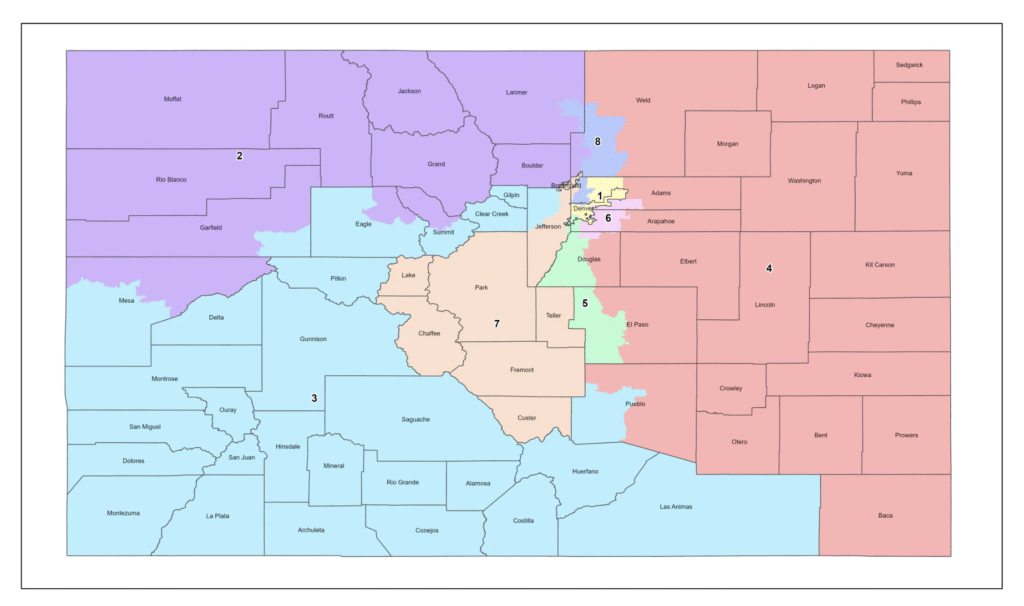
Redistricting scheme would give Colorado Democrats seven House members, split El Paso County | Bob Loevy
Bob Loevy
bob-loevy@coloradopolitics.com
Updated 2 days ago
A proposed redistricting plan, which could give Colorado seven Democratic members of the U.S. House of Representatives and only one Republican, would split El Paso County into two parts and thereby weaken the county’s influence in Congress. El Paso County,...

Is Trump a builder or just a latter-day headhunter? | SONDERMANN
By Eric Sondermann
by-eric-sondermann@coloradopolitics.com
Updated 5 days ago
It was well under 100 hours after President Donald Trump’s overly long, overly theatrical State of the Union speech that he unleashed American bombers across Iran. As I write, it is now less than 100 hours since those bombers started...
PREV
PREVIOUS
Noonan: Colorado ed policy trending toward daily, not annual assessments
Students across Colorado are now taking their PARCC assessments, also known as the Colorado Measure of Academic Success. United Opt Out, the organization working to stop standardized tests such as PARCC, will find out whether it can successfully push testing opt-out into middle and elementary schools. On April 11, Colorado’s House Education Committee unanimously passed […]

Nicolais: Senate candidate Keyser’s day in court
Jon Keyser’s failure to collect enough petition signatures to make June’s Republican primary ballot is the big story of Colorado politicos right now. Coming up 86 signatures short, Keyser’s U.S. Senate campaign finds itself in mortal peril. The campaign will now go before a Denver District Court to plead its case. Depending on why signatures […]