

Reapportionment commission looks West
Cowboys, ski bums, and Colorado Ute tribes were at center stage in a showdown Monday as the state’s Reapportionment Commission voted on preliminary legislative districts for the western portion of the state. While Democrats called for more competitive districts, Republicans prevailed with a map that ultimately retained their Western Slope voter registration dominance but will likely see two Republican representatives living in the same district and Grand County attached to the Front Range.
The 6-5 vote was along party lines, with the commission’s unaffiliated chair, Mario Carrera, of Parker, defying some predictions by voting with Republicans for a map developed by former state Rep. Steve Tool, Republican from Windsor.
Tool’s adopted plan removes both Jackson and Grand Counties from HD 57, and instead proposes to potentially combine the two counties and the rural portion of Larimer County into one House district. The change could result in both state Reps. Randy Baumgardner, R-Hot Sulphur Springs and B.J. Nikkel, R-Loveland, sharing a single district.
Tool explained that his goal was to create a “footprint” where he could fulfill a Colorado Supreme Court decision, written by Justice Gregory Hobbs, that he said mandated that counties retain whole districts allotted to them.
Though the commission has not yet dealt with the area, Tool sees Weld County retaining three districts. However, because the county is allotted 3.27 House districts the excess would be pushed, as HD 49, towards the west. There it could be combined with a portion of Larimer County, which has 3.87 House districts, and both Grand County and Jackson Counties that because of their sparse population receive only a combined total of .21 House districts.
“I’ve made some Republicans mad at me, I suppose,” Tool said of his plan.
Morgan Carroll, D-Aurora, however, said Tool was trying to carve out the Western Slope to leave the maximum number of districts in Weld and Larimer Counties. The move she said could mean another Republican seat.
In addition to the removal of Grand County from the Western Slope, the new map would expand HD 58 represented by Rep. Don Coram, R-Montrose, to encompass much of HD 61, currently represented by Rep. Roger Wilson, D-Glenwood Springs. Hinsdale County would be absorbed under the new map and Gunnison County would be split, with only the northwest region of the county remaining in its former district. In turn, HD 61 would expand to divide Delta County by taking over the portion once represented by HD 58 and recede from its stake in Rio Blanco and most of Garfield counties. Finally, HD 59 would expand to represent the southern half of Montezuma County. ?
If it sounds complicated, it is. But that’s the job of the Reapportionment Commission, which must divvy up the state’s legislative districts after each biennial Census to conform to population changes over the last ten years. The Commission is made up of three appointments by the governor, a total of four by legislative leaders and four by the Colorado chief justice.
The decision to adopt the Tool map constituted a minor victory for Republicans who argued that a map drawn by Rep. Matt Jones, D-Louisville, split Delta County too many times, separated Ute tribes and constituted a partisan move to expand Democratic power.
Jones said his map, which he told The Colorado Statesman had been written in consultation with other Democrats, would have created three competitive districts in the region by bringing Republican and Democratic voter registration in House Districts 56, 59, and 61 within five percentage points of each other.
Both Jones and Sen. Morgan Carroll, D-Aurora, argued that competitive districts would provide a voice for the unaffiliated voter and should be an important consideration in developing the western portion of the state’s districts. Republicans, however, said that making districts competitive should be a criteria, but lower on the list of priorities. Further, they lambasted Democrats for trying to increase their pull in the southern corner and called the move a partisan ploy.
“I see the Western Slope dividing into two distinct areas. One is the more liberal, progressive and Democratic direction and the other … [is] the cowboy parts of the Western Slope, where you have the mining, you have the ranching. That, of course, is the Republicans,” ventured Robert Loevy, a political science professor at Colorado College and one of the Republican members of the commission. “I think that what we have here, simply put, is creating three districts based on the ski districts, based on their liberal populations, in what is basically a very Republican part of the state. My major concern is the effect on the other four districts.”
Loevy said that Republican voters have been packed into Republican House districts to accommodate the whims of Democrats.
Carroll, however, rejected the assertions and said there was more similarity than difference between the maps of Tool and Jones. She said their goal was to give unaffiliated voters real representation at the state house.
“The opposite of a non-competitive district is a politically gerrymandered district,” Carroll said. “That means that one party will rule and the other two will have a much harder time feeling like their vote counts, their phones calls are going to get returned or their opinions are going to get represented. I don’t think that is a small issue and I think it goes directly to the core of representative democracy…”
Jones said he was particularly concerned with HD 59, where his split of the county along Southern and Ute Mountain Ute tribal lines would give Republicans roughly a 2 percent advantage instead of an 8 percent gap found in Tool’s map. The map by Tool has three districts where Republicans and Democrats are within 8 percent, including two that are near 2 percent.
Commissioner Gayle Berry, former Republican Representative for HD 55 in Grand Junction, challenged Jones’ map and said it did not show numbers that were significantly different than those currently in play.
Berry said considering maps based solely on voter registration numbers failed to determine victories in the region. Looking at the last Senate races, she said, saw Jones’ map giving deep victories to Democrats in HD 59. She pointed out, as did other Republicans, that party performance should instead be considered.
“Clearly that would create a district that is more Democrat performing than it is today, by far. And I find that one of the more – add that to my list – things I find objectionable in drawing maps,” Berry said.? ?
Jones said that the 2010 state treasurer’s race in HD 59 showed that Republicans had won by four percentage points, putting the number in the competitive range.
Republicans also argued that despite the numbers, Jones’ proposed split of the county along tribal lines raised serious concern about community of interest representation. They said they did not want to see any change in the Ute tribes representation until the commission had the opportunity to speak with them.? ?
While ultimately Democratic concerns for competitiveness were overruled by Tool’s proposal, the map was not without its own controversy. Both the Democratic and Republican party chairs in Grand County, Robert McVay and Harry Kottcamp, voiced opposition to both maps that would place Grand County with the Front Range.
The party chairs said that Grand County has little in common with Larimer County, and they expressed their concerns that the two areas competed for both water and tourism connected with Rocky Mountain National Forest. Because of the clear competitive nature of the counties, they said they should be represented by someone who does not have solely the Front Range’s interests at heart.
Tool said that he viewed the rural nature of Grand County and its status as a gateway to Rocky Mountain National Forest as a uniting interest with Larimer County. However, Andrew Gold, a resident of Tabernash in Grand County, said the move would constitute an “egregious power grab and betrayal to West Slope communities.”
“Grand County shares more with West Slope communities than it ever will with the Front Range,” Gold argued. “We share a common legislative voice regarding issues such as water, tourism, transportation, energy development, agriculture, rural development and others. Orphaning Grand County to a Front Range dominated district is in essence a stripping of our legislative voice and so diminishes not only Grand County but the entire Western half of the state.”
While Grand County was ultimately left out of the Western Slope, it will likely see considerable debate as the maps are discussed at public hearings later in the summer.
More disagreement about what to do with Gunnison County
Tool’s decision to change HD 61 by splitting Gunnison County ruffled the feathers of Sen. Gail Schwartz, D-Snowmass Village.? ?
Schwartz, who recently lost a battle with the commission to keep the San Luis Valley in her Senate district, argued against any map that split the county. She said the county’s oil and gas region in the northwest corner melds with other portions of the county heavily dependent on agriculture and education to create an economy that does not allow it to be divided.
“I believe that the culture of agriculture is really the foundation of that county and if you break that apart you break apart more or less the economic fiber of that community,” Schwartz said.
However, Republicans maintained that ultimately the northern half of the state was more akin to the ski resort communities of Pitkin County, and breaking the county in two would allow for representatives to have better transportation routes to their constituents.
After the vote, Tool told The Statesman that he was particularly pleased that he was able to create a single district out of La Plata, Montezuma, and Archuleta counties in the southwest portion of the state, and he pointed to the removal of Jackson County from the Western slope in order to combine it with Larimer County as successful elements of his map.
Jones said that he still felt he had the superior map. He complained that splitting Gunnison County was a poor decision and said not creating a more competitive district out of HD 59 was a disservice to the unaffiliated voters in the region.
“I think we could have passed a much more constitutional map,” Jones said. “They took the areas of Gunnison and Crested Butte and split it, they did not keep the resort communities in the Four Corners area whole, and they didn’t keep the agricultural, mining, uranium exploration area east of that whole.”
Still, Jones said he was not necessarily concerned that the process would devolve into a partisan collapse, as the redistricting panel did when it failed to produce a mutually acceptable map a few weeks ago. He said he was encouraged by the bipartisanship that had occurred previous to the vote and looked forward to the process proceeding.
Tool agreed, and said he hopes the commission can continue in a bipartisan fashion.
“We have some policy differences in what we believe. But, I think that is one of the fundamental things that you have in a democracy. You have a market place of ideas, we air them, argue for what we think is the right idea and one comes out stronger than the other,” said Mario Nicolais, a Republican member of the commission and an attorney with the Hackstaff Law Group.
The commission adopted the Senate Region Three map unanimously. It puts Grand County in SD 8. It further removes Eagle from SD 8 and puts it in SD 5, which, in addition to Eagle, will now only include Pitkin, Lake Chaffee, Delta, Gunnison and Hinsdale counties.? ?
In addition, the commission heard testimony from residents of the El Paso and Douglas County areas about House Districts 17 and 18 in Colorado Springs.
Those testifying said they hoped the commission would take into consideration the communities that already existed in the area and add to them appropriately. Those testifying pointed to HD 17, for instance, as one district where more Hispanics could be added in an attempt to increase their voice. The district is currently represented by Rep. Mark Barker, R-Colorado Springs.

Primary rival sues to prevent Democrat Eileen Laubacher from going through assembly in Colorado’s 4th CD
Ernest Luning
ernest.luning@coloradopolitics.com
Updated 9 hours ago
Democratic congressional candidate Trish Calvarese on Monday asked a judge to prevent one of her primary rivals, Eileen Laubacher, from participating in the caucus and assembly process to seek the nomination to challenge Republican U.S. Rep. Lauren Boebert in Colorado’s...
Colorado lawmakers tackle legislation on sexual assault
Jenny Deam
jenny-deam@coloradopolitics.com
Updated 9 hours ago
A panel of Colorado lawmakers on Monday unanimously approved a bill that supporters say will offer protections and support to victims of domestic violence, stalking, sex trafficking and sexual assault, including mandatory training for law enforcement on trauma. The measure,...

Colorado Supreme Court clarifies restraining order violations can always support burglary charge
Michael Karlik
michael.karlik@coloradopolitics.com
Updated 13 hours ago
The Colorado Supreme Court’s majority ruled on Monday that a violation of a restraining order can also serve as a basis for finding a defendant guilty of burglary. Under state law, a person commits second-degree burglary by unlawfully entering or...

Big week ahead for major legislation to address housing affordability woes
Zach Halaschak, Washington Examiner
zach.halaschak.washington.examiner@gazetteedit.wpenginepowered.com
Updated 15 hours ago
The Senate is pushing ahead with a bipartisan bill to improve housing affordability, teeing up a critical week for housing on Capitol Hill and raising major questions about what provisions will be included. Senate Majority Leader John Thune (R-SD) filed cloture on legislation from the...

Macron goes nuclear with increases to French warhead arsenal
Timothy Nerozzi, Washington Examiner
timothy.nerozzi.washington.examiner@gazetteedit.wpenginepowered.com
Updated 15 hours ago
French President Emmanuel Macron is channeling the atomic spirit of his predecessor Charles de Gaulle with orders for the French military to “increase the number of nuclear warheads” in the nation’s arsenal. Macron announced the seismic shift in France’s defensive...

Who has been killed so far during US-Israel mission in Iran?
David Zimmermann and Keely Bastow, Washington Examiner
david.zimmermann.and.keely.bastow.washington.examiner@gazetteedit.wpenginepowered.com
Updated 15 hours ago
There have been numerous casualties on all sides since the joint U.S.-Israel strikes against Iran commenced over the weekend, with more lives expected to be lost as the campaign continues. The Islamic regime’s leadership is currently bearing the brunt of...
Colorado Senate swears in Adrienne Benavidez after district vacancy win
Marianne Goodland
marianne.goodland@coloradopolitics.com
Updated 15 hours ago
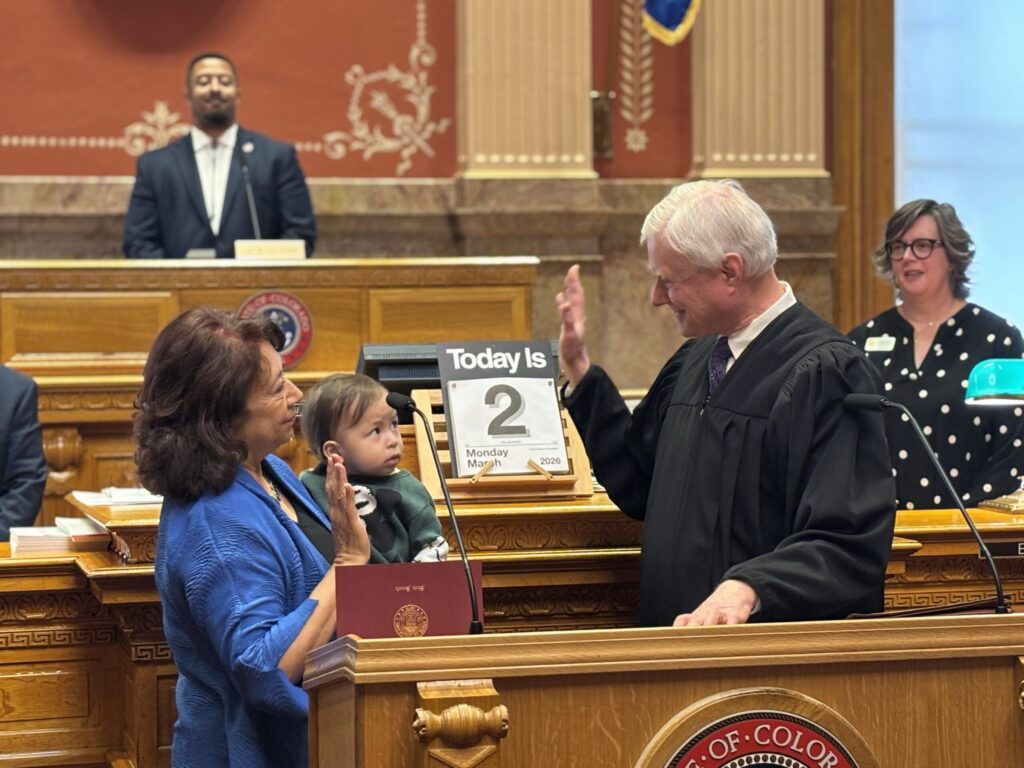
Sen. Adrienne Benavidez, a Democrat from Adams County, was sworn in Monday to the Colorado Senate, just four days after winning a vacancy election in District 21. She was sworn in by Colorado Court of Appeals Justice Lino S. Lipinsky...

10th Circuit judge creates vacancy, district court gets new chief judge | COURT CRAWL
Michael Karlik
michael.karlik@coloradopolitics.com
Updated 17 hours ago
Welcome to Court Crawl, Colorado Politics’ roundup of news from the third branch of government. A longtime member of the Denver-based federal appeals court will give the president a vacancy to fill, plus Colorado’s federal trial court will see a...

Denver mayor says his commute time tripled following ‘road diet’ change
Mark Samuelson Special to The Denver Gazette
mark.samuelson@denvergazette.com
Updated 14 hours ago
Mayor Mike Johnston is pushing back sharply against the claim by Denver councilmembers and bike activists that the city succumbed to lobbying pressure in revising a “road diet” plan for East Alameda Avenue, while noting that his own commute time...

Rural legislators, Colorado farmers defeat pollinator bill backed by Gov. Polis
Marianne Goodland
marianne.goodland@coloradopolitics.com
Updated 15 hours ago
A proposal to limit the use of neonicotinoid-coated crop seeds collapsed in the Senate Agriculture and Natural Resources Committee last week, as rural lawmakers, including two Democrats, joined Republicans to reject what they called an expensive, impractical mandate on farmers....