

Colorado Department of Education challenges funding eligibility for ‘first public Christian school’
EDITOR’S NOTE: An earlier version of this story reported that Riverstone Academy was a charter school. Because it is authorized by the Education ReEnvisioned BOCES, it is considered a contract school rather than a charter school.
A new school, touted as the first public Christian school in Colorado, is facing pushback from the state education department over its right to public funding.
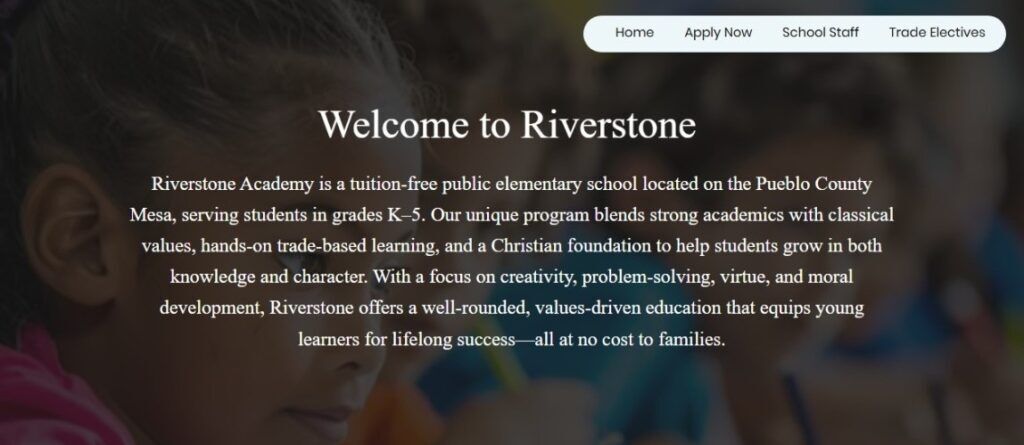
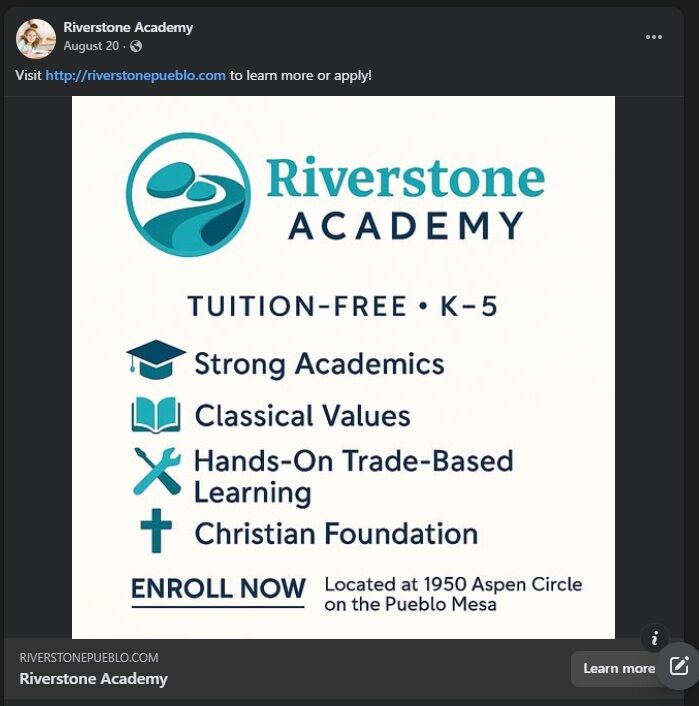
According to its official website, Riverstone Academy is a K-5 public elementary school based in Pueblo that “blends strong academics with classical values, hands-on trade-based learning, and a Christian foundation to help students grow in both knowledge and character.”
The website also states that the school opened this fall. It is contracted with the Education ReEnvisioned BOCES (Boards of Cooperative Educational Services) and partners with the Christian education programming nonprofit Forging Education. Based in Monument, the BOCES provides specialized educational programming to schools, districts and homeschooling families and currently partners with D-49, Montezuma Cortez RE-1 and Pikes Peak State College.
During a presentation to D-49’s board of education on Oct. 9, the BOCES’s executive director, Ken Witt, called the new addition “Colorado’s first public Christian school” and the result of developing a program that parents wished existed.
“We’re confident that the Espinoza ruling of the Supreme Court says ‘We can’t care when we apply public money to these private education institutions, we can’t care whether they are religiously associated or not, so we don’t,’” he said.
The ruling he referred to was Espinoza et al. v. Montana Department of Revenue et al., where the U.S. Supreme Court determined that the state department couldn’t deny religious schools from receiving financial assistance through a tax incentive program.
Along with his role with the BOCES, Witt recently acted as the superintendent in Woodland Park RE-2, where he implemented the American Birthright social studies education standard backed by conservative groups and pulled material from a high school course the district believed taught critical race theory concepts. He resigned in March after the district lost funding from a local sales tax and a last-minute attempt to sell district property to its charter school.
He had previously attempted to change social studies standards as the Jefferson County school board president. That led to his removal in a 2015 recall election.
In a letter sent to Witt and D-49 Superintendent Peter Hilts the following day, the Colorado Department of Education’s district operations special advisor Jennifer Okes raised concerns about the school’s sectarian operation and instruction as a publicly funded school.
She refers to the Colorado and U.S. constitutions, with the former permitting sectarian tenets or doctrines to be taught in public schools and the latter stating “Congress shall make no law respecting an establishment of religion.”
“ERBOCES is a public entity bound by the federal and state constitutions,” the letter read. “Thus, any school that ERBOCES operates must be nonsectarian in nature.”
Additionally, Okes noted that the school uses curriculum from Masterbooks and Berean Builders, both of which feature faith-based materials.
The letter goes on to ask if D-49 intends to include students enrolled at Riverstone in its fall pupil count, which is used to determine school districts’ state funding, since it doesn’t meet the same requirements and standards as other public schools.
“As such, any pupils that D-49 submits for funding from Riverstone Academy would not be eligible for funding,” Okes wrote.
A spokesperson for D-49 told The Gazette in an email that, since the school district does not directly authorize Riverstone, they are deferring all questions about the school to the BOCES.
During the meeting, D-49 board member Mike Heil raised these same concerns regarding the constitutional violations of the school.
“As somebody who gets deep into our U.S. Constitution and our U.S. history, eroding that separation of church and state is very concerning,” he said. “And, for us to be a partner in that, it does not sit well with me.”
Board President Lori Thompson then clarified that “separation of church and state is not contained in the United States Constitution,” while Vice President Jamilynn D’Avola added that public schools in the United States previously taught the Bible and prayed in classrooms before the 1960s.
“And they were funded,” she said. “So, there you go.”
The Supreme Court ruled in the 1962 case Engel v. Vitale that prayers in public school violated the Establishment Clause of the First Amendment in the U.S. Constitution since citizens adhere to a variety of beliefs, and the government endorsing any particular belief system would be inappropriate.

Clash of the titans: Democratic race for governor pits two candidates similar in focus, but very different in style | Vince Bzdek
Vince Bzdek
vince.bzdek@gazette.com
Updated 6 hours ago
By Vince Bzdek The race for governor is shaping up to be a clash of Democratic titans, U.S. Sen. Michael Bennet and Attorney General Phil Weiser. They are two of Colorado’s highest profile politicians with deep track records who...
Colorado High School Activities Association reaches settlement with D-49, other school districts in trans athletics lawsuit
Eric Young
eric.young@gazette.com
Updated 2 days ago
Months after adopting new policies restricting students to athletic participation based on their biological sex and filing a federal lawsuit, School District 49 and other Colorado school districts have reached a settlement with the Colorado High School Activities Association (CHSAA)...
New-look Douglas County school board names returning director as president
Noah Festenstein
noah.festenstein@denvergazette.com
Updated 4 days ago
After four new directors swore in earlier than expected, the new-look Douglas County school board met for the first time Tuesday night to elect a new board president and discuss issues addressed by the previous board. Douglas County voters in...
Denver school board elects Gaytán as president
Nico Brambila
nico.brambila@denvergazette.com
Updated 4 days ago
After weeks of jockeying for votes, the Denver Public Schools Board of Education chose a new slate of officers during a specially called meeting Tuesday, selecting Director Xóchitl Gaytán as board president — a role that carries significant control over...
Colorado Higher Education Director Angie Paccione to step down
Marianne Goodland
marianne.goodland@coloradopolitics.com
Updated 2 days ago
Angie Paccione, who has led the Colorado Department of Higher Education since 2019, is returning to the private sector, Gov. Jared Polis said. Paccione’s last day is Jan. 9. The governor’s office said Gov. Jared Polis would decide on the...
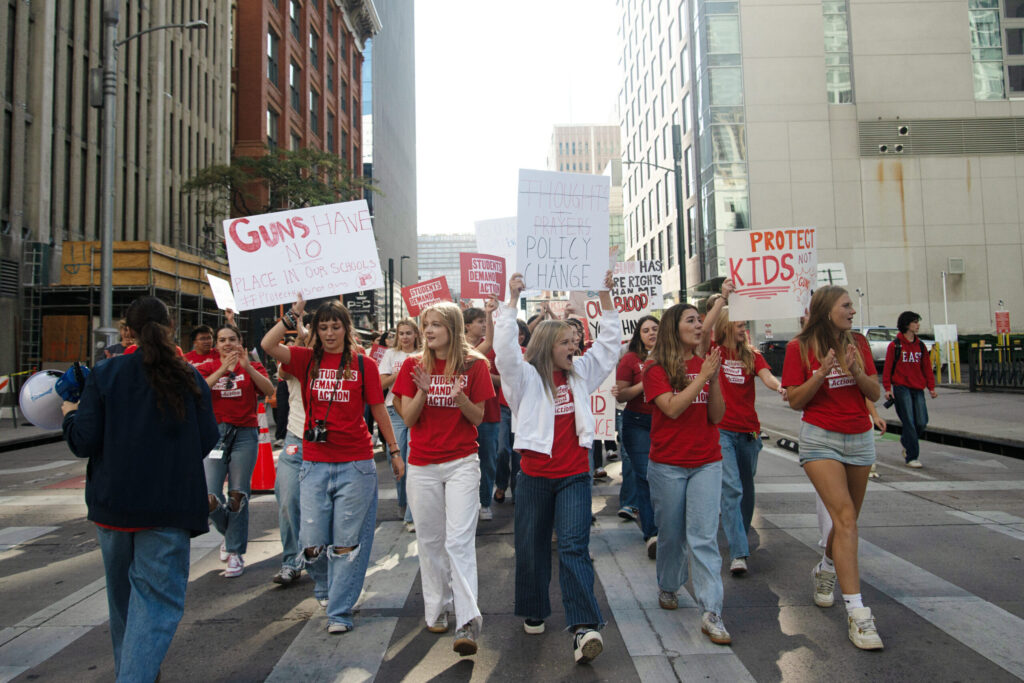
Survey reveals widespread dissatisfaction with Colorado’s public education system
Marissa Ventrelli
marissa.ventrelli@coloradopolitics.com
Updated 4 days ago
Most Colorado voters are dissatisfied with the state’s public education system and many lament that it’s headed in the wrong direction, citing – among other worries – “woke” ideology permeating schools, according to a recent poll. Meanwhile, the minority of...
Colorado Springs D-11 board member running for state House seat
Eric Young
eric.young@gazette.com
Updated 1 week ago
A Colorado Springs District 11 board member has thrown their hat into the ring for a seat in the state House of Representatives. A candidate affidavit and committee registration form for Jill Haffley, vice president of D-11’s Board of Education,...
Jeffco Public Schools discusses budget cuts, mill levy
Sage Kelley
sage.kelley@denvergazette.com
Updated 2 weeks ago
A $60 million structural deficit continues to hang over the Jeffco Public Schools. The Jeffco Board of Education met with members of the district’s financial team on Nov. 13 to discuss updates to the Budget Reduction Blueprint — or overall...
Audit: Denver school district owes more than it owns, despite nearly $1B in unspent bond cash
Nico Brambila
nico.brambila@denvergazette.com
Updated 2 weeks ago
Denver Public Schools is operating with a negative net position — owing more in long-term obligations than it holds in assets — a rare and troubling financial posture for a major Colorado school district, according to an audit. Presented on...
DPS board president creates committees that may fall outside public view
Nico Brambila
nico.brambila@denvergazette.com
Updated 2 weeks ago
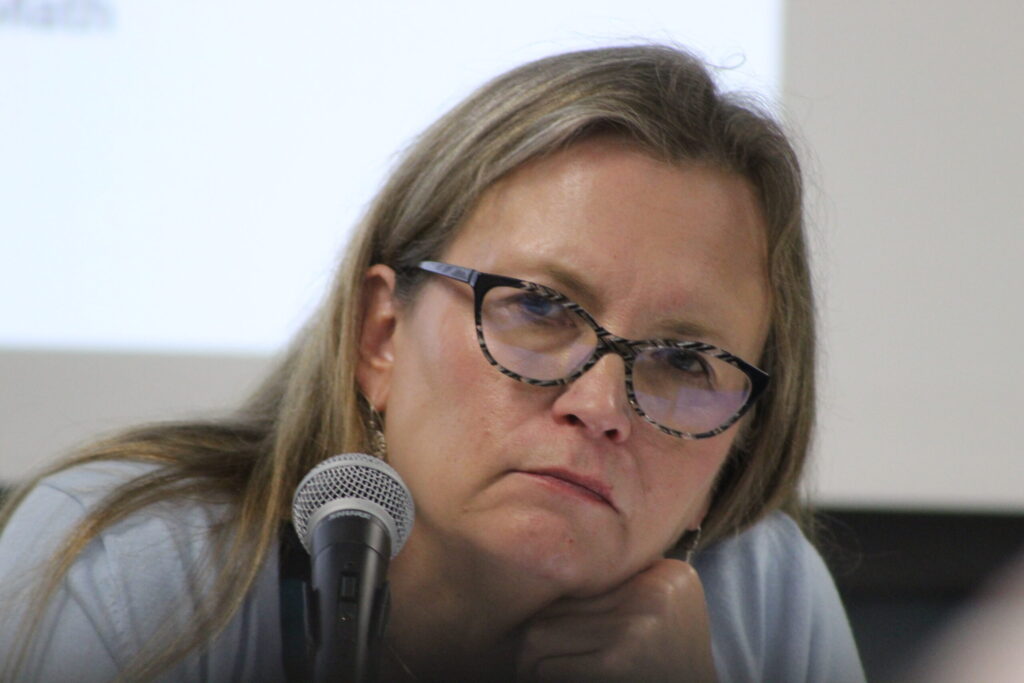
As one of her last official acts on the Denver Public Schools Board of Education, President Carrie Olson created a two-member committee that will not likely conduct its business in public as state law demands. The two-person committee headed by...
PREV
PREVIOUS

Colorado voters to decide fate of additional funding for school meals program, SNAP
Two statewide ballot measures are up for voter approval early next month, the aim of which is to raise additional funds for free school meals program and help pay for the federal food stamp program. Both Propositions LL and MM are tied to the Healthy School Meals for All program, which voters approved in 2022. […]
Accusations of racism ripple through Denver school leadership
“Racist” has become a go-to accusation by Denver Public Schools leaders and those who attend board meetings. A White woman asking a Black heckler to stop? “Racist.” A White board member proposing guardrails on the board of education hiring outside counsel when the district has in-house Black counsel? “Racist.” Another White board member accused of […]