

Can only charitable crowd-sourcing save public ed funding? | NOONAN
Proposition HH failed to bring more dollars to Colorado’s public schools. It couldn’t possibly have lost because people think too much money is flowing into K-12 education, could it?
Certainly citizens don’t think about $11,000 per-year, per-student is enough to cover all the circumstances teachers, students and parents face in giving and receiving a uniform and equitable education, as stated in our Constitution. That amount only works for communities with the highest incomes, the fewest kids with low-incomes and the fewest kids learning English as a second language according to data on 111 school districts that fully report their Accountability numbers to the Colorado Department of Education (CDE).
For communities and school districts with lots of low-income kids (more than 25% on Free and Reduced Lunch – FRL) and more than 15% of students trying to figure out how to spell in English (English Language Learners – ELL), $11,000 per student doesn’t cut it.
The Colorado Department of Education, in its explanation to the Accountability Task Force that’s supposed to re-think our current standardized-test-based assessment program, asserted there’s a weak correlation between low-achievement test scores and special groups of students: FRL, ELL and Special Education. Let them explain that theory to you. In actuality, the data show strong correlations between high percentages of FRL and ELL students in districts and their students’ low aggregated test scores leading to low performance ratings.
Stay up to speed: Sign-up for daily opinion in your inbox Monday-Friday
There’s also a strong correlation between negative achievement outcomes and money. Low-income communities, especially with high numbers of FRL and ELL students, lead to districts with low scores on CMAS achievement tests and not enough dollars and resources to offset the barriers to more positive outcomes.
A clear comparison is Telluride school district in the ski-town resort community and Burlington school district on the eastern plains on the way to Kansas. Both have about the same number of students in their districts, but Telluride has a Distinction CDE performance rating and Burlington has an Improvement CDE performance rating. Telluride ranks sixth in the state for total spending at $18,898 among 111 fully reporting districts. Burlington rates 100th with $10,772 per student.
Based on CDE data, Telluride receives 70% of its per-student income from local property taxes with average household income of more than $75,000 per year. It receives 25% school finance from state funds. That puts Telluride at 95% funding from in-state taxes. Burlington, with average household income of $54,934, receives only 39% of its total per-student revenue from local taxes with 49% coming from the state. That puts Burlington at 88% funding from in-state taxes. Burlington’s total comes up about $8,000 short of Telluride’s. So much for uniform and equitable school finance as required by our Constitution.
To complicate matters, Telluride’s student population is much less challenging in terms of FRL and ELL students than Burlington’s. Telluride is 24% minority, 0% to 25% with students on FRL, and 15% of students in ELL status. Burlington is 46% minority, with 50% to 75% of students on FRL, and 19% of students in ELL status. If level of difficulty is like a score in Olympic diving, then Burlington’s education level of difficulty is about 40% higher than Telluride’s, yet it’s receiving about 40% less money than the resort town.
So with $8,000 fewer dollars per student and a student body facing many more challenges than Telluride’s pupils, Burlington is nevertheless expected to educate its students to at least accredited status to stay out of the harm’s way of the long accountability arm of the state while maintaining its respectability as a district. Good luck, Burlington! And good luck Fremont and Ignacio. And Alamosa and Fort Morgan. And Huerfano and Pueblo City 60. And Westminster and Montrose, among many other districts whose FRL and ELL percentages as well as per-student funding present negative impacts that every district with a “Distinction” performance rating does not face.
Since Gov. Jared Polis and too many in the legislature, including Democrats who supposedly are all-in supporting public schools, haven’t drummed up the guts to be serious with the people of the state about education funding, it’s time for new funding solutions. The governor has exploited every sin that’s taxed, so that option is off the table. He won’t put up a decent initiative to get more money. That leaves… GoFundMe.
Currently, the state owes about $10 billion to school districts based on a decade plus of underfunding. Thus, the “GoFundMe K-12 Colorado Public Schools” campaign would have to be a statewide effort. It should also be targeted to districts in the Improvement performance rating category, with funds going first to districts with 50-percent-plus on FRL status and 10-percent-plus on ELL status.
The distribution of money should be calculated based on the up or down compared to the state’s $11,000 average per student. That way, donors will know their dollars are going first to the districts with the most barriers to achieving “Accredited” performance ratings.
It’s the perfect season for “GoFundMe K-12 Public Schools Colorado.” Make an end-of-year charitable contribution to the cause. Let’s show our K-12 students and teachers we are willing to save the K-12 ship even if our state leaders are not.
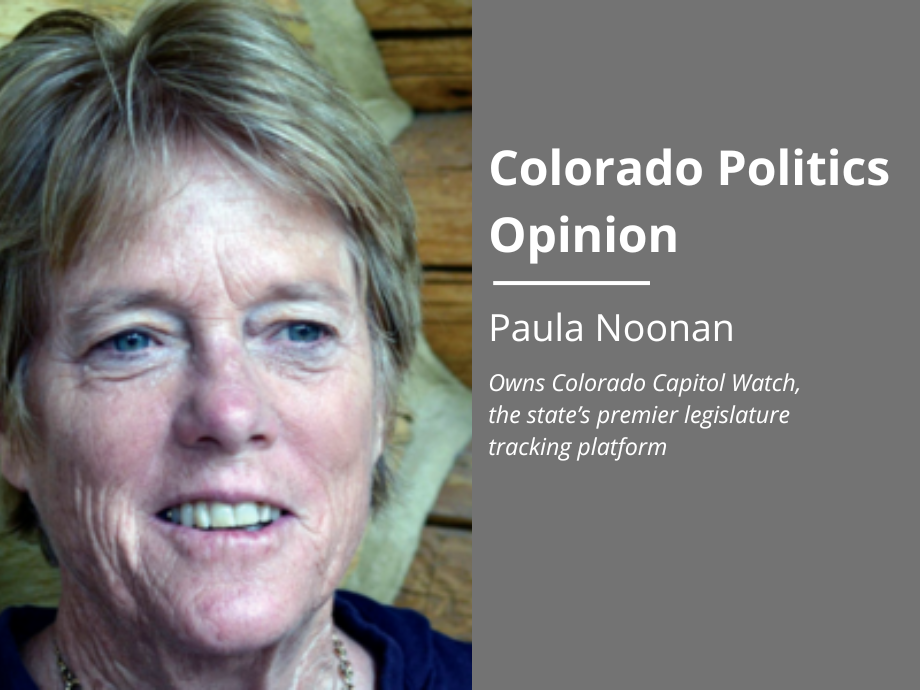
Paula Noonan owns Colorado Capitol Watch, the state’s premier legislature tracking platform.

Real leadership requires long-term thinking | BIDLACK
Hal Bidlack
hal-bidlack@coloradopolitics.com
Updated 3 hours ago
I make no secret of my fidelity to the University of Michigan. I grew up in Ann Arbor, the son of a UM school dean, and all three of my degrees, BA, MA, and Ph.D., are from that lovely campus....
Psychedelics are a safe, novel approach to Colorado’s mental health crisis | OPINION
Colorado Politics
colorado-politics@coloradopolitics.com
Updated 3 hours ago
By Sarah Markey and Dafna Michaelson-Jenet We all have moments in which we experience feelings of anxiety and depression. This is part of what it means to be human in today’s world — there is no shortage of suffering. The...
Trump admin’s maiming of renewables agencies an energy affront | HUDSON
Miller Hudson
miller-hudson@coloradopolitics.com
Updated 1 day ago
NREL has a rhythmic resonance that won’t be matched by NLR, Colorado’s newly christened National Laboratory of the Rockies. Nearly lost to memory is how the National Renewable Energy Laboratory authorized by President George H. W. Bush in 1991 was...

Ranchers are not an endangered species, nor an invasive one | GABEL
Rachel Gabel
rachel-gabel@coloradopolitics.com
Updated 18 hours ago
Animal agriculture, ranching, hunting and farming are not dying ways of life. The cowboy is not about to ride off into the sunset and certain extinction. Beef is not going to be replaced by cultured meat, any variety of bugs,...

Colorado’s Public Utilities Commission votes to suspend reality | CALDARA
Jon Caldara
jon-caldara@coloradopolitics.com
Updated 17 hours ago
Colorado’s Public Utilities Commission has done it again — proving when regulators get together, they can create a fantasyland so detached from reality it makes Disneyland look like a documentary. Colorado’s Public Utilities Commission just adopted a new rule ordering...
Dear Abby: A better answer to your question | SONDERMANN
Eric Sondermann
eric-sondermann@coloradopolitics.com
Updated 4 days ago
It was the beginning of October. I had been invited to speak to a class on political journalism at Colorado College, my old alma mater. The class was taught by none other than Vince Bzdek, the editor-in-chief of this paper...
Trumpian Republicans’ explanations for Epstein child sex abuse appalling | MAES
Dennis Maes
dennis-maes@coloradopolitics.com
Updated 4 days ago
During the course of my career as an attorney and judge, spanning five decades, I have witnessed events most individuals would never experience. Without any question the most revolting, repulsive and vile of which are matters involving the sexual assault...
The theatrics of land-use in Douglas County | NOONAN
Paula Noonan
paula-noonan@coloradopolitics.com
Updated 5 days ago
If anyone thinks a county commission land-use session lacks theatricality, think again. Just drop into a land-use meeting in Douglas County with its current three commissioners. Citizens attending a Nov. 25 Dougco land-use session were treated to the following actions:...
Colorado’s muffled majority looks for a voice in our elections | OPINION
Colorado Politics
colorado-politics@coloradopolitics.com
Updated 5 days ago
By Linda Templin A massive number of Americans (85% according to the Pew Trust) want total or major election reform. They want a more responsive government, not shutdowns and spectacles of abuse. This is no time for self-interested tinkering around...

We can build a better path forward for Colorado health care | PODIUM
Colorado Politics
colorado-politics@coloradopolitics.com
Updated 6 days ago
By Jeff Tieman and Julie Reiskin Colorado is careening toward a health care disaster, and unless we change course now, too many of our neighbors will bear the cost — in dollars, in well-being and in lives. Colorado’s health care...
PREV
PREVIOUS

It’s time to allow independent contractors to save for retirement | OPINION
Veronica Leal I am part of the growing trend of Americans older than 60 who utilize flexible work opportunities to supplement social security savings, maintain financial freedom, and help care for my family during retirement. With more than 76 million Americans projected to be involved in flexible work in 2024, the number of older independent […]

When public protests cross the line | Denver Gazette
We extend a heartfelt welcome to the many who have come to Colorado this week for the Jewish National Fund-USA conference. It begins today at the Colorado Convention Center in downtown Denver, where Gov. Jared Polis is expected to address the gathering. The conference convenes amid a particularly challenging time for the Jewish community in […]