

Colorado Springs expands ordinance prohibiting sitting or lying on sidewalks

The Colorado Springs City Council approved an expansion of an ordinance Tuesday that prohibits anyone from sitting, lying, kneeling or reclining on sidewalks, trails, alleys and other rights of way – a law that critics say targets homeless people.
The expansion of the area where the law will apply was approved on a 7 to 2 vote with Councilwomen Yolanda Avila and Nancy Henjum opposed. The council backed the expansion of the law after hearing from concerned residents who said the fines and potential jail time imposed for breaking the law make it harder for people to exit homelessness. Business representatives also spoke up saying the expansion could push more homeless residents to the fringes of the expansion area where they would be more of a problem for them.
Councilman Wayne Williams was among the councilmen who backed the law, in part, because nonprofits have space for homeless residents to go during the day, he said.
“If we were to reach a stage where there was insufficient space then we would react differently,” he said.
Colorado Springs City Council appointment shifting balance of power on council
The law has applied to a portion of Old Colorado City and the core of downtown since 2016. The change will expand the downtown boundaries where the law applies north to Cache la Poudre Street and south to Cheyenne Road. The expanded area encompasses the sidewalks and roads around new venues including the Switchbacks Stadium and Robson Arena. It will also apply to sidewalks and rights of way around homeless service providers including the Springs Rescue Mission and the Salvation Army’s R.J. Montgomery Center.
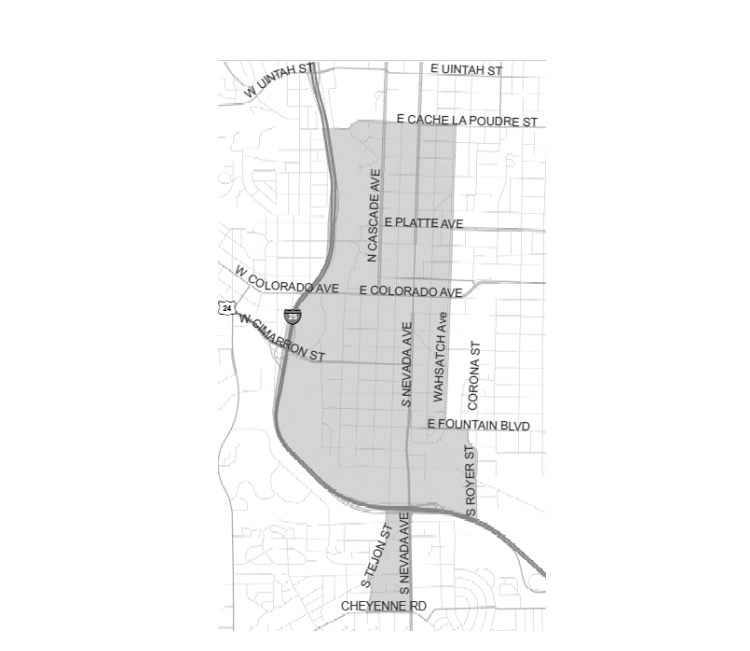
Williams said the city would work with businesses and others on the east side of South Nevada not included in the expanded boundary who have concerns that more homeless people will be pushed into their neighborhood. The city may consider a boundary adjustment, he said.
Southern Cross Shopping Center owner John Kim said he feared the new boundary could push more homeless people to his business and intensify issues he is already combating.
Citizens group launching bid to put recreational marijuana sales on Colorado Springs ballot
Nick Xenos, deputy director of the Vanguard School, had similar concerns the change would push more people using drugs to spend time outside of the school. The school pays for additional security now to address the issues, he said.
The police department asked for an expansion of the ordinance based, in part, on data that show where trespassing and camping have been the most problematic around downtown, said Police Cmdr. John Koch.
He also noted that as more people have started visiting the new stadiums and U.S. Olympic and Paralympic Museum, people blocking sidewalks and rights of way have become more of an issue.
Since the ordinance was first passed in 2016, the police department has issued 88 citations for violating it, he said. Once issued a ticket, the person must go to municipal court and the judge will decide if the individual will pay a fine, serve probation or go to jail.
City of Colorado Springs Attorney Shantel Diane Withrow told city council she could not say how many people had served jail time for violating the existing ordinance.
The police department expects to educate homeless residents over 60 days about the newly expanded area before they start to issue citations, Koch said.
Jack Briggs, president and CEO of the Springs Rescue Mission, was one of the few who spoke in support of the expansion as proposed saying it would incentivize people to seek services.
“We at the Rescue Mission believe it is a positive tool for compassion,” he said.
Others disputed the positive effect of the law saying that the possible fines up to $500 and sentences of up to 90 days in jail are counterproductive and make it harder for people to find homes.
“Please do not do this. Do not continue to criminalize homelessness. … It is a difficult and very scary place to be,” said Melissa Hall, who was homeless with her five children at one time.
Instead of expanding the ordinance, the city could focus more on funding housing and the Colorado Springs Fire Department’s outreach program, said Jonathan Christiansen, with the Chinook Center, a nonprofit that works on social justice issues. The fire department employs behavioral health professionals among others to help people exit homelessness and get treatment for mental illness and addiction.
Police can enforce existing trespassing and camping laws, they don’t need an expansion of the ordinance against sitting or lying in rights of way, Christiansen said.
“It’s really just a heartless attempt to brush people under the rug,” he said.
Henjum said she would like the city to better track and understand how the law is enforced.
She also called on the city administration to propose permanent funding in next year’s budget for the fire department’s outreach teams that currently rely on grants.


Colorado gun policy receives ‘A-‘ from Giffords Law Center
Marissa Ventrelli
marissa.ventrelli@coloradopolitics.com
Updated 13 hours ago
Colorado earned an A minus anew on the Giffords Law Center’s annual Gun Law Scorecard – due in part to a law passed during the last legislative session that requires individuals to undergo training and obtain a permit to purchase...

Colorado vacancy panels face challenge: Replacing senator and representative from the same area
Marianne Goodland
marianne.goodland@coloradopolitics.com
Updated 13 hours ago
Two vacancy committees that will convene in the next month or so will have an interesting challenge: Picking a new state senator and state representative who will represent the same geographic area. The vacancy election for Senate District 25, represented...
Higher home values, abatements to push DPS tax bills up in 2025
Nico Brambila
nico.brambila@denvergazette.com
Updated 11 hours ago
Denver homeowners will pay more in school taxes next year even though Denver Public Schools (DPS) slightly lowered its overall tax rate. The increase is being driven by rising assessed home values, a full 52.142-mill levy and a dramatic increase...

Trump administration announces $12 billion soybean aid package
RACHAEL WRIGHT Special to The Gazette
rachael-wright-special-to-the-gazette@coloradopolitics.com
Updated 13 hours ago
President Donald Trump and Secretary of Agriculture Brooke Rollins announced Monday that the administration was planning to disburse a $12 billion dollar aid package as part of the Farmer Bridge Assistance (FBA) Program, to make targeted, one-time payments to crop...

Federal judge rejects Tina Peters’ request for release pending appeal
Michael Karlik
michael.karlik@coloradopolitics.com
Updated 14 hours ago
A federal judge rejected the petition of former Mesa County clerk Tina Peters on Monday to be released from incarceration pending the resolution of her criminal appeal. Chief U.S. Magistrate Judge Scott T. Varholak wrote in a Dec. 8 order...

Colorado justices lay down framework for analyzing defamation lawsuits involving ‘public interest’ issues
Michael Karlik
michael.karlik@coloradopolitics.com
Updated 16 hours ago
The Colorado Supreme Court clarified on Monday how judges should evaluate whether lawsuits arising from a person’s speech — in particular, online consumer reviews — are connected to an “issue of public interest” and merit protection from legal liability. As...

Federal judge rejects DPS’ attempt to obtain 9News sourcing documents in First Amendment case
Michael Karlik
michael.karlik@coloradopolitics.com
Updated 17 hours ago
A federal judge rejected Denver Public Schools’ attempt on Monday to obtain documents from 9News related to its interview with a former principal who alleges his termination amounted to a constitutional violation. At the same time, the attorney for plaintiff...

Audit finds major gaps in Colorado’s oil and gas reporting, enforcement
Marissa Ventrelli
marissa.ventrelli@coloradopolitics.com
Updated 16 hours ago
The agencies responsible for regulating Colorado’s oil and gas industry are underperforming when it comes to reporting and enforcement and they also failed to collect payments amounting to hundreds of thousands of dollars in lost revenue, according to a state...

Colorado Gives Foundation turns 50 during giving season
Kyla Pearce
kyla.pearce@gazette.com
Updated 21 hours ago
Colorado Gives Day is Tuesday. The Colorado Gives Foundation, which started as a small hospital fundraising group and has grown into a statewide nonprofit, is celebrating its 50th anniversary shortly after Giving Tuesday. Colorado Gives Day, which was created by...

Colorado Democrat Julie Gonzales launches U.S. Senate primary challenge to incumbent John Hickenlooper
Ernest Luning
ernest.luning@coloradopolitics.com
Updated 13 hours ago
Declaring that Colorado “needs a fighter, not a bystander,” state Sen. Julie Gonzales, a Denver Democrat, on Monday launched her long-anticipated primary challenge to U.S. Sen. John Hickenlooper. Pitching her campaign as a departure from “old-playbook politics,” Gonzales said she’s...
PREV
PREVIOUS
White House threatens new export controls targeting strategic Russian industries
The White House is weighing new export controls on advanced technologies, threatening Russia’s strategic ambitions, and plans to surge natural gas to Europe if Moscow invades Ukraine, administration officials said. “We are prepared to implement sanctions with massive consequences that were not considered in 2014. That means the gradualism of the past is out, and […]

Legislative panel rejects request for audit of state health agency's COVID-19 testing contracts
An audit request from Sen. Rob Woodward, R-Loveland, for two contracts between the Colorado Department of Public Health and Environment and two labs handling COVID-19 testing was turned down on a 4-4 tie by the Legislative Audit Committee. The committee is half Democrat, half Republican, hence the potential for a tie vote. The panel killed the […]