

Senate panels approve revamped greenhouse gas emissions bill with support from the Polis administration
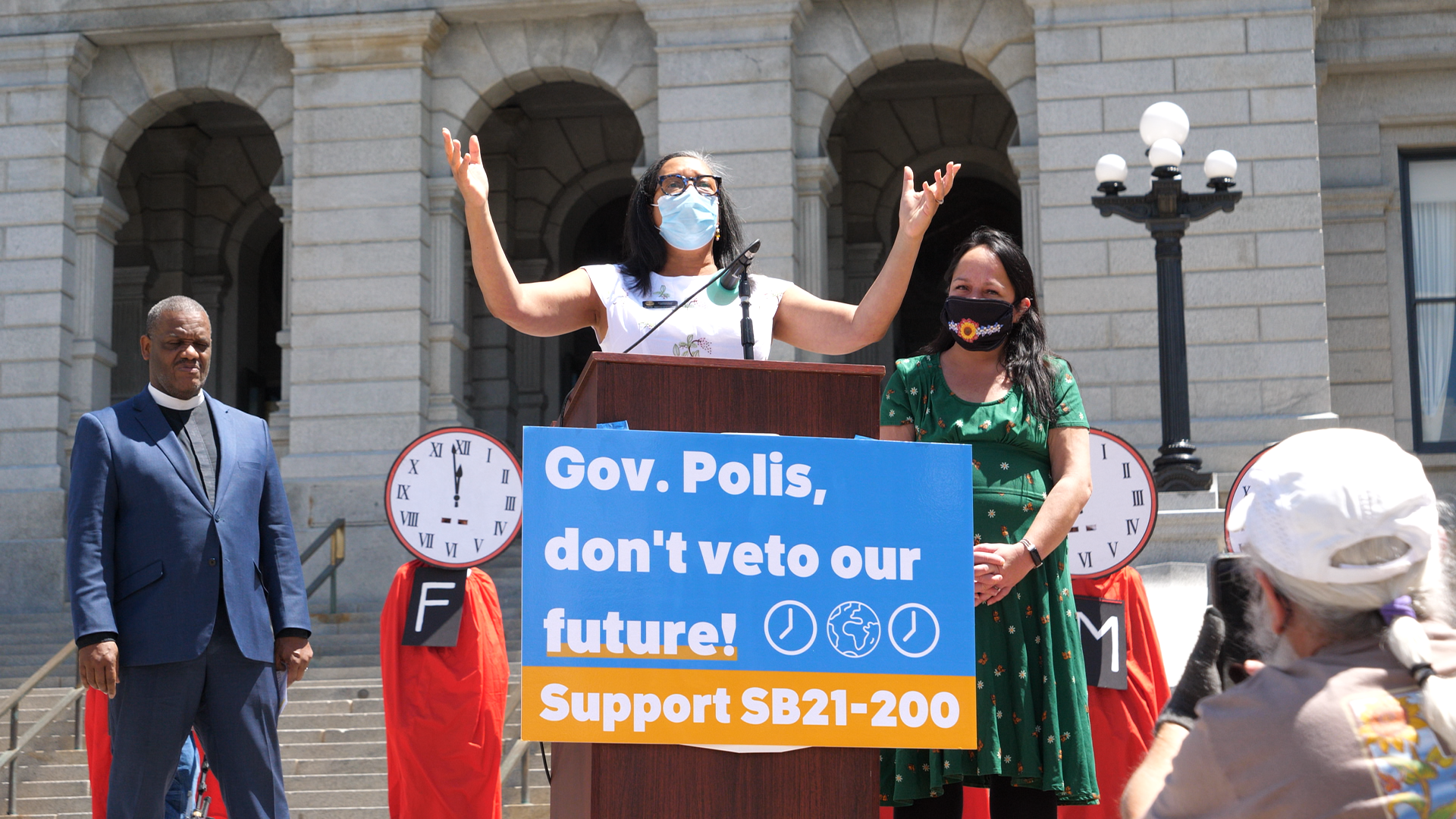
An effort from legislative Democrats to codify sector-specific greenhouse gas emissions targets in state law, add enforcement mechanisms to some of those goals and center the voices of communities disproportionately impacted by climate change is speeding through the legislative process in the final days of the session.
And this time, it appears to have the blessing of Gov. Jared Polis.
The Senate Finance and Appropriations panels and the chamber’s Committee of the Whole on Monday voted to advance House Bill 1266, a measure that was originally aimed at environmental justice via the creation of an ombudsperson and an advisory committee. Those elements remained, but the panel also signed off on a significant overhaul in the form of an amendment that bill sponsor Sen. Faith Winter, D-Westminster, labeled as “the baby of Senate Bill 200.”
That’s this session’s landmark climate action bill, one that caused quite a stir under the Democratic-controlled Gold Dome.
SB 200 from Winter, Sen. Dominick Moreno, D-Commerce City, and Rep. Dominique Jackson, D-Aurora, is a wide-ranging bill designed primarily to make the Air Quality Control Commission the “program manager of meeting our greenhouse gas reduction goals.”
Those goals were established by the state’s landmark climate action plan, put in place by legislation passed in 2019, seeking to reduce greenhouse gas emissions by at least 26% by 2025, at least 50% by 2030 and 90% by 2050, based on 2005 levels. But some Democratic lawmakers and climate activists worry that a “road map” to meeting the 2050 goal released by Polis earlier this year could fall short without clear, enforceable standards.
Implementing those standards across five sectors of the economy – transportation, oil and gas, electric, industry and buildings – was one of the primary goals of the original legislation. One problem, though: Polis was not on board. The bill stalled when it reached the Senate floor after Polis told the Gazette editorial board he would veto the legislation if it reached his desk.
After weeks of negotiation, Winter and Jackson decided to move in a different direction and add elements of SB 200 into HB 1266, which also features Sen. Janet Buckner, D-Aurora, as a co-prime sponsor.
“We’ve always in [SB] 200 wanted measurability, equity and enforceability in five sectors,” Winter said while laying out the differences between the two pieces of legislation during the hearing during the Finance Committee. “Through conversations, we have measurability in all five sectors… we also have equity through the environmental justice provisions.”
The bill also included enforceability, Winter said, just not to the same level as the bill sponsors originally had intended. Instead of enforcement mechanisms on all five sectors, the amendment dropped those provisions on the transportation and building sectors.
According to Colorado Energy Office Director Will Toor, that change addressed Polis’ “biggest discomfort” and was enough to bring the administration on board. He said during the Finance hearing that discomfort stemmed from “trying to apply the traditional air regulatory approach to buildings and to transportation, which are sectors where there is not similarly an industry to regulate.”
“If you want to reduce emissions from the oil and gas industry, it’s relatively straightforward to work with the industry on a regulatory structure,” Toor said. “If you’re talking about transportation… there’s nothing that’s analogous.
“Instead, there are millions of individual businesses and residents who are making decisions about how they travel and what vehicles they’re buying and so we think there’s just a different strategy that you need.”
To that point, Toor pointed to elements from the $5.4 billion transportation funding measure that cleared the General Assembly last week.
Winter acknowledged those elements too, referencing Senate Bill 260 in noting that “there’s other bills in the system that make significant progress in both those sectors, but still we don’t have enforceability.”
“But having measurability and equity in all five sectors is a huge step forward,” she added.
While the negotiations may have brought Polis into the fold, the revamped measure still faced vehement opposition from the oil and gas industry and electric utilities.
As they had in the initial hearing on SB200, representatives of those groups once again accused the bill sponsors of “moving the goalposts” on emissions targets. But this time it was done in the dark of night, as Scott Prestidge of the Colorado Oil and Gas Association put it. And he wasn’t alone.
“It’s very difficult for us to digest and respond to a 25-page amendment that we got at six o’clock in the morning,” said Geoffrey Hier of the Colorado Rural Electric Association. “Even though it was apparently available on Friday, it was not distributed.”
Complaints about the stakeholder process were a common refrain from representatives of the oil and gas industry and electric utilities. Lynn Granger, the executive director of American Petroleum Institute in Colorado, testified that the development of the amendment was “so disappointing.”
“What we have seen unfold in the past 24 hours is far cry from sound policy development,” she said. “In order to truly address the problem with tangible, feasible solutions that actually meet the intended goals, due process is critical.
“How does one know what is actually feasible or not if they receive no input from the parties who will actually be executing and complying with the different policies? They do not.”
On the other side of the issue, the hearing drew supportive testimony from a number of advocates and environmental groups.
“Coloradans are already bracing for another summer of climate change-driven wildfires, drought, and bad air quality – climate action can’t wait,” said Conservation Colorado Executive Director Kelly Nordini in a statement. “The combined bill is progress that will require emissions reductions from some of the state’s largest pollution sources and enact strong environmental justice provisions, and more will need to be done to put us on track to meet our climate goals.”
The bill is now awaiting a final vote in the Senate. Should it advance through a third reading vote, it will go back to the House for consideration of the changes Winter added.

Colorado gun policy receives ‘A-‘ from Giffords Law Center
Marissa Ventrelli
marissa.ventrelli@coloradopolitics.com
Updated 14 hours ago
Colorado earned an A minus anew on the Giffords Law Center’s annual Gun Law Scorecard – due in part to a law passed during the last legislative session that requires individuals to undergo training and obtain a permit to purchase...
Colorado vacancy panels face challenge: Replacing senator and representative from the same area
Marianne Goodland
marianne.goodland@coloradopolitics.com
Updated 13 hours ago
Two vacancy committees that will convene in the next month or so will have an interesting challenge: Picking a new state senator and state representative who will represent the same geographic area. The vacancy election for Senate District 25, represented...
Higher home values, abatements to push DPS tax bills up in 2025
Nico Brambila
nico.brambila@denvergazette.com
Updated 11 hours ago
Denver homeowners will pay more in school taxes next year even though Denver Public Schools (DPS) slightly lowered its overall tax rate. The increase is being driven by rising assessed home values, a full 52.142-mill levy and a dramatic increase...

Trump administration announces $12 billion soybean aid package
RACHAEL WRIGHT Special to The Gazette
rachael-wright-special-to-the-gazette@coloradopolitics.com
Updated 13 hours ago
President Donald Trump and Secretary of Agriculture Brooke Rollins announced Monday that the administration was planning to disburse a $12 billion dollar aid package as part of the Farmer Bridge Assistance (FBA) Program, to make targeted, one-time payments to crop...
Federal judge rejects Tina Peters’ request for release pending appeal
Michael Karlik
michael.karlik@coloradopolitics.com
Updated 14 hours ago
A federal judge rejected the petition of former Mesa County clerk Tina Peters on Monday to be released from incarceration pending the resolution of her criminal appeal. Chief U.S. Magistrate Judge Scott T. Varholak wrote in a Dec. 8 order...
Colorado justices lay down framework for analyzing defamation lawsuits involving ‘public interest’ issues
Michael Karlik
michael.karlik@coloradopolitics.com
Updated 17 hours ago
The Colorado Supreme Court clarified on Monday how judges should evaluate whether lawsuits arising from a person’s speech — in particular, online consumer reviews — are connected to an “issue of public interest” and merit protection from legal liability. As...

Federal judge rejects DPS’ attempt to obtain 9News sourcing documents in First Amendment case
Michael Karlik
michael.karlik@coloradopolitics.com
Updated 17 hours ago
A federal judge rejected Denver Public Schools’ attempt on Monday to obtain documents from 9News related to its interview with a former principal who alleges his termination amounted to a constitutional violation. At the same time, the attorney for plaintiff...
Audit finds major gaps in Colorado’s oil and gas reporting, enforcement
Marissa Ventrelli
marissa.ventrelli@coloradopolitics.com
Updated 16 hours ago
The agencies responsible for regulating Colorado’s oil and gas industry are underperforming when it comes to reporting and enforcement and they also failed to collect payments amounting to hundreds of thousands of dollars in lost revenue, according to a state...

Colorado Gives Foundation turns 50 during giving season
Kyla Pearce
kyla.pearce@gazette.com
Updated 22 hours ago
Colorado Gives Day is Tuesday. The Colorado Gives Foundation, which started as a small hospital fundraising group and has grown into a statewide nonprofit, is celebrating its 50th anniversary shortly after Giving Tuesday. Colorado Gives Day, which was created by...

Colorado Democrat Julie Gonzales launches U.S. Senate primary challenge to incumbent John Hickenlooper
Ernest Luning
ernest.luning@coloradopolitics.com
Updated 14 hours ago
Declaring that Colorado “needs a fighter, not a bystander,” state Sen. Julie Gonzales, a Denver Democrat, on Monday launched her long-anticipated primary challenge to U.S. Sen. John Hickenlooper. Pitching her campaign as a departure from “old-playbook politics,” Gonzales said she’s...
PREV
PREVIOUS

Virtual court proceedings did not violate man's rights, Supreme Court says
An Adams County judge did not violate a man’s constitutional rights during the pandemic by holding a hearing with witnesses online, instead of in person, due to COVID-19-related concerns. Juan Johnny Hernandez argued that the video testimony violated the clause of the Sixth Amendment guaranteeing the right of the criminally accused to confront witnesses against them. […]

After years of work, conservation easement fix dies in late Monday committee vote
Reparations for hundreds of landowners deprived of legally-obtained tax credits by the Department of Revenue went down in flames Monday night, when a House Republican put a “poison pill” amendment on Senate Bill 33. Landowners, some who traveled for hours to see the bill move through the process Monday, were in shock and crying after […]