

COVER STORY: THE CRAFTSMAN | GOP leader Hugh McKean puts his House in order

A house divided against itself cannot stand.
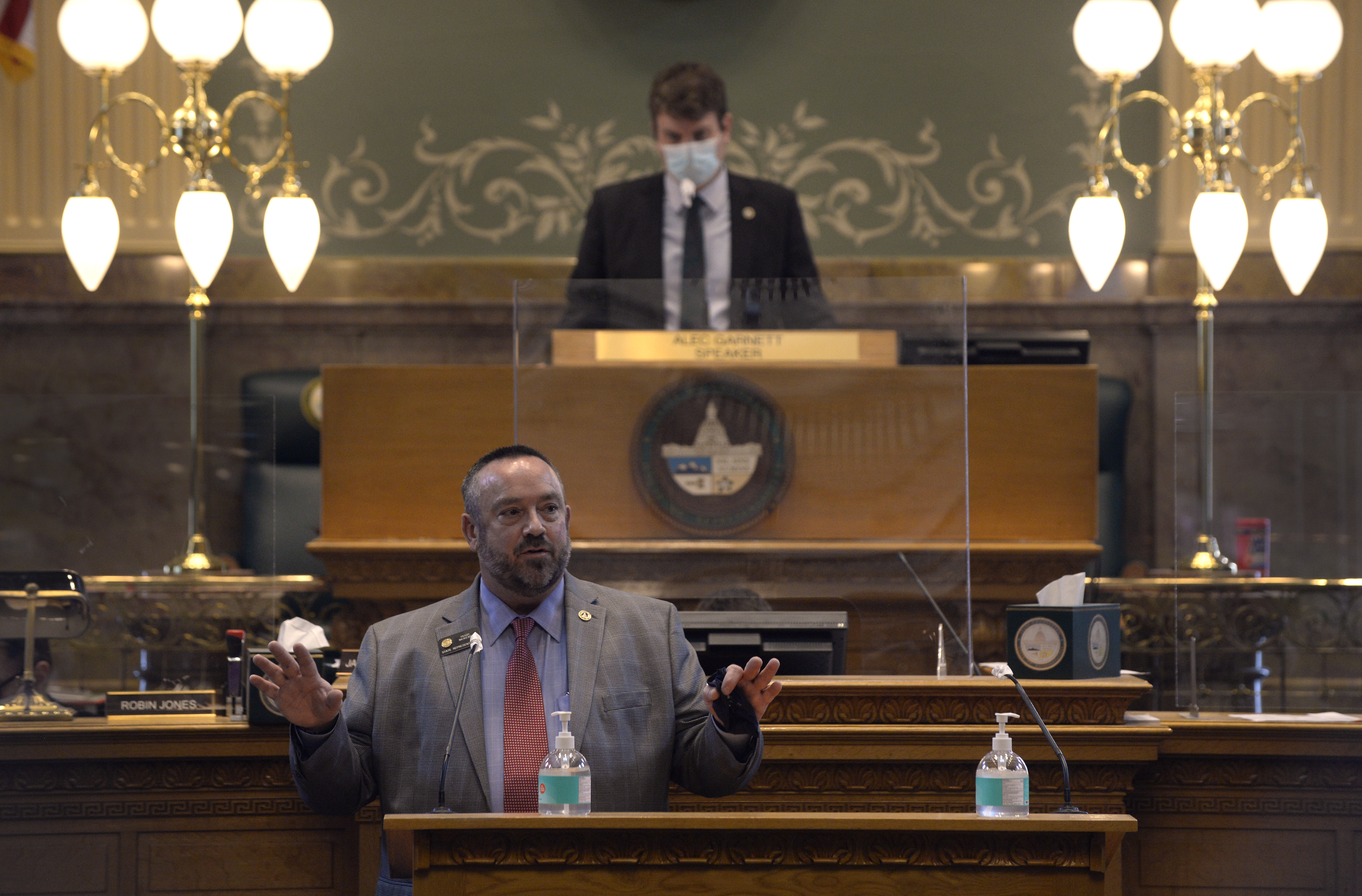
Few lawmakers under the gold dome understand the practical elements of the famous phrase uttered by Abraham Lincoln better than House Minority Leader Hugh McKean. McKean has been a general contractor in Loveland since 1994 and knows a thing or two about building sturdy structures.
“I love puzzles,” McKean told Colorado Politics in a recent interview when asked about the nexus between his leadership role and his day job. “Contracting, building stuff is putting together a puzzle and so is this, so is actually any work in the legislature. It’s trying to figure out how the pieces fit best and I think that that’s exactly what this is.
“What we’re doing is putting together the puzzle of Colorado.”
Few envy McKean as he works to put the pieces back together after one of the most difficult years in the state’s history. Leading a minority party out of the wilderness and back to political relevancy is a tough enough job. Doing that in the face of a once-in-a generation pandemic, coupled with an economic crisis, social unrest and a government-imposed lockdown makes the task all the more difficult.
Asked by Colorado Politics what he would focus on if he were in McKean’s shoes, former Speaker Frank McNulty simply laughed.
“Getting a different pair of shoes,” said McNulty, the last Republican to wield the speaker’s gavel in the state House of Representatives.
And if he didn’t have enough on his plate, McKean has inherited an unruly splintered caucus that at times appears most interested in squabbling amongst itself. That has to end if House Republicans want to prove to voters they should control the state’s legislative agenda, former state Rep. Lois Landgraf told Colorado Politics.
“I think we have to get rid of the divide,” said Landgraf, who was a leader in the House GOP caucus’ centrist wing for four terms before being term-limited out of office earlier this year. “Republicans have to come together and stop damaging the people in their own party.”
Polly Lawrence, a former Republican state lawmaker from Littleton, put it in a different way.
“We’re good at voting against each other all the time,” she said with a laugh. “I would say the first thing they need to do is rather than be the party of ‘no,’ they need to have alternative solutions.”
A new direction
McKean steps into the spotlight as the House Republicans’ leading man after the caucus spent four years under the leadership of Rep. Patrick Neville.
The Castle Rock lawmaker is the latest iteration in the Neville political dynasty – his father, Tim, served as a state senator while his brother, Joe, has worn a number of hats in the political arena, most recently that of president of Rearden Strategic, which has managed campaign strategy or paid for advertising on behalf of GOP candidates. The youngest of the trio, Patrick Neville is in the early days of his fourth and final term and has been the standard-bearer for the conservative agenda in the House.
Under Neville’s leadership, the focus for House Republicans was on issues such as guns and opposition to abortion and LGBTQ rights, unsuccessful recalls, unsuccessful lawsuits over the red flag law and Gov. Jared Polis’ handling of the pandemic.
RELATED:
While that strategy excited some on the right, the House GOP caucus shrunk under Neville’s leadership. House Republicans held steady in 2020 but lost three seats after the 2018 session, including two seats never before represented by Democrats.
Those include House District 25, now served by Democratic Rep. Lisa Cutter of Littleton, and more damningly House District 37, which is represented by Rep. Tom Sullivan, D-Centennial. Sullivan defeated incumbent Rep. Cole Wist, who had been Neville’s assistant House minority leader in the 2017 and 2018 sessions before facing opposition from within his own caucus over support for the 2018 red flag bill. With Sullivan as a co-sponsor, the law passed in the 2019 session.
“I didn’t think Patrick Neville was very good at communication and focusing on kitchen-table issues,” said Lawrence, who’s had a front-row seat to the House Republican caucus’ internal politicking.
Elected to office in 2012, Lawrence rose to the position of assistant minority leader under former House Republican Leader Brian DelGrosso, McKean’s predecessor in the Loveland-based 51st House District. Lawrence was seen by some as a possible successor to DelGrosso. But after Republicans lost three seats in the House in 2016, conservatives led an effort to remove the caucus’ leadership, ousting Lawrence and installing Neville as minority leader.
Lawrence said she’s seen the ideological split among House Republicans deepen in recent years. But she told Colorado Politics she’s optimistic McKean’s congenial approach can get Republicans back on the same page.
“I think there’s a lot of areas where agreement can be found,” she said. “I’m hopeful because Hugh is more outgoing and he’s more willing to have that broader conversation to find common ground rather than call people names: ‘Oh, well, you voted for this so you must be a [Republican in name only].’ That’s not helpful.'”
For his part, McKean confirmed that’s the direction he wants to take the caucus. Asked how his leadership style would differ from Neville’s, he said the difference his members would see was not “personality-driven.” Instead, he said his goal was to empower them to best represent their constituents.
“That’s kind of what I think is a really new attitude: how do we make each one of our members most successful in serving their districts because that’s what ends up serving everyone the best,” he said. “That means that you get the best bills run. You get the best chances for reelection. You get the best contact and input from the people you serve. That’s the biggest difference.”
McKean also tracks closely with Lawrence’s desire for a focus on kitchen-table issues. He said while some want to focus on turning out the base – the hardcore Republicans he estimates make up around 28% of the electorate – he wants his party to be able to appeal to the remaining 72% as well.
“I think that there are a tremendous number of people, not just in Colorado but across the country, who are not necessarily dedicated to one party or another, but they are dedicated to the issues at their kitchen table that affect their lives,” he said. “How do you make sure people are at work? How are kids doing at school and how are our roads and bridges? Those are the biggest things right now that literally affect families.”
Caucus split
Not everyone is on board with the new approach though.
A little more than a week after McKean’s GOP colleagues elevated him to the caucus’ top leadership role, he faced a defection. Jim Pfaff, who served as chief of staff for the House Republican caucus under Neville, resigned and aired scathing criticism on his way out the door.
“Pat is a strong leader whom I was honored to serve,” Pfaff said in a November statement. “I was unlikely to continue on in my position without Rep. Neville at the helm of the caucus. But I waited to see who would replace him as leader. That person was Hugh McKean, a man whom I refuse to serve.”
He said McKean and Republicans spent money on primary races instead of focusing on the general election.
“As it turned out, many good GOP candidates in winnable districts could not match Democrats in fundraising,” Pfaff stated. “That is the losing strategy which has been plaguing Republicans for a decade-and-a-half now. I decided I would not use my skills and expertise to support losing strategies.”
Some Republicans who spoke to Colorado Politics questioned the sincerity of that missive, noting it’s unclear whether McKean would have opted to continue on with Pfaff as his chief of staff. Pfaff did not return multiple requests for comment.
But regardless of the sincerity, Pfaff’s statement illustrates the divide between those loyal to Neville and those more keen on the direction McKean wants to take the caucus. That’s how McNulty sees it.
“There’s been a lot of discord within the House GOP caucus and some have characterized it as conservatives versus moderates. I don’t think that’s accurate,” he said. “I think you have those who have pledged allegiance to former Minority Leader Patrick Neville and those who want to move the caucus in a direction that brings all of those GOP members together.”
That divide isn’t limited solely to staff and thus far has manifested itself in different ways.
Take a recent debate over a gun storage proposal as an example. The House on March 8 spent 10 hours debating the measure, with Republicans throwing more than 30 amendments at the bill, all but one rejected. That was a part of the strategy McKean and his caucus agreed to. What came next, McKean said, was not.
Debate the following day prior to the vote on third reading and final passage of the bill started with Rep. Mark Baisley, R-Roxborough Park, demanding anyone voting for what he viewed as an unconstitutional bill to renounce their oaths of office. He also claimed those who voted for the bill have no personal or professional integrity.
He was followed by Rep. Richard Holtorf, R-Akron, who said the bill will push the divide between rural and urban residents further and warned rebellious people from rural Colorado have had enough.
“Our country was founded on rebellion,” he said, “and there are political winds where I come from … as we chisel away, with the best intentions, if this continues to go like this, there may be a breaking point.”
The message he brought was not his own, Holtorf said. But in the “farthest ends of the state, there’s guns-a-go-go and nobody’s afraid of them, and nobody’s afraid to use them.”
Wild cards in play
According to McKean, those are the “wild cards you’re all ways going to have.” But he added he’d rather have members speak their minds, rather than have him as a puppet master orchestrating their every floor speech.
“There are comments that don’t help,” he said. “The debate needs to be more civil and more evenly-guided but at the same time, if those kinds of things are kept off the floor just because nobody wants to have to deal with it, then I think we can do a disservice to the people of Colorado.”
Others in the caucus are more brazen in their opposition to McKean’s strategy.
Rep. Dave Williams, a firebrand from Colorado Springs, in November opted to drop out of consideration for assistant minority leader because he said McKean deserved people on his leadership team that would have his back.
“I do not believe in the direction where we’re headed,” he said at the time.
When Colorado Politics caught up with him four months later, Williams said he still hasn’t really changed his mind.
“I think the jury is still out for me – my concerns that I had when I ran initially for leadership still exist,” he said. “I think Rep. McKean is more inclined to work with Democrats rather than make the case that they should be out of power and when it comes to elections, it’s a zero-sum game.
Williams told Colorado Politics he’d be happy to be wrong about McKean’s approach, particularly if it leads House Republicans to the promised land.
“But I seriously doubt that we’re going to get there through this congenial, compromising way of thinking,” he said. “For me, I’d rather have nine less Democrats in the House, so I’m not looking to compromise much with Democrats.”
He laid out a policy agenda that would have Republicans fighting to “remove corruption, reform the system and restore balance back to Colorado.”
“I think for House Republicans, and this could be the same for Senate Republicans, the message could be, ‘Hey, go ahead and get us back to where we have divided government, get us back to where there are reasonable checks and balances on Democrats and let’s get rid of one-party rule.'”
Landgraf said there should be room for Williams and those like him.
“But everybody needs to play nice in the sandbox,” she said. “They need to accept the moderates, the moderates need to accept them. You have to agree to disagree sometimes, and sometimes you have to suck it up and vote.
“Republicans all need to find a way to work together. Until we do that, we’re in trouble because throwing people out of the party is ludicrous.”
Managing doubts
Convincing Williams and others in the caucus who harbor doubts in McKean’s approach could prove pivotal to the effort to win back the House.
“I do think the most important thing is for the caucus to have one voice,” McNulty said when asked about the importance of legislating to the minority party’s success in future elections. Like Lawrence, he advocated for McKean to focus on kitchen-table issues, those “that Colorado families and businesses can relate to.”
“Having that policy agenda, making sure that it’s clear and concise and that everyone can articulate it well is first and foremost,” he said.
Landgraf agreed the caucus needed to pull together to speak with one voice but highlighted a different factor.
“I think you have to have a very, very strong leader or leaders who are people who are able to reach out to both sides,” she said.
Does she believe McKean fits that bill? “I certainly hope he can,” she said.
It becomes all the more important that he does because nearly every Republican interviewed by Colorado Politics highlighted the unique opportunity the 2022 elections could present to the House GOP caucus – should Republican lawmakers prove they deserve voter’s trust.
“I think this is the biggest opportunity we’ve had in 50 years,” McKean said.
Williams agreed. “It’s a huge opportunity,” he said.
Two factors in particular were at the tip of Republican tongues, the first of which is redistricting. GOP officials past and present who spoke with Colorado Politics universally cried foul over the state of the political maps set after the 2010 census. But they have reason for optimism in the form of Amendments Y and Z passed by Colorado voters in 2018. Those amendments intend to guard against partisan gerrymandering by, among other things, allowing an independent commission to draw districts for state and federal lawmakers.
“That coming back even just a little bit, where we have fair seats, where we have a larger number of competitive seats, causes an immediate opportunity,” McNulty said.
Just how immediate the opportunity via redistricting ends up being is still an open question, though. The Census Bureau has announced that the data required for the once-in-a-decade political remapping prescribed in the U.S. Constitution will be delayed until fall, missing a spring deadline by months this year. The delay could have an effect on the 2022 election cycle, if new maps can’t be prepared in time.
A member of the state’s nonpartisan Legislative Council, the body charged with facilitating the redistricting commissioner selection and other technical aspects of the commission’s work, said last month it’s unclear exactly how the delay will affect Colorado’s process. But McKean is optimistic that new maps will be in place by 2022.
“We’ll find out from the Supreme Court if we’re allowed to do this, because the legislature will ask on behalf of the commission, but it sounds like we’ll have census data sometime around September,” he said. “They know what the rubric is and so I think we can move quickly on it.”
Republicans also seem poised to benefit from the direction the political winds tend to blow two years after a new president is elected. While the old adage that a new president’s party suffers in the midterms is derived from the results of congressional elections, down-ballot state House races in Colorado have mirrored those results.
Republicans in the House expanded their majority from a slender three-seat edge to a 17-vote advantage two years into Bill Clinton’s presidency. Democrats picked up a state House seat in 2002 even as Republicans bucked the trend by gaining U.S. House seats in the first two years of George W. Bush’s Washington. Republicans famously swept into power in Washington two years into Barack Obama’s first term on the back of the Tea Party movement. In Colorado, that election delivered the House to Republicans for a brief two-year stretch, the only point where the party has controlled the speaker’s gavel since 2005. The sole midterm election of Donald Trump’s presidency saw Democrats shore up General Assembly power by picking up four seats in the state House and flipping the state Senate.
Still, it appears that trend is set to come into conflict with another: the tale of the poll tape shows Colorado is becoming bluer every election cycle.
Along with sizable margins in both the House and Senate, the state’s governor, attorney general, treasurer and secretary of state are Democrats. As are a majority of the congressional delegation – including four of the seven U.S. House members and both U.S. senators. The University of Colorado Board of Regents was the last holdout of GOP control, but that too flipped to Democrats last fall. Heidi Ganahl, an at-large regent on that board, is the only Republican elected to statewide office.
Built to stand
But McKean sees a sliver of hope.
“Elected officials who hold office is only one metric,” he said, highlighting ballot initiatives over the course of the last five elections on taxation and government control in which he said the results aligned with conservative positions. “What I keep saying is that we’re in a situation where Colorado voters, they really like conservative ideas, they don’t seem to be willing to vote for conservatives.”
McKean said he’s optimistic that coming out of a full year of COVID-19, messages on individual responsibility, the role of government on people’s lives, fiscal accountability and free enterprise will resonate and give his House candidates a boost at the ballot box next year.
Come 2022, McKean said his top priority is protecting the seats the House GOP already holds.
“That’s just everybody’s first job and always should be,” he said.
But he’s got his eyes on expanding his caucus, as well.
“I think that when we see what happens under redistricting, there are parts of the state that have been begging for better representation,” he said, demurring when asked to identify specific areas. “And so when I look at that, is it one seat? Is it four seats?
“It’s making sure that what we do is have people who are elected in districts where we really can put our head on the pillow at night and know that those people are being represented well.”
But to do that, Hugh McKean will have to convince those voters that the house he’s building will in fact stand.






Federal judge labels appeal ‘frivolous,’ state Supreme Court to hold arguments | COURT CRAWL
Michael Karlik
michael.karlik@coloradopolitics.com
Updated 1 hour ago
Welcome to Court Crawl, Colorado Politics’ roundup of news from the third branch of government. A federal judge deemed a government defendant’s appeal “frivolous,” and the state Supreme Court will have an abbreviated oral argument schedule next week. Heard on...

Humane Colorado bids fond farewell to its CEO at Celebration of Compassionate Leadership | NONPROFIT REGISTER
Joanne Davidson Special to Colorado Politics
joanne-davidson-special-to-colorado-politics@coloradopolitics.com
Updated 3 hours ago
HUMANE COLORADO Denver News: Veterinarian Apryl Steele is not one to toot her own horn, so the general public might have no idea of the depth and scope of the role she has played in elevating the standard of care for companion animals and for expanding the socially...
Colorado gun policy receives ‘A-‘ from Giffords Law Center
Marissa Ventrelli
marissa.ventrelli@coloradopolitics.com
Updated 3 hours ago
Colorado earned an A minus anew on the Giffords Law Center’s annual Gun Law Scorecard – due in part to a law passed during the last legislative session that requires individuals to undergo training and obtain a permit to purchase...

Colorado vacancy panels face challenge: Replacing senator and representative from the same area
Marianne Goodland
marianne.goodland@coloradopolitics.com
Updated 19 hours ago
Two vacancy committees that will convene in the next month or so will have an interesting challenge: Picking a new state senator and state representative who will represent the same geographic area. The vacancy election for Senate District 25, represented...
Higher home values, abatements to push DPS tax bills up in 2025
Nico Brambila
nico.brambila@denvergazette.com
Updated 16 hours ago
Denver homeowners will pay more in school taxes next year even though Denver Public Schools (DPS) slightly lowered its overall tax rate. The increase is being driven by rising assessed home values, a full 52.142-mill levy and a dramatic increase...

Denver approves $30M shelter contract with Urban Alchemy
Deborah Grigsby
deborah.smith@denvergazette.com
Updated 3 hours ago
With a 9-4 vote, Denver City Council members approved a new $30 million, three-year contract with Urban Alchemy, a San Francisco-based nonprofit, to run The Aspen, a former DoubleTree Hotel that has been turned into a homeless shelter. More than...

Trump administration announces $12 billion soybean aid package
RACHAEL WRIGHT Special to The Gazette
rachael-wright-special-to-the-gazette@coloradopolitics.com
Updated 18 hours ago
President Donald Trump and Secretary of Agriculture Brooke Rollins announced Monday that the administration was planning to disburse a $12 billion dollar aid package as part of the Farmer Bridge Assistance (FBA) Program, to make targeted, one-time payments to crop...

Adams County officials call for resignation of county treasurer after ‘inappropriate behavior’
9News
9news@coloradopolitics.com
Updated 3 hours ago
Adams County Commissioners requested the resignation of the county’s treasurer after multiple allegations of inappropriate behavior toward staff members, but he has declined to step down. An independent investigation found multiple allegations against County Treasurer Alex Villagran to be credible,...
Federal judge rejects Tina Peters’ request for release pending appeal
Michael Karlik
michael.karlik@coloradopolitics.com
Updated 19 hours ago
A federal judge rejected the petition of former Mesa County clerk Tina Peters on Monday to be released from incarceration pending the resolution of her criminal appeal. Chief U.S. Magistrate Judge Scott T. Varholak wrote in a Dec. 8 order...

Colorado justices lay down framework for analyzing defamation lawsuits involving ‘public interest’ issues
Michael Karlik
michael.karlik@coloradopolitics.com
Updated 22 hours ago
The Colorado Supreme Court clarified on Monday how judges should evaluate whether lawsuits arising from a person’s speech — in particular, online consumer reviews — are connected to an “issue of public interest” and merit protection from legal liability. As...
PREV
PREVIOUS

Colorado cancer doctors have a pack mentality
She was a good girl. Molly, the late golden retriever from Denver, might prove to be as good a girl as this world has known. That’s if the hopes are realized for researchers at the Flint Animal Cancer Clinic at Colorado State, the University of Colorado Cancer Center on the Anschutz Medical Campus and Children’s Hospital […]

Legislature steers $20 million into 12 state parks
Gov. Jared Polis and a contingency of state officials gathered at the marina at Cherry Creek State Park on Sunday morning to hail new legislation to steer $20 million from the state operating budget to state parks next year. The windfall is expected to accelerate development of Fishers Peak State Park, so declared by Polis […]