

Denver community workers struggle with housing
Many of Denver’s community workers – teachers, patrol officers, janitors, licensed nurses and full-time retail associates – cannot afford to either rent or buy a home, according to a study released last week by the National Housing Conference.
Commissioned by Housing Colorado, and a supplement to the NHC’s Paycheck to Paycheck Report, the study profiled the five professions in Boulder, Colorado Springs, Denver, Fort Collins, Greeley and Pueblo. It was designed to showcase how Colorado compared to other housing markets analyzed in the Paycheck to Paycheck Report.
According to the study, only school teachers and police officers among the five professions can afford to pay Denver’s rental rates, and none of those working in those professions can afford to buy a home in the city.
The study results closely followed approval of a $156 million, 10-year affordable housing program in the City and County of Denver. It calls for establishing permanent funds to support city affordable housing programs: an affordable housing linkage fee charged to new construction and part of the city’s existing property tax revenue. The program aims to produce, preserve and rehabilitate 6,000 affordable housing units.
City Councilman Albus Brooks, one of two council members who championed the affordable housing ordinance on the council, said the program should help the workers in the study, since it is directed at workers who earn $65,000 a year and less, along with those with salaries between $60,000 to $80,000 a year.
“We’re really trying to get a handle on the need for worker housing,” Brooks said. “We’re setting up the largest affordable housing program in the state, and I think it’s a significant step in the right direction to make sure the people who work in the city can find housing.”
According to the ordinance establishing the program, qualified households earning 80 percent or less of the area median income or 100 percent of the area median income could take part, depending on the types of housing.
Brooks said the city’s office of economic development will oversee the program, along with other housing-related services and programs.
“Need is pretty overwhelming”
Sara Reynolds, executive director of Housing Colorado, said her organization did not take an official stance on Denver’s affordable housing program before it was approved by City Council on Sept. 19.
“But our general position has always been that the need is pretty overwhelming, so that means it will take federal, state and local resources to help people get into homes,” Reynolds said.
How to fund affordable housing programs is up to local communities, she added. For example, Reynolds said lodging and property taxes has helped develop worker housing in some Colorado mountain communities. In Eagle and Summit counties, voters this fall will consider sales tax increases for affordable housing.
“It can be extremely complex to make affordable housing happen, and you need different funding tools to fill any gaps,” Reynolds said. “So some level of local funds is key to filling those gaps.”
Study details fragile housing situation for many
In a research note, Brian Stromberg, the National Housing Conference’s housing research specialist, wrote that home prices in Denver are 48 percent more expensive than the national median. Denver’s rental rates are also higher than the national median of $1,056 a month. The study found many hardworking Coloradans can only afford a home by a very slim margin.
“One unexpected expense like a car repair or a medical bill can mean cutbacks on essentials like food, heat, and child care,” Stromberg noted. “Or can even result in losing their home. Tens of thousands of people are one event away from a housing crisis.”
While housing affordability may not seem to be at a crisis point in Colorado compared to notoriously high-cost places such as California or New York, Stromberg wrote, “the cost of housing in metro areas around the state is at the edge of affordability for essential service workers like janitors, nurses, and police officers, while the high-cost markets of Boulder and Denver are challenging for workers across the earnings spectrum.”
Stromberg also noted a lack of affordable housing has impacts that reverberate throughout a community, as workers are forced to move to more affordable areas, spend more time on longer commutes, or spend less on essential household costs like health care and food.
“This can make qualified workers difficult to come by, impacting the ability of local businesses to survive and presenting longer term economic development consequences when industries feel they are priced out of the Colorado market,” he wrote.


Clash of the titans: Democratic race for governor pits two candidates similar in focus, but very different in style | Vince Bzdek
Vince Bzdek
vince.bzdek@gazette.com
Updated 3 hours ago
By Vince Bzdek The race for governor is shaping up to be a clash of Democratic titans, U.S. Sen. Michael Bennet and Attorney General Phil Weiser. They are two of Colorado’s highest profile politicians with deep track records who...

Calendar Dec. 8-14
Rachael Wright
rachael.wright@coloradopolitics.com
Updated 3 days ago
CoPo’s weekly political calendar will help you find political and public-policy events throughout Colorado. It includes candidate and issue campaign events, public policy meetings, court hearings, state and local party conventions, assemblies, debates, rallies, parades, speaking engagements, traveling dignitary appearances,...
GOP chair candidates circle Benson, statehouse candidate alleges SOS voter fraud | A LOOK BACK
Rachael Wright
rachael.wright@coloradopolitics.com
Updated 3 days ago
Thirty-Five Years Ago This Week: Although Colorado Republican Party Chairman Bruce Benson had told one of his predecessors that he hadn’t yet made up his mind as to whether he’d run for a third term, party insiders had already begun...
Dear Abby: A better answer to your question | SONDERMANN
Eric Sondermann
eric-sondermann@coloradopolitics.com
Updated 1 day ago
It was the beginning of October. I had been invited to speak to a class on political journalism at Colorado College, my old alma mater. The class was taught by none other than Vince Bzdek, the editor-in-chief of this paper...

Federal judge declines to order Denver to let police critic apply for review board
Michael Karlik
michael.karlik@coloradopolitics.com
Updated 7 hours ago
A federal judge declined on Friday to order that Denver permit a longtime police critic to apply to join the board tasked with reviewing officers’ use of force. Regan Benson sought to become one of the two community members on...
Flags lowered, colors raised: Colorado leaders and friends celebrate Sen. Faith Winter’s life
Marianne Goodland
marianne.goodland@coloradopolitics.com
Updated 1 day ago
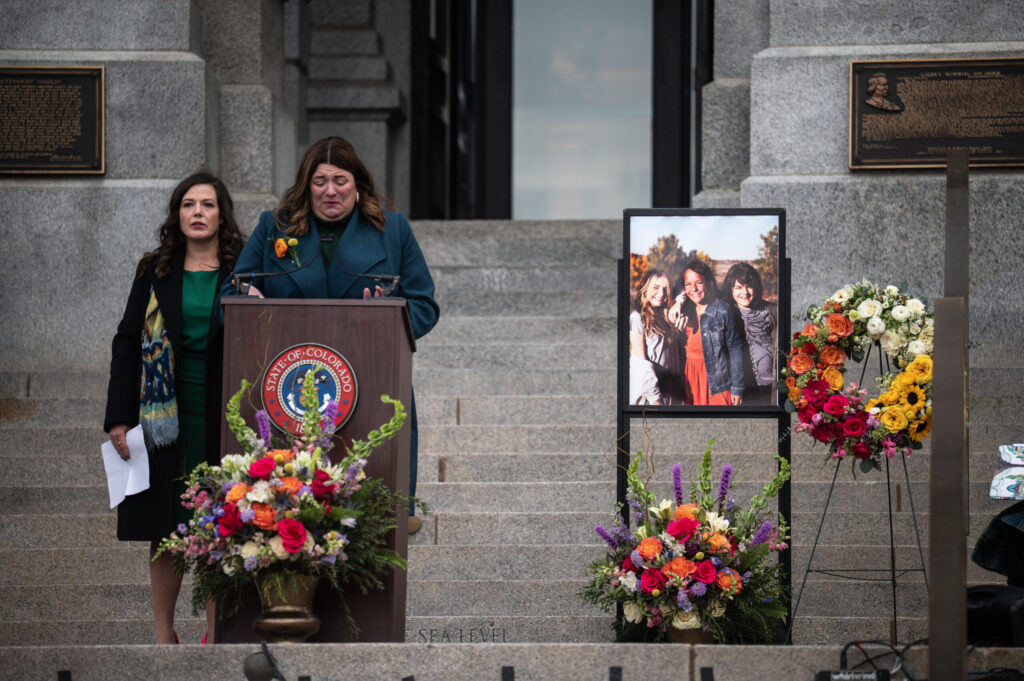
It was the colors that stood out as hundreds braved the cold on Friday to celebrate the life of Sen. Faith Winter, who died in a two-car crash on Nov. 26. Flags at the state Capitol flew at half-staff at...
Colorado Supreme Court to hear case on ballot measure disclosure requirements
Marissa Ventrelli
marissa.ventrelli@coloradopolitics.com
Updated 1 day ago
The Colorado Supreme Court has agreed to hear a case challenging whether the state can require ballot measure committees to disclose the names of their registered agents in election communications. The case stems from a complaint filed during the 2020...
Divided 10th Circuit orders pretrial release of defendant facing drug charges
Michael Karlik
michael.karlik@coloradopolitics.com
Updated 24 hours ago
The Denver-based federal appeals court overturned a judge’s order keeping a defendant in custody pending trial on Friday, ruling 2-1 that she was entitled to release under the law. Erika Esmeralda Garcia stands accused of two charges related to the...

Trump finally gets his peace prize as FIFA hands him inaugural award at World Cup draw
Christian Datoc and Mabinty Quarshie, Washington Examiner
christian.datoc.and.mabinty.quarshie.washington.examiner@gazetteedit.wpenginepowered.com
Updated 1 day ago
President Donald Trump has long said he is unbothered by being snubbed for a Nobel Peace Prize. However, that did not stop his friend and FIFA President Gianni Infantino from handing him an award and a medal on Friday, seemingly created just...

Outgoing CPW director Jeff Davis lands new role, same salary amid Colorado hiring freeze
Marianne Goodland
marianne.goodland@coloradopolitics.com
Updated 1 day ago
Jeff Davis, who resigned as director of Colorado Parks and Wildlife late last month, will continue to receive the same salary in his new role as a senior policy adviser to the Department of Natural Resources, according to the department....