

‘Activist’ JBC notches successful 2015 session

Going into the 2015 legislative session no one knew what to make of the new Joint Budget Committee. With an even split, three from each party, would anything get done? With so many new people would the JBC get bogged down? Looking back on 2015, it’s clear now that the JBC was one of the most productive, driving forces of the session.
In the first regular session of the 70th General Assembly, 682 bills were introduced: 290 in the Senate and 392 in the House. However, only 54 percent of those, or 367, were passed. That’s the lowest percentage and number of bills passed in many years.
When considering the legislative output in 2015 the JBC stands out. Our evenly divided committee with four new members produced an enormous body of work. We introduced 72 bills and passed all but one. Many of those were supplemental bills, and the Long Bill had a nice package, but an incredible range of other topics became the subject of JBC-initiated legislation. All told, over 19 percent of bills passed this year came from the JBC.

I’ve described this new JBC as an “Activist JBC” that has taken on certain departments while partnering with the administration on other issues. Several of Gov. Hickenlooper’s budget requests became JBC-sponsored bills, such as the bill I carried to expand the Medicaid waiver for children with autism and eliminate the waiting list. Another bill authorized the hiring of 100 new county caseworkers and supervisors to begin to address a shortfall in child protection staffing across Colorado.
This new Activist JBC has improved government process and transparency. We particularly focused on long-term planning and cost-benefit analysis. We codified the office of the State Architect and added staff to manage new master plans for state properties. We worked with the Capital Development Committee on this and other planning and process improvements, including a new method that uses depreciation to fund controlled maintenance costs of future projects and transitioning payments for certificates of participation from the capital to the operating budget. Information technology requests and processes were also examined with the Joint Technology Committee. The interactions between JBC, CDC, JTC and the Legislative Audit Committee have all increased in quality and coordination.
Developmental disability services have been a major focus for the past several years and in 2015 we took some significant steps forward. Expanding the children with autism waiver was just the beginning. We increased funding for respite care in the supplemental package. We introduced a bill to add people with intellectual and developmental disabilities to the statutes requiring mandatory reporting of suspected abuse of elders, which now includes these at-risk adults. We funded a pilot program to serve people in crisis with co-occurring IDD and mental illnesses. HB 1318 requires the consolidation of the various Medicaid waivers serving this population and reforms the system for case management and service delivery. Also, three members of the JBC serve on the Regional Center Task Force, which is due to deliver a report next year recommending the future scope of these state-operated facilities.
New challenges were taken in stride. We were required to reserve funds for two separate TABOR refunds. Transfers to the HUTF and capital construction fund were triggered by Colorado’s strong economy but diminished due to the TABOR refund. However, healthy discussions about various types of revenue that affect the TABOR limits did not resolve looming budgetary problems. The proposed new enterprise for the hospital provider will be viewed in a different context in November.
This year the JBC made the budget look easy, even if the annual Long Bill was a week late. The calendar was cruel to us this year, with the March revenue estimate occurring during the third week of the month instead of the fourth. The deadline calendar was similarly skewed. So we were a week late. And it was worth the wait.
The Colorado Constitution requires a balanced budget introduced as a single bill. That’s why we call it the “Long Bill.” It can’t contain substantive legislation, only appropriations of funds. Just about anything you can dream of can be proposed as an amendment to the Long Bill, as long as it properly appropriates money for a purpose. Dozens of amendments to the Long Bill are proposed each year, but relatively few are passed. This year this was particularly true. The Long Bill was perfectly fine the way it was introduced. For the most part.
The legislature is adept at dispensing disappointment. A split legislature perhaps doubles the penchant. JBC caused me at least two primary sources of disappointment: LARC and affordable housing. Both were included in Gov. Hickenlooper’s executive budget request, but neither made it past partisan opposition. LARC, or long-acting reversible contraception, was supported by a majority of the JBC and the Long Bill included a $5 million placeholder for HB 1194. That bill failed in the Senate. The governor’s request for $3.4 million for affordable housing grants and loans was denied by a split 3-to-3 vote of the JBC.
Disappointments aside, I’m proud of the work the JBC did together this year. We didn’t agree on everything requested by the governor, but we crafted a budget that meets Colorado’s needs and invests in our future. Congratulations on a job well done to my colleagues Reps. Millie Hamner, D-Dillon, Bob Rankin, R-Carbondale, and Dave Young, D-Greeley, Sen. Kevin Grantham, R-Cañon City, and our Chair, Sen. Kent Lambert, R-Colorado Springs. We get to do this all over again in November!
— Sen. Pat Steadman, a Democrat, represents Denver.


Clash of the titans: Democratic race for governor pits two candidates similar in focus, but very different in style | Vince Bzdek
Vince Bzdek
vince.bzdek@gazette.com
Updated 7 hours ago
By Vince Bzdek The race for governor is shaping up to be a clash of Democratic titans, U.S. Sen. Michael Bennet and Attorney General Phil Weiser. They are two of Colorado’s highest profile politicians with deep track records who...

Calendar Dec. 8-14
Rachael Wright
rachael.wright@coloradopolitics.com
Updated 4 days ago
CoPo’s weekly political calendar will help you find political and public-policy events throughout Colorado. It includes candidate and issue campaign events, public policy meetings, court hearings, state and local party conventions, assemblies, debates, rallies, parades, speaking engagements, traveling dignitary appearances,...
GOP chair candidates circle Benson, statehouse candidate alleges SOS voter fraud | A LOOK BACK
Rachael Wright
rachael.wright@coloradopolitics.com
Updated 4 days ago
Thirty-Five Years Ago This Week: Although Colorado Republican Party Chairman Bruce Benson had told one of his predecessors that he hadn’t yet made up his mind as to whether he’d run for a third term, party insiders had already begun...
Dear Abby: A better answer to your question | SONDERMANN
Eric Sondermann
eric-sondermann@coloradopolitics.com
Updated 2 days ago
It was the beginning of October. I had been invited to speak to a class on political journalism at Colorado College, my old alma mater. The class was taught by none other than Vince Bzdek, the editor-in-chief of this paper...

Federal judge declines to order Denver to let police critic apply for review board
Michael Karlik
michael.karlik@coloradopolitics.com
Updated 11 hours ago
A federal judge declined on Friday to order that Denver permit a longtime police critic to apply to join the board tasked with reviewing officers’ use of force. Regan Benson sought to become one of the two community members on...
Flags lowered, colors raised: Colorado leaders and friends celebrate Sen. Faith Winter’s life
Marianne Goodland
marianne.goodland@coloradopolitics.com
Updated 1 day ago
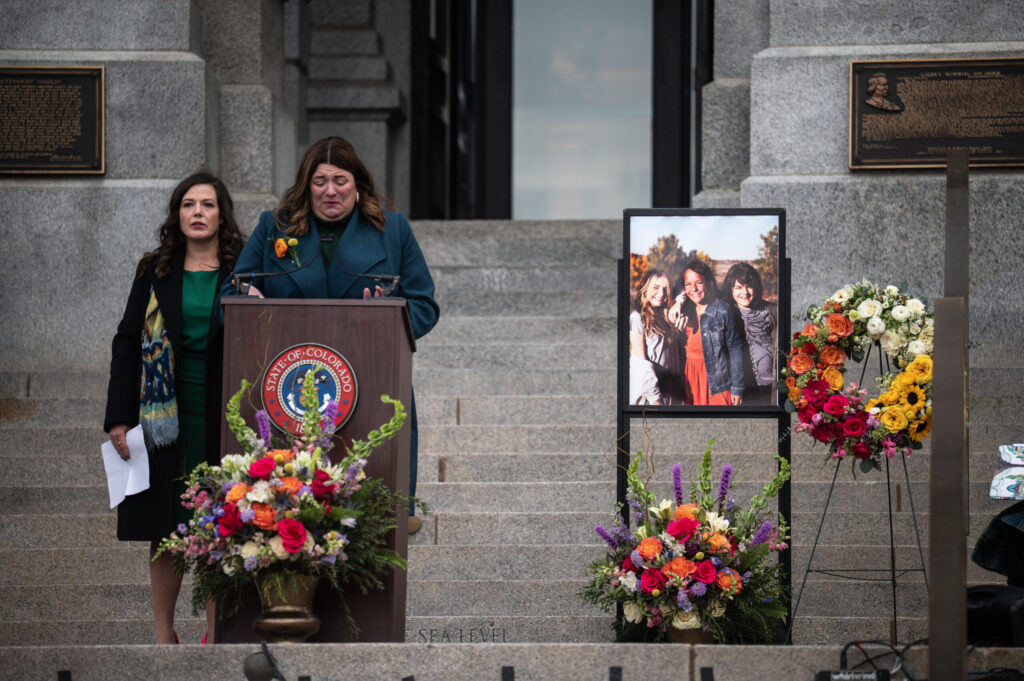
It was the colors that stood out as hundreds braved the cold on Friday to celebrate the life of Sen. Faith Winter, who died in a two-car crash on Nov. 26. Flags at the state Capitol flew at half-staff at...
Colorado Supreme Court to hear case on ballot measure disclosure requirements
Marissa Ventrelli
marissa.ventrelli@coloradopolitics.com
Updated 1 day ago
The Colorado Supreme Court has agreed to hear a case challenging whether the state can require ballot measure committees to disclose the names of their registered agents in election communications. The case stems from a complaint filed during the 2020...
Divided 10th Circuit orders pretrial release of defendant facing drug charges
Michael Karlik
michael.karlik@coloradopolitics.com
Updated 1 day ago
The Denver-based federal appeals court overturned a judge’s order keeping a defendant in custody pending trial on Friday, ruling 2-1 that she was entitled to release under the law. Erika Esmeralda Garcia stands accused of two charges related to the...

Trump finally gets his peace prize as FIFA hands him inaugural award at World Cup draw
Christian Datoc and Mabinty Quarshie, Washington Examiner
christian.datoc.and.mabinty.quarshie.washington.examiner@gazetteedit.wpenginepowered.com
Updated 1 day ago
President Donald Trump has long said he is unbothered by being snubbed for a Nobel Peace Prize. However, that did not stop his friend and FIFA President Gianni Infantino from handing him an award and a medal on Friday, seemingly created just...

Outgoing CPW director Jeff Davis lands new role, same salary amid Colorado hiring freeze
Marianne Goodland
marianne.goodland@coloradopolitics.com
Updated 1 day ago
Jeff Davis, who resigned as director of Colorado Parks and Wildlife late last month, will continue to receive the same salary in his new role as a senior policy adviser to the Department of Natural Resources, according to the department....
PREV
PREVIOUS

Let the sun shine in on ballot measures via basic fiscal facts
The days of playing “20 questions” with petition circulators about the fiscal facts of a proposed ballot initiative are coming to a close thanks to a landmark law Gov. Hickenlooper signed into law this week. House Bill 1057, which passed with solid bipartisan support, will give voters a clear and unbiased fiscal impact statement on […]

Keep TPP in the sunshine
This week, Democrats in the U.S. Senate blocked a proposal to “fast track” President Obama’s Trans-Pacific Partnership Agreement (“TPP”). I, for one, am glad that they did. Much has been said about the merits of these regional trade agreements, and there are pros and cons, which need to be considered and debated. However, engaging in that […]